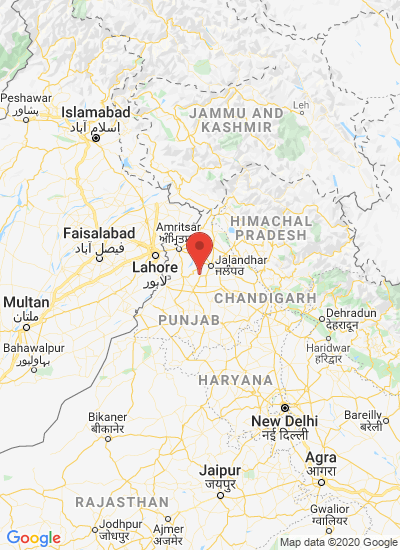
Punjab Agricultural University’s four new potato varieties—Punjab Potato 101, 102, 103 and 104—offer farmers options for high yield, early harvesting and late-blight resistance.
Punjab Agricultural University Introduces Four Potato Varieties for Higher Yield and Disease Resistance
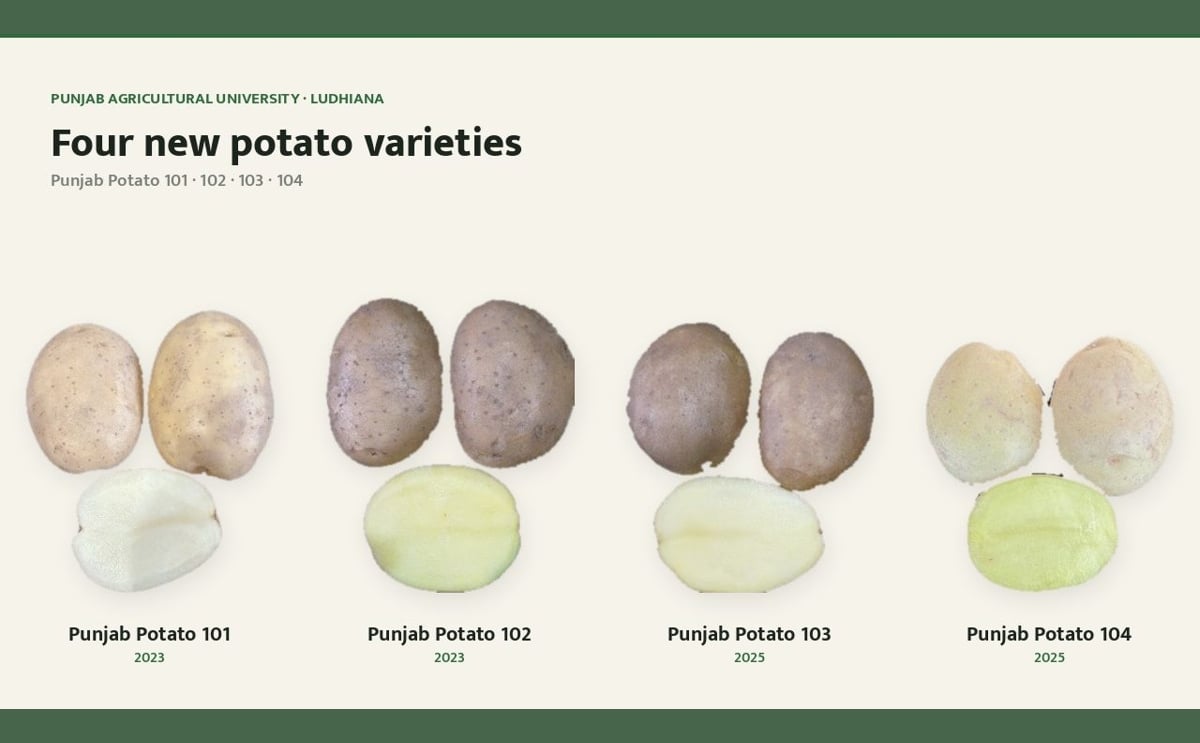
Punjab Agricultural University (PAU), Ludhiana, has expanded its potato varietal portfolio with four Punjab Potato varieties—PP-101, PP-102, PP-103 and PP-104—giving growers options based not only on yield but also on crop duration, early market opportunities and resistance to late blight.
Developed by the Department of Vegetable Science at PAU, the four varieties have different strengths. PP-102 records the highest average tuber yield at 184 quintals per acre, while PP-101 combines high yield with early bulking. PP-103 is designed for early harvesting, and PP-104 offers moderate resistance to late blight.
According to PAU, the varieties are now available for seed through the university.
PP-102: Highest-yielding option
Punjab Potato-102, released in 2023, is a table-purpose variety with an average tuber yield of 184 quintals per acre, making it the highest-yielding among the four.
The plants are medium-tall, vigorous and erect, with light-green foliage. Its tubers are light brown, oval-round, uniform and have shallow eyes, with creamy-yellow flesh. PAU lists PP-102 as a main-season table potato variety.
PP-101: Early bulking with 178 quintals per acre
Punjab Potato-101, also released in 2023, has an average yield of 178 quintals per acre and is particularly suited to growers looking for early bulking.
The variety produces uniform, light-brown, oval-round tubers with shallow eyes and creamy-white flesh. Its early-bulking character can be important in Punjab’s intensive cropping systems, where harvesting the potato crop earlier can create additional time for the succeeding crop.
PP-103: Early harvest in 80–90 days
Punjab Potato-103, released in 2025, is aimed at farmers who place a premium on early harvesting.
PAU describes it as an early-bulking variety with potential for 354.1 quintals per hectare after 80 days, equivalent to about 142 quintals per acre. If allowed to remain in the field for full maturity, its total tuber yield can reach around 180 quintals per acre.
The plants are medium-tall, compact and vigorous, while the tubers have light-brown skin and creamy-white flesh and are oblong in shape.
This flexibility may be particularly useful in vegetable-based rotations. A farmer can harvest earlier to target the early market or retain the crop longer to pursue higher total yield.
PP-104: Moderate protection against late blight
Punjab Potato-104, also released in 2025, has an average yield of 174 quintals per acre.
Its major distinguishing feature is moderate resistance to late blight, a significant disease concern in potato production. PAU describes PP-104 as a medium-to-late maturing, table-purpose variety with tall, erect and compact plants and dark-green foliage.
Its tubers are round, light brown and have yellowish-white flesh.
Why variety selection matters beyond yield
For Punjab’s potato growers, the choice of variety is not simply a comparison of yield numbers.
Potato is often integrated into intensive vegetable and multiple-cropping systems, making crop duration and the timing of field clearance critical. An early-bulking variety can allow farmers to harvest sooner and prepare the field for the next crop.
This makes PP-101 and particularly PP-103 relevant for farmers looking to fit potato into tight two- or three-crop rotations. On the other hand, PP-102 may appeal to growers prioritising maximum total tuber production, while PP-104 provides an option for areas where late blight is a recurring concern.
PAU’s potato breeding programme
The four varieties are the result of PAU’s in-house potato breeding programme. PAU says the programme was initiated in 2016, using off-season conditions at Keylong in Himachal Pradesh for hybridisation and generation of segregating populations, followed by evaluation of agronomic traits at Ludhiana.
The programme has been led by Dr Sat Pal Sharma, Principal Vegetable Breeder and Head of the Department of Vegetable Science, with Dr Navjot Singh Brar also part of the potato breeding team. PAU credits Dr Sharma with establishing the university’s in-house potato breeding programme and says the work ultimately led to the release of Punjab Potato-101 to 104.
Seed availability
PAU has made seed of its potato varieties available to farmers. The university has previously announced certified and truthfully labelled seed of PP-101 and PP-102 through its Directorate of Seeds, while its current package of practices includes all four varieties.
Farmers seeking seed can contact the Directorate of Seeds, Punjab Agricultural University, Ludhiana, at directorseeds@pau.edu. The Indian Potato report also lists hodvc@pau.edu for enquiries.
Seed quality remains critical
For potato seed production, choosing the right variety is only one part of the equation. Maintaining seed health is equally important.
PAU’s Seed Plot Technique recommends monitoring aphid populations because aphids can transmit viruses to seed potatoes. The guidance highlighted in the Indian Potato report is to cut the haulms when the aphid population reaches 20 aphids per 100 leaves, helping protect the health of the seed crop for the following season.
With four varieties now available, PAU’s potato breeding effort gives Punjab growers a broader choice: PP-102 for maximum yield, PP-101 for early bulking, PP-103 for rapid harvest and crop rotation flexibility, and PP-104 where late-blight resistance is a priority.
The development marks another step in PAU’s effort to breed potato varieties specifically suited to the production conditions and cropping systems of Punjab.
¿Te gustaría recibir noticias como esta por correo electrónico? ¡Únete y suscríbete!
Get the latest potato industry news straight to your WhatsApp. Join the PotatoPro WhatsApp Community!
Related News

Octubre 06, 2026
Dutch Potato Organisation Celebrated Potato Tuesday at Utrecht Central Station on October 6
The Dutch Potato Organisation celebrated Potato Tuesday on October 6 at Utrecht Central Station during the Week of Our Food. Visitors can enjoy free recipe booklets and discover the people behind the Dutch potato industry.

Octubre 05, 2026
Idaho Potato Harvest Shows Solid Quality but Lower Yields in 2026
Idaho’s 2026 potato harvest is showing solid quality but lower yields, with frost, heat, warm nights and wildfire smoke affecting production. Planted area fell to 298,915 acres as growers report smaller crops.

Octubre 04, 2026
McCain Proposes to Cut Potato Prices for Tasmanian Growers by USD 10.4 per Tonne
McCain is proposing a USD 10.43 per tonne cut in Tasmanian processing potato prices. TasFarmers says grower committee talks have ended ahead of planting, while McCain says conversations with growers are continuing.