Dr. Neil Gudmestad speaks with members of the R.D. Offutt research team during a research trial near Staples. Pictured from left are RDO Farm Manager Nate Warmbold, Gudmestad, RDO Agronomist Annika Merkens, RDO Farm Manager Jake Jacobson and RDO Agronomis
R.D. Offutt Farms Establishes 90-Acre Potato Research Farm in Wadena County

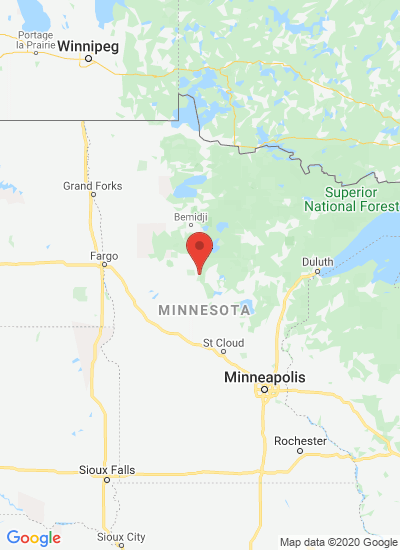
For more than 60 years, R.D. Offutt Farms has paired science with stewardship to grow potatoes the right way. This January, the company doubled down on that commitment, selecting Wadena County as the home of a new 90-acre potato research farm focused on the future of sustainable agriculture. Jennifer Maleitzke, director of communications and external affairs, said developing a potato research farm in Wadena County offered the family-owned business a unique opportunity.
Jennifer Maleitzke:
"Previously, all of our research was done in plots within commercial fields. This field will be specifically for research."
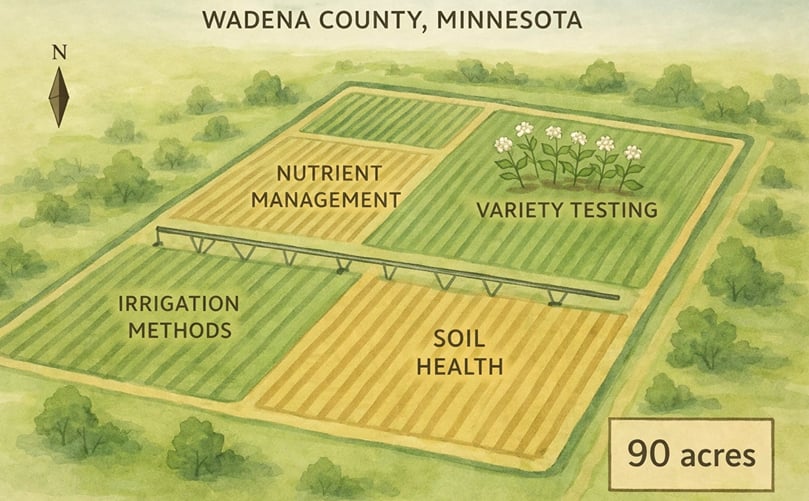
An artist’s rendering shows the planned layout of R.D. Offutt Farms’ 90-acre potato research farm. The research farm will be located in Shell River Township with land preparation beginning in the spring
A fresh approach to research
Over the past six decades, R.D. Offutt Farms (RDO) has led hundreds of field trials — from nutrient management and irrigation strategies to variety development and disease research. Adding to their ongoing commitment to sustainable farming practices and science-based research, the project, led by Tom Ryan, president of RDO, said the Wadena County research field offers something RDO has never had before: a clean, controlled field dedicated solely to learning, testing and improving potato farming practices.
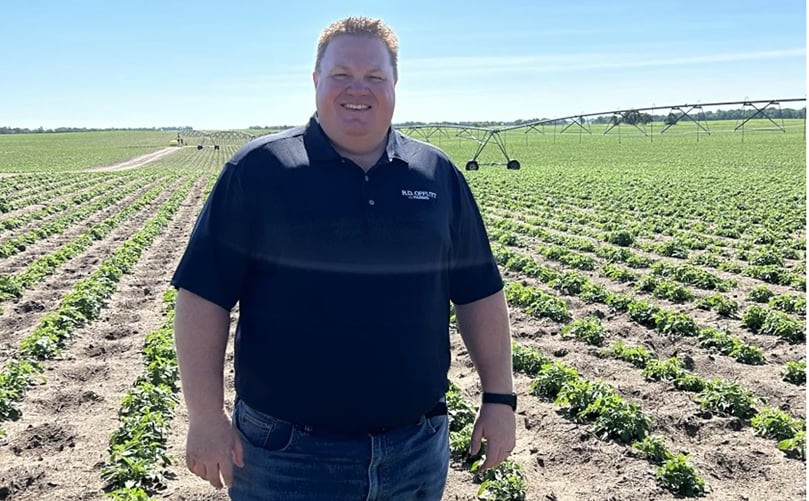
Tom Ryan, President of R.D. Offutt Farms in the field
Tom Ryan:
"A clean slate lets us control variables and get crisp answers. We can set up replicated trials, establish clear baselines and measure changes over time — soil health, water use, disease pressure and quality — without the noise of legacy practices. It’s the foundation for credible, repeatable results. It will also mirror real-world farming practices, with crops being rotated and cover crop trials will be incorporated during years without potatoes. This research farm gives us a place to test new practices and technologies under real‑world conditions and openly share what we learn."
Research trials are designed to be realistic, with equipment, field sizes and economics tracked alongside agronomy.
Tom Ryan:
"If a practice improves quality but adds cost, we’ll say so. If it saves water and holds yield, we’ll show the numbers. Then we package it into simple playbooks — what to change, when to change it and what to expect."
Additionally, Ryan said, the research will provide RDO additional ways to explore how to reduce fertilizer and chemical inputs by better understanding crop needs, testing varieties and biological products and leveraging soil mapping, weather-based models and variable-rate technology. The new 90-acre potato research farm will be located in Shell River Township, with land preparation to begin this spring. The first research trials are expected to begin in 2027.
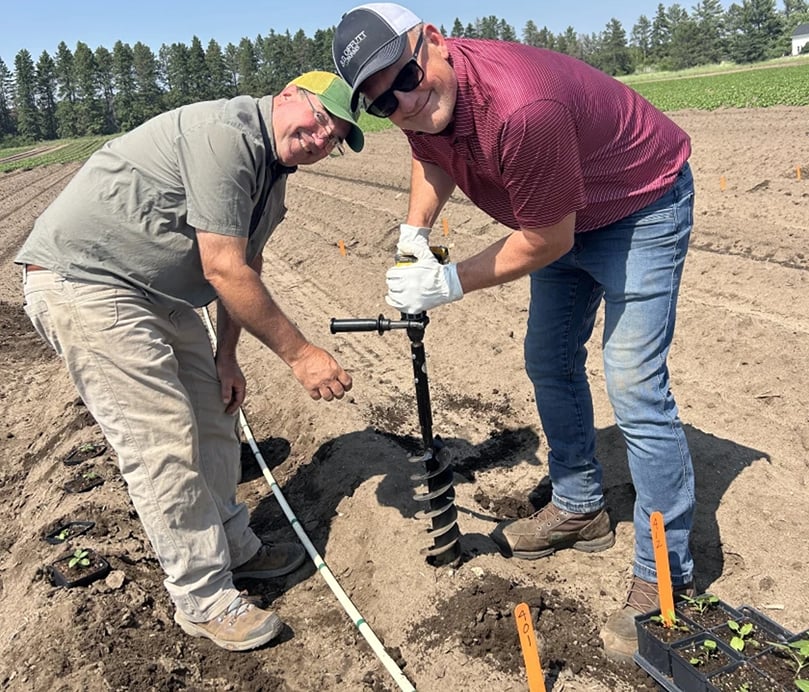
RDO Farm Directors Jon Gilley and Joel Steffel installing a research plot at a field in Park Rapids in 2025
The focus in Wadena County, said Ryan, will be on nutrient management, genetic research and gene editing, irrigation management, advanced product trials and technology innovation. The research aims to benefit local farmers by providing practical data they can apply directly to their operations. Results will be shared through field days, publications and short, actionable summaries.
Tom Ryan:
"Research trials can help take some of the risk out of trying something new — whether that’s varieties, irrigation strategies, cover crops, or disease management approaches."
Benefits for Minnesota growers and the industry
From across the Midwest to Wadena County, Ryan said the goal is to bridge the gap between scientific discovery and practical farming.
Tom Ryan:
"Our goal is to find clear, usable answers that can lead to stronger crops, more efficient use of inputs and positive environmental outcomes. If the information we share helps farmers make decisions that fit their own operations — and do it with fewer resources per pound of food — that’s a win for growers, our customers, our communities and the environment."
RDO envisions the research farm as a model that could eventually be adapted for other crops or locations. But for now, Ryan said, potatoes in Wadena County are the focus.
Tom Ryan:
"This research farm is about more than improving our own operations — it’s about contributing to the future of potato farming in a scalable, meaningful way. By creating a dedicated space for collaborative research, we hope to help growers across the industry adopt practices that are both productive and environmentally responsible."
¿Te gustaría recibir noticias como esta por correo electrónico? ¡Únete y suscríbete!
Get the latest potato industry news straight to your WhatsApp. Join the PotatoPro WhatsApp Community!
Empresa Destacada
Noticias relacionadas

Septiembre 28, 2026
México: menor oferta de papa podría impulsar los precios durante el invierno
En México, el cierre de cosechas, los menores rendimientos y la reducción de la superficie sembrada podrían restringir la oferta de papa y generar presión al alza sobre los precios entre diciembre de 2026 y febrero de 2027.

Septiembre 28, 2026
España: la sequía reduce la cosecha de patatas en 2026
La producción española de patata caerá entre un 8% y un 10% en 2026, hasta unos 1,8 millones de toneladas, con descensos de hasta 35% en Andalucía debido principalmente a la sequía y los menores rendimientos.

Septiembre 23, 2026
Chile: buscan mejorar el diagnóstico molecular de la sarna polvorienta y la sarna común en papa
En Chile, el proyecto SCAB-ID 2.0 busca validar un sistema de qPCR multiplex capaz de detectar y diferenciar simultáneamente la sarna polvorienta y la sarna común de la papa, con miras a transferirlo a laboratorios de diagnóstico agrícola.