
Packaging Equipment in the Potato Industry: Ensuring Quality, Safety and Shelf Life
Packaging is the last step in almost every potato value chain, and often the one that decides whether a product reaches the consumer in the condition the grower or processor intended. Packaging equipment in the potato industry covers everything from a simple weigh-and-bag unit at a farm packhouse to fully automated lines that weigh, bag, inspect, case and palletise potato chips at more than 200 bags a minute.
Why packaging matters: For fresh potatoes, the pack has to protect tubers from light, bruising and moisture build-up while letting them breathe. For processed products, it has to keep oxygen and moisture away from fried chips, hold frozen fries through months of cold storage, or keep fine flakes, flour and starch dry and free of contamination. In every case the packaging line also carries the label, the date and batch code, and the net weight that consumers and inspectors rely on.
Product protection and shelf life: Barrier films, gas flushing and vacuum packing slow the chemical changes that limit shelf life, such as oil oxidation in chips or moisture pick-up in dehydrated potatoes. Rigid outer cases and stable pallets protect fragile products during storage and transport, where crushed chips or burst bags of fries are a direct loss.
Food safety and traceability: Packaging lines are the point where foreign bodies are screened out, seals are checked and every pack is linked to a production batch. Retailers and foodservice buyers expect this to be documented, and in most markets parts of it are a legal requirement.
Retail presentation: Pack format, print quality and fill level shape how a product looks on the shelf. A well-filled stand-up pouch of potato wedges or a neat 2 kg bag of washed potatoes sells differently from an under-filled or creased pack.
Fresh versus processed packaging: Fresh potato packing is mainly about weighing irregular, heavy, living products into breathable bags, nets or boxes, usually from 1 kg to 25 kg. Processed potato packing deals with products that are fragile (chips), frozen and sometimes icy (fries and specialities), or dusty and hygroscopic (flakes, flour and starch), and it relies much more on sealed barrier packs, gas control and high-speed automation.
Main product categories: The main categories that need packaging are fresh table potatoes, potato chips and crisps, frozen French fries, frozen wedges and other potato specialities, chilled peeled and pre-cooked potatoes, dehydrated flakes and granules, potato flour and potato starch. Each places different demands on the weighing system, the packaging machine and the film or bag.
Inside the Machines: Main Types of Potato Packaging Equipment
The machines below make up most primary packaging in the potato sector. Many lines combine two or more of them, for example a multihead weigher feeding a vertical bagmaker with nitrogen flushing.
Vertical Form-Fill-Seal (VFFS) Machines
Working principle: A VFFS machine pulls flat film from a reel over a forming collar into a tube, seals the long edge, drops the weighed product into the tube and then makes a cross seal that closes one bag and forms the bottom of the next. Machines run in intermittent motion (the film stops for each seal) or continuous motion (rotary or moving jaws seal while the film keeps moving), which is faster and gentler on light products.
Potato applications: VFFS is the standard machine for potato chips, frozen fries, wedges and many small fresh packs. Syntegon lists snacks, frozen food and powder products among VFFS applications and quotes outputs of up to 300 bags per minute for its range, while GEA’s SmartPacker CX400 is marketed for frozen and fresh vegetables and potato products in bags up to 5 kg.
Continuous versus intermittent motion: High-speed snack baggers use rotary jaws in continuous motion: tna rates its robag FX 3e at up to 250 bags a minute with rotary triple, double, single or flat jaws, and Ishida’s Atlas series uses a single rotary jaw motion. Intermittent machines such as GEA’s SmartPacker SX400 are slower but handle heavier bags, up to 10 kg, and are simpler to maintain.
Advantages: Small floor area, wide choice of bag styles (pillow, gusseted, block-bottom, stand-up), easy integration with weighers and gas flushing, and high speed.
Limitations: Free-falling product can break fragile items if the drop is badly designed, and product caught in the cross seal is a common cause of leaking packs. Changeovers between bag widths need a new forming set.
Animated cycle of a vertical form-fill-seal bagmaker with nitrogen flushing. Nitrogen lowers the oxygen left in the bag, which slows oil oxidation in chips; shelf life still depends on barrier film, seal quality and storage conditions.
Horizontal Form-Fill-Seal (HFFS) Machines
Working principle: Also called flow wrappers, HFFS machines feed products horizontally into a film tube that is sealed along the bottom and at each end. Products are placed one by one or in trays rather than dropped as a weighed charge.
Potato applications: HFFS suits single or grouped items: trays of baby potatoes, chilled potato dishes, multipacks of chip bags and individual baking potatoes. ULMA has used its Atlanta flow wrapper for trayless baking potatoes, with the tubers lined up by an overhead brush before wrapping.
Advantages and limitations: Flow wrapping gives tight, well-presented packs with good label space, but it needs products that can be handled individually and it takes more floor length than a vertical machine. It is not suited to loose, free-flowing products such as chips or fries.
Side-by-side comparison of vertical and horizontal form-fill-seal machines and the potato products each suits.
Multihead Weighing Machines
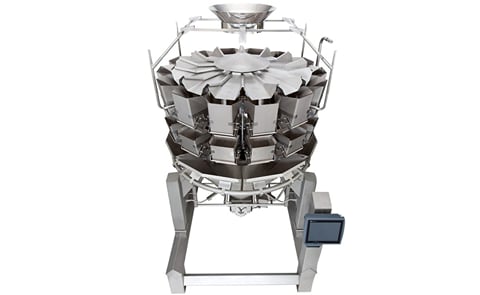
Working principle: A multihead (combination) weigher has 10 to 32 small weigh hoppers arranged around a central cone. A computer checks the weights in all the hoppers and opens the combination that comes closest to the target weight, so packs are filled accurately without topping up by hand.
Potato applications: Multihead weighers feed VFFS machines for chips and frozen products and also handle whole potatoes in larger versions. Ishida pairs its weighers with bagmakers for chips, while Newtec builds large-bucket models for washed potatoes, such as the Newtec 4015B2, rated at up to 85 portions a minute at 2 kg with typical giveaway below 0.2%.
Advantages and limitations: High speed and very low giveaway are the main benefits. The trade-offs are cost, the need for a clean and steady product feed, and possible sticking of seasoned or wet products, which calls for textured contact surfaces or special hopper designs.
Simplified 10-head view of combination weighing. Real weighers for chips and fries typically have 14 to 24 heads and repeat this cycle many times a minute; weights shown are illustrative.
Automatic Potato Weighing and Bagging Machines
Working principle: In fresh produce, weighing and bagging are often separate modules: a weigher (multihead, linear or belt-type) makes up the portion, and a bagger fills pre-made wicketed bags, nets, paper bags or sacks, which are then closed with a clip, heat seal or tape.
Potato applications: This is the main packing method for table potatoes in retail and wholesale sizes. One Newtec system for potatoes combines a 14-head weigher with a wicketed bagger for 2 to 5 kg bags at up to 50 bags a minute, and a switchable outlet for 10 to 20 kg sacks or boxes.
Advantages and limitations: Pre-made bags allow paper and printed mesh formats that are hard to make on a VFFS machine. Speeds are lower than for small snack packs, and bag supply and closing systems add more moving parts to maintain.
Vacuum Packaging Machines
Working principle: Chamber machines or thermoforming lines remove air from the pack before sealing, which slows microbial growth and oxidation.
Potato applications: Vacuum packing is used for peeled, cut and pre-cooked chilled potatoes, often followed by pasteurisation. MULTIVAC notes that vacuum packs suit only pressure-insensitive produce such as potatoes, because the product is compressed.
Advantages and limitations: Vacuum gives long chilled shelf life in a compact pack, but it is unsuitable for fragile products such as chips and is not normally used for frozen fries.
Tray Sealing and Thermoforming Machines
Working principle: Tray sealers seal a lidding film onto pre-made trays, while thermoformers form the tray from a bottom web, fill it and seal it in one machine. Both can work with vacuum or modified atmosphere packaging (MAP).
Potato applications: Gratins, rösti, roast potatoes, salads and other chilled or ready-to-heat potato dishes. Dutch processor Peka Kroef replaced older equipment with four MULTIVAC R 535 thermoforming machines that pack in MAP or vacuum and added inspection systems at the outfeed that detect air bubbles or foreign particles in the seal seam.
Advantages and limitations: Rigid trays protect soft products and look good on the shelf. Material use per kilogram of product is higher than for bags, and changeovers between tray sizes need different tooling.
Nitrogen-Flushing Packaging Systems
Working principle: Nitrogen is fed into the forming tube or pack just before sealing to push out air. On VFFS machines this is built into the forming set; on tray sealers and thermoformers it is part of the MAP system.
Potato applications: Potato chips are the main example: pillow bags are puffed up with nitrogen to reduce oxidation of the frying oil and to cushion the chips. MAP with nitrogen and carbon dioxide is also used for chilled potato products.
Advantages and limitations: Gas flushing extends shelf life without preservatives, but it only works with barrier films and well-sealed packs. Residual oxygen has to be checked regularly, and gas use is a running cost.
Powder Filling and Bagging Machines for Flakes, Flour and Starch
Working principle: Fine and dusty products are dosed by auger (screw) fillers, cup fillers or gross-weigh scales, then filled into pouches, open-mouth bags or valve bags. Valve baggers fill through a small sleeve that closes itself or is sealed afterwards, which keeps dust down.
Potato applications: Retail mash pouches, 20 to 25 kg sacks of flakes, flour and native starch for food and industrial users. Premier Tech lists open-mouth baggers, valve bag fillers and bulk bag fillers for flour and points out that flour dust can be explosive in certain concentrations.
Advantages and limitations: These machines handle products that would flood or bridge in a multihead weigher. Dust control, explosion protection and frequent cleaning are essential, and auger fillers need regular calibration because bulk density changes with moisture and particle size.
Bulk Bagging Systems
Working principle: Bulk bag fillers hang a flexible intermediate bulk container (FIBC, or big bag) from a frame, often on load cells, fill it from a hopper and may vibrate or densify the bag to stabilise it.
Potato applications: Starch, flour and flakes sold to industrial customers, and in some markets whole potatoes moved in big bags between farms, packers and processors.
Advantages and limitations: Bulk bags cut packaging cost per tonne and labour, but the buyer must have handling equipment to empty them, and food-grade bags with suitable liners are needed for ingredients.
The table summarises the main primary packaging machines and the potato products each suits best.
| Machine | How it works | Best suited potato products | Main strengths | Main limitations |
|---|---|---|---|---|
| VFFS | Forms bags from reel film, fills and seals vertically | Chips, frozen fries, wedges, small fresh packs | Fast, compact, many bag styles | Product in seal; drop height can break fragile items |
| HFFS (flow wrap) | Wraps items or trays horizontally | Baking potatoes, trays, chilled dishes, multipacks | Neat packs, good label area | Needs individual items; longer footprint |
| Multihead weigher | Computer selects best combination of hopper weights | Chips, fries, specialities, whole potatoes | Accuracy and speed | Cost; sticky or wet products need special contact parts |
| Weigher and bagger | Separate weigher fills pre-made bags, nets or sacks | Fresh table potatoes 1–25 kg | Paper and mesh formats | Lower speed; more mechanisms |
| Vacuum packaging | Removes air before sealing | Peeled and pre-cooked potatoes | Long chilled shelf life | Compresses product; not for chips |
| Tray sealing and thermoforming | Seals lid film on trays or forms trays in-line | Gratins, rösti, chilled sides | Product protection and presentation | More material; tooling changes |
| Nitrogen flushing | Replaces air with nitrogen before sealing | Chips, MAP chilled products | Shelf life without additives | Needs barrier film and tight seals |
| Powder fillers and baggers | Auger, valve or open-mouth filling | Flakes, granules, flour, starch | Handles dusty products | Dust, explosion risk, calibration |
| Bulk bag (FIBC) fillers | Fills 500–1,500 kg bags on a frame | Starch, flour, flakes; some fresh potatoes | Low cost per tonne | Buyer needs handling equipment |
Primary packaging machines matched to potato product groups. Main uses are shown as solid dots and selected uses as rings, based on manufacturer application lists. Hover over or tap a row for details and source links.
From Fresh Tubers to Starch: Matching Machines to Each Potato Product
Product properties decide machine choice more than any other factor. Moisture, temperature, shape, size, fragility and flowability all change how a product moves through a weigher and how well it can be sealed.
Fresh Table Potatoes: Fresh potatoes are heavy, irregular in size and shape, often wet or soiled, and still respiring. Packing lines need gentle drops to avoid bruising, large weigh buckets or belt weighers, and breathable packaging such as mesh, perforated polyethylene or paper with a window. Light must be kept out as far as possible to prevent greening, which is why many retailers use opaque or printed bags for washed potatoes.
Typical lines combine grading and washing, a weigher, a bagger for 1 to 5 kg retail packs, and separate filling of 10 to 25 kg sacks or boxes for wholesale and foodservice. US packer ADS Management, which runs a local potato packing facility with Barnwood Valley Farms in Massachusetts, has invested in ULMA flow wrappers and a VTI 640 vertical bagger to pack a range of fresh produce formats.
Potato Chips and Crisps: Chips are light, brittle, oily and often seasoned. Packaging lines are designed around gentle handling: low drop heights, timing hoppers that release a compact charge into the bag, and continuous-motion bagmakers that do not jerk the film. Nitrogen flushing and metallised or high-barrier films protect flavour and crunch.
Seal integrity is a constant concern because chip fragments and seasoning dust can get caught in the seal. In a Czech crisp plant, Ishida reported that a sudden rise in seal rejects can point to a change in tuber size producing larger chips, which shows how seal and weight data help spot upstream process changes.
Frozen French Fries: Fries arrive at the packaging line at freezer temperature and may carry frost or ice crystals. The film must remain flexible and seal reliably at low temperature, and machines must be built for wet cleaning in cold, humid rooms. Pack sizes range from small retail bags to 2.5 kg foodservice packs and larger catering bags.
VFFS machines with multihead weighers dominate. Rovema says its REVO series can pack frozen fries in 500 to 1,000 g bags at 80 to 100 bags a minute, and GEA lists French fries and potato wedges among the main uses of its SmartPacker SX400, which handles bags up to 10 kg. Lines usually end in case packing and palletising inside or next to the cold store.
Frozen Potato Wedges and Other Frozen Specialities: Wedges, hash browns, croquettes, rösti and coated specialities vary more in shape and size than straight-cut fries. Larger pieces need bigger weigh buckets and wider forming tubes, coated products can shed crumb that contaminates seals, and formed products may need to be laid flat rather than dropped. Stand-up pouches with zips and cartons are more common here than in the fries category.
Dehydrated Potato Flakes and Granules: Flakes are light and fragile, granules are free-flowing, and both are hygroscopic. Retail packs are often filled on VFFS machines with auger or volumetric dosing, sometimes with nitrogen flushing. Industrial packs of 10 to 25 kg go into multiwall paper bags with a polyethylene liner, or into bulk bags. Dust extraction and moisture control in the packing room are as important as the filler itself.
Potato Flour: Potato flour is fine, cohesive and dusty. It does not flow evenly into multihead weighers, so auger fillers, valve baggers and bottom-up fillers are used. Premier Tech, for example, describes a bottom-up open-mouth bagger for powders including flour and starch, which fills from inside the bag to limit dust.
Potato Starch: Native and modified potato starch is very fine and easily airborne, and starch dust needs the same explosion-risk assessment as flour dust. Most starch leaves the factory in 25 kg paper valve bags, in FIBCs or in bulk tankers. Food and pharmaceutical customers expect liners, sealed valves and full lot traceability.
The table brings these product requirements together.
| Product | Key handling properties | Typical pack formats | Core equipment | Special requirements |
|---|---|---|---|---|
| Fresh table potatoes | Heavy, irregular, may be wet, respiring | Mesh, PE or paper bags 1–5 kg; sacks and boxes 10–25 kg; big bags | Large-bucket weigher, bagger or VFFS, sack filler | Gentle drops, ventilation, light protection |
| Chips and crisps | Light, brittle, oily, seasoned | Pillow and gusseted bags, multipacks | Multihead weigher, continuous VFFS, N₂ flush | Low breakage, barrier film, seal checks |
| Frozen fries | Cold, may carry ice, fairly robust | Retail bags, 2.5 kg foodservice bags, cases | Multihead weigher, hygienic VFFS | Low-temperature sealing, wet cleaning |
| Wedges and specialities | Larger, irregular, coated | Pouches, bags, cartons | Large-bucket weigher, VFFS or cartoner | Crumb control, bigger tubes |
| Chilled peeled potatoes | Moist, perishable | Vacuum or MAP packs, trays | Thermoformer, tray sealer, chamber vacuum | Hygiene, cold chain, pasteurisation |
| Flakes and granules | Light or free-flowing, hygroscopic | Pouches, lined paper bags, FIBCs | Auger or cup filler with VFFS, open-mouth bagger | Dust and moisture control |
| Potato flour | Fine, cohesive, dusty | Paper bags, FIBCs | Auger filler, valve or bottom-up bagger | Dust extraction, explosion protection |
| Potato starch | Very fine, airborne | 25 kg valve bags, FIBCs, bulk | Valve bagger, FIBC filler | Explosion protection, liners, lot tracing |
Fresh versus Frozen Potato Packaging Compared
Fresh and frozen potatoes are the two largest packing streams by volume, and they need very different lines. The table sets out the main differences.
| Factor | Fresh table potatoes | Frozen fries and specialities |
|---|---|---|
| Product state | Living, respiring tubers; may be wet or soiled | Blanched, fried and frozen; may carry frost |
| Main packaging goal | Ventilation, light protection, bruise prevention | Moisture barrier, seal integrity at low temperature |
| Typical pack weights | 1–5 kg retail; 10–25 kg sacks; about 1 t big bags | Retail bags to 2.5 kg foodservice bags and cases |
| Weighing | Large-bucket multihead, linear or belt weighers | Multihead weighers with hygienic design |
| Packing machine | Wicketed or mesh baggers, VFFS, sack and box fillers | Washdown VFFS with product-in-seal detection |
| Materials | Mesh, perforated PE, paper with window | PE film, laminates, recyclable paper-based bags |
| Room conditions | Ambient or cool packhouse | Chilled packing room close to the cold store |
| Key quality checks | Weight, grade, defects, greening | Weight, seals, metal, temperature history |
Beyond the Bag: Inspection, Case Packing and Palletising Equipment
Once products are in their primary pack, a second set of machines checks them, codes them and turns them into cases and pallets. These machines often decide whether a line meets its real output target, because a stop at the case packer or palletiser quickly backs up the bagmakers.
Checkweighers: Weigh every pack on a moving belt and reject those outside set limits. Modern units send the average weight back to the filler so it can correct drift, and they keep the records needed for average-quantity and net-content rules.
Metal detectors: Detect ferrous, non-ferrous and stainless steel fragments. On snack lines they are often placed in the product drop between weigher and bagmaker, as with the Rovema BVC 180 bagger shown with a metal detector built into the weigher frame. Metallised films make metal detection of the sealed pack much harder, so this position matters for chips.
X-ray inspection systems: Find dense foreign bodies such as stone, glass, bone or some plastics, even through metallised film, and can also check fill level, missing products and product trapped in the seal. They cost more than metal detectors and need radiation safety procedures.
Date and batch coding: Thermal-transfer printers mark the film before forming on VFFS lines; inkjet and laser coders mark cases and bags. Vision systems can read codes to confirm they are present and legible.
Labelling machines: Apply weight-price labels on fresh produce packs, promotional labels or logistics labels on cases and pallets.
Carton erectors and case packers: Form cases from flat blanks and load bags, pouches or trays into them, either upright for display or flat for transport. Snack case packers must place light bags without crushing them.
Case sealers: Close cases with tape or hot-melt glue.
Robotic packaging systems: Pick-and-place robots handle trays and pouches, while articulated robots build pallet layers. They reduce repetitive manual lifting, a particular issue for 10 to 25 kg sacks.
Palletisers: Build pallet patterns automatically using layer-forming conveyors or robots.
Stretch wrappers and stretch hooders: Stabilise loaded pallets with film for storage and transport. Stretch hooding, offered for example by Premier Tech for flour and powder lines, places a film hood over the pallet and is common for heavy sack loads.
Integration with primary packaging: End-of-line machines are linked to the bagmakers by conveyors with buffer zones, and to each other by a line control system. If the case packer stops, the buffer gives operators time to fix it before the bagmakers have to slow or stop. Reject stations, accumulation tables and clear signalling between machines are what make the line work as one system rather than a set of separate machines.
Films, Paper and Mesh: Choosing Packaging Materials for Potato Products
Packaging materials must suit the product, the machine and the market. A film that seals well on one VFFS machine may wrinkle or tear on another, so material and machine choices should be tested together.
Polyethylene (PE) and polypropylene (PP): PE is soft, tough at low temperatures and seals at relatively low temperatures, which is why it is widely used for frozen fries and fresh potato bags. PP is stiffer and clearer, with better moisture barrier and print quality. Both are moisture barriers but poor oxygen barriers unless coated or combined with other layers.
BOPP films: Biaxially oriented polypropylene is strong, clear or white and prints well. It is common as the outer and inner layer of chip bags, often with a heat-seal coating or co-extruded sealant layer.
Metallised films and multilayer laminates: A thin layer of aluminium on BOPP or PET gives a much better oxygen, moisture and light barrier at low weight. Laminates combine several films and adhesives to get the right mix of barrier, stiffness, print surface and seal strength. They protect chips well but are hard to recycle because the layers cannot easily be separated.
How a chip bag is built: A common chip bag structure has a printed BOPP outer film for graphics and stiffness, an adhesive or extruded tie layer, and a metallised BOPP inner film whose aluminium layer provides the oxygen, light and moisture barrier and whose sealant surface makes the heat seals. Mono-material alternatives replace the metallised layer with coated or high-barrier PP so the whole bag can be recycled as polypropylene.
Paper and multiwall paper bags: Paper is used for fresh potato bags (often with a window), for flakes, flour and starch sacks, and increasingly for frozen products. Lamb Weston introduced a recyclable paper bag for frozen French fries for US foodservice customers in 2024. The bag was designed to run on the company’s existing equipment and to pass paper-recycling acceptance tests.
Mesh bags: Knitted or extruded PE and PP mesh lets air circulate around fresh potatoes and shows the product, but gives no light protection. Mesh with a printed film band or paper label is common for retail.
Corrugated cardboard cartons: Used for cases of chips and frozen products, and for fresh potato boxes in some markets. Board grade must suit cold, damp storage for frozen products.
Bulk bags and FIBCs: Woven PP bags, usually holding about 500 to 1,500 kg, with optional liners and discharge spouts. Food-grade versions are produced in hygienic conditions and certified for food contact.
Recyclable and mono-material packaging: Mono-material films (all-PE or all-PP structures) are designed to be recycled in a single stream. PepsiCo Europe has said that moving to mono-materials will make its crisp packets easier to recycle, with the aim of eliminating virgin fossil-based plastic from its crisp packets by 2030. Mono-material films usually have a narrower sealing window and less stiffness than laminates, so bagmakers may need different jaws, temperatures and settings.
The table compares the main materials by barrier properties and typical potato uses.
| Material | Moisture barrier | Oxygen barrier | Typical potato uses | Machine and sustainability notes |
|---|---|---|---|---|
| PE film | Good | Poor | Frozen fries, fresh potato bags, liners | Seals at low temperature; recyclable as mono-PE where collected |
| PP / BOPP film | Very good | Poor unless coated | Chip bags (outer and inner layers), fresh packs | Stiff, prints well; mono-PP structures are emerging |
| Metallised BOPP / PET | Excellent | Very good | Chips, flakes pouches | Blocks metal detection after sealing |
| Multilayer laminates | Excellent | Excellent | Premium snacks, long-life pouches | Hard to recycle; wide sealing window |
| Paper and multiwall paper | Low unless coated or lined | Low | Fresh potatoes, flakes, flour, starch, some frozen | Widely recyclable; needs coating or liner for moisture |
| PE / PP mesh | None | None | Fresh potatoes | Ventilation; no light protection |
| Corrugated board | Low | None | Cases, fresh potato boxes | Recyclable; must suit cold, damp stores |
| FIBC (woven PP) | Low unless lined | Low | Starch, flour, flakes, some fresh potatoes | Reusable in some systems; food-grade versions available |
Step by Step: How an Industrial Potato Packaging Line Works
The sequence of machines is similar across products: feeding, weighing or dosing, filling, sealing, inspection, coding, case packing and palletising. The details change with the product.
Animated overview of the nine main stages of an automated potato packing line. Each stage is a separate machine linked by conveyors, buffers and line controls, so a stop at one station affects the whole line.
Process Flow for Potato Chips and Crisps
Seasoned chips leave the seasoning drum and are spread over a distribution system that feeds several weigher and bagmaker pairs. Each multihead weigher makes up the pack weight and drops it, sometimes through a metal detector, into a continuous-motion VFFS bagmaker. The film is printed with date and batch code before forming, and nitrogen is flushed into the bag as it is sealed. Packs then pass a seal tester, a checkweigher and often an X-ray system before a case packer loads them into cartons, and a palletiser and stretch wrapper finish the load.
Ishida describes a standard configuration of its AS-Series weigher, Inspira bagmaker and ACP-700 case packer delivering 150 bags a minute for potato chips, with seal tester, checkweigher and X-ray in between. At Russia’s KDV Group, Ishida Atlas bagmakers pack chip brands in 40 g to 160 g bags on a line designed together with the processing equipment supplier.
The main stations of an automated potato chip packing line. Optional steps vary with retailer and export requirements. Hover over or tap each step for what it does and a source example.
Process Flow for Frozen French Fries
After the freezing tunnel, fries pass over a shaker that removes ice and small pieces, then go by conveyor to a distribution system above several weigher and VFFS pairs. Bags are sealed, metal-detected and checkweighed, then packed into cases by a case packer or robot, palletised and moved into the cold store. Because the product warms quickly, the line is laid out to keep the time between freezer and cold store short, and the packing room is chilled.
Process Flow for Fresh Potatoes
Potatoes are tipped from boxes or bulk trailers, washed or brushed, graded by size and quality (often by optical sorters), then conveyed to the weighers. Retail portions go into wicketed bags, mesh bags or VFFS bags; larger portions go into sacks or boxes. A checkweigher and a labeller follow, and packed bags are placed in crates, boxes or roll cages, or palletised. Newtec’s potato solution, for instance, includes a checkweigher with a drop-down reject after the bagger.
Process Flow for Potato Flakes and Starch
Flakes and starch are conveyed from the dryer or silo by pneumatic or mechanical conveyors to a surge hopper above the filler. An auger, gross-weigh scale or valve packer fills paper sacks or FIBCs, which are closed by sewing, heat sealing or valve closing, metal-detected, checkweighed and palletised, often by robot. Dust extraction runs at every transfer point, and electrical equipment must suit the dust-explosion zone of the area.
How Machines Are Integrated and Synchronised
In a modern line each machine has its own controller, linked to a line controller or supervisory system over an industrial network. The weigher and bagmaker run as a matched pair, with the bagmaker signalling when it is ready for the next charge. Downstream, photo-eyes on conveyors detect when buffers are filling, so upstream machines can slow down or pause rather than jam. Reject signals from checkweighers and inspection systems are linked to the batch record. Many lines also collect overall equipment effectiveness (OEE) data, so managers can see where time and product are lost.
How to Choose the Right Potato Packaging Machine for Your Plant
Type of potato product: Start with the product properties described above. A machine designed for free-flowing frozen vegetables may not handle large wedges, and a weigher built for chips will not cope with 2 kg of whole potatoes.
Packaging format and pack size: List every pack size and style the line must run now and in the next few years. The range of bag widths and lengths sets the forming sets and the machine size.
Production capacity: Calculate the required output in kg/hour or bags/minute from the peak season, not the average, and add margin for changeovers and stops. Published maximum speeds are reached only with ideal products and films.
Weighing accuracy: Giveaway (product given away above the declared weight) is often the largest saving from better weighing. Ask suppliers for standard deviation and giveaway figures measured on your product.
Automation level: Match automation to labour cost, labour availability and volume (see the comparison in the next section).
Packaging material compatibility: If you plan to move to mono-material or paper-based packs, confirm the machine can seal them. Syntegon, for example, says its SVE DoyZip machine is optimised for recyclable mono-materials and paper-based packaging.
Product handling and breakage: Check drop heights, transfer points and conveyor types. For chips, ask for trials that measure breakage before and after packing.
Shelf-life requirements: Decide whether you need gas flushing, vacuum or high-barrier film, and whether the machine can achieve and monitor the residual oxygen level you need.
Hygiene and food safety: Look for open-frame, stainless steel designs with sloping surfaces, tool-free removal of contact parts and a suitable ingress protection rating for wet cleaning. Frozen and fresh lines need washdown designs.
Energy consumption: Sealing jaws, compressed air and vacuum pumps are the main energy users. Servo drives and efficient sealing systems can reduce consumption.
Factory space and layout: Measure ceiling height for VFFS and weigher platforms, floor length for flow wrappers and space for film reels, maintenance access and buffers.
Spare parts and service: Check local stock of wear parts (jaws, sealing strips, knives, belts, load cells) and the response time of service engineers. A cheaper machine without local support can cost more over its life.
Compatibility with existing equipment: Confirm that controls, communication protocols, conveyor heights and safety systems can be linked to your current processing line.
Maximum speeds published by manufacturers for selected machines used with potato products. Figures are rated maximums, not guaranteed line output, and units differ between bags and weighed portions. Hover over or tap a bar for details and the source.
The decision path below turns these criteria into a starting point for choosing machines.
Decision path for selecting primary packaging equipment by potato product, pack size and volume. It summarises typical choices; final selection should follow product trials and supplier quotations.
Recommendations by Business Size
Small operations: Farm packhouses and small snack makers often start with a semi-automatic weigher and bagger, or an entry-level weigher with an intermittent VFFS machine. Ishida’s First Range combines a 10- or 14-head economy weigher with an intermittent Astro-S-103 or rotary Atlas-113 bagmaker for snacks, and Syntegon makes a Terra 25 HS bagger in India for snacks. Manual case packing and palletising are usually acceptable at this scale.
Medium operations: A regional processor or packer will typically run two to six weigher and bagmaker pairs, automatic checkweighing and metal detection, and at least partly automated case packing. Buying from one supplier for weighing and bagging can simplify integration and service.
Large operations: Large chip and fry plants run many lines with central distribution systems, continuous-motion bagmakers, X-ray inspection, robotic case packing and palletising, and plant-wide data systems. At this scale, availability, cleaning time and changeover speed matter more than the purchase price of any one machine.
Manual, Semi-Automatic or Fully Automatic: Which Packaging System Fits?
Manual systems: Operators weigh product on a scale, fill pre-made bags and close them with a clip, sewing machine or heat sealer. Investment is low and the system is flexible, but output depends on the workforce, weights vary more, and repetitive lifting of heavy sacks is a health and safety concern.
Semi-automatic systems: A machine does the weighing or dosing, while people place bags, close them or move them to pallets. This is common for fresh potato sacks, flour and starch bags and small snack runs. It improves accuracy and output without the full cost of automation.
Fully automatic systems: Machines handle the whole process from product feed to pallet, with operators supervising, changing reels and fixing faults. They give the highest output and accuracy and lowest labour per tonne, but need the largest investment, skilled maintenance staff and steady volumes to pay back.
The table compares the three levels of automation.
| Factor | Manual | Semi-automatic | Fully automatic |
|---|---|---|---|
| Initial investment | Low | Medium | High |
| Production capacity | Low; set by workforce | Medium | High; set by machines |
| Labour requirement | High | Medium | Low per tonne, but more skilled |
| Operational efficiency | Variable | Good | Highest when well maintained |
| Weighing accuracy | Lowest; more giveaway | Good | Highest; lowest giveaway |
| Maintenance | Minimal | Moderate | Planned maintenance programme needed |
| Flexibility | Very high | High | Depends on design; changeovers take time |
| Best suited to | Very small packers, trials, niche products | Small and medium packers and processors | Medium and large processors with steady volumes |
AI, Robots and Recyclable Films: Latest Trends in Potato Packaging
High-speed automated packaging: Snack bagmakers continue to get faster and more compact. Ishida states that its twin weighers and bagmakers can pack potato chips at up to 260 packs a minute. In May 2026 tna introduced the robag Quantum at Interpack, aimed at producers of potato chips and similar snacks who need more output per forming tube rather than more machines. Both are commercial products; actual speeds depend on product and pack.
Artificial intelligence in inspection: AI is moving into commercial inspection equipment. In July 2026 Mettler-Toledo launched the X56 DXD+ dual-energy X-ray system with AI capabilities, which also checks for product trapped in seals, and highlighted potato products and crisps among its applications. Deep-learning image analysis to reduce false rejects is commercially available from several suppliers, although performance on a given product should be tested before purchase.
Robotics and automated palletising: Robotic case packing and palletising are now standard on large lines and increasingly affordable for medium plants, partly because of labour shortages. tna, for example, presents its robag 3e as a way of addressing labour shortages and rising costs.
Smart sensors and connected systems: Weighers, bagmakers and checkweighers record weights, rejects, stops and settings. Ishida’s crisp line case study shows OEE displayed in terms of availability, performance and quality, and GEA lists a CostFox software option for its SmartPacker baggers.
Predictive maintenance: Monitoring of motor current, vibration, temperature and seal performance can warn of wear before a breakdown. Suppliers offer remote service and condition monitoring, but most potato packers still rely mainly on planned preventive maintenance; predictive programmes are an emerging rather than standard practice.
Sustainable materials and machine adaptation: Recyclable mono-material and paper-based packs are now commercial in several potato categories, from Walkers paper outer bags for Walkers Baked multipacks to Lamb Weston’s paper fry bag. Machine makers are adapting sealing systems: GEA says its CX400 can run mono PE, PP and paper-based options, and ULMA has shown its VTC 840 bagger with a pack suitable for the paper recycling stream.
Improved barrier technologies: Coated mono-PP films, high-barrier PE and barrier coatings on paper aim to match the protection of metallised laminates in recyclable formats. These are commercially available for some products, but matching the shelf life of traditional chip laminates remains a development area for many brands.
Reduced material use: ULMA’s Venturi system on its VTI640 bagger is said to shorten pack length by more than 20% for delicate fresh produce, an example of how machine design can cut film use.
Digital data integration: Linking packaging data with processing, quality and enterprise systems allows full batch traceability, automatic reporting for net-weight rules and quicker root-cause analysis.
Keeping the Line Running: Maintenance and Troubleshooting
Routine maintenance: Daily tasks include cleaning product-contact parts, checking seal jaws and knives, removing seasoning and dust build-up, and testing metal detectors and checkweighers with test pieces and reference weights. Weekly and monthly tasks cover belts, bearings, pneumatic components, vacuum pumps and gas supply. Suppliers’ maintenance schedules should be the starting point, adjusted to local hours and product.
Cleaning: Dry cleaning with brushes and vacuum is used for chip and powder lines, where water would create sticky residues or microbial risk. Wet cleaning is common for fresh and frozen lines and needs washdown-rated machines. Cleaning chemicals must be compatible with machine materials and approved for food areas.
Calibration: Weigh cells, checkweighers and auger fillers must be calibrated against certified test weights. Regular calibration is part of meeting net-weight laws and limits giveaway.
Lubrication: Use food-grade lubricants where there is any chance of incidental contact with food, and follow the supplier’s intervals. Too much lubricant attracts dust and product.
Operator training: Many faults come from incorrect settings, poor film threading or skipped checks. Structured training, written work instructions and clear limits on who can change machine settings reduce both downtime and quality problems.
The table lists the most common faults on potato packing lines, their usual causes and how to correct and prevent them.
| Problem | Possible causes | Corrective and preventive action |
|---|---|---|
| Incorrect package weights | Uneven product feed, dirty or damaged weigh hoppers, load cell drift, wrong target settings, changing bulk density | Clean and calibrate weighers; check feed system; lock settings; use checkweigher feedback |
| Poor heat sealing | Wrong jaw temperature, pressure or dwell time; worn jaws or sealing strips; film outside specification; product in seal | Set and record sealing parameters per film; replace worn parts; check film certificates; improve product drop timing |
| Film misalignment | Incorrect film threading, worn pull belts, wrong registration mark detection, unwinding tension | Re-thread to diagram; replace belts; clean or adjust photo-eye; check reel brake |
| Product breakage | High drop heights, aggressive conveyors, overfilled weigher buckets, fast bagmaker motion | Reduce drop heights; use gentle conveyors; lower feed rate; switch to continuous motion where possible |
| Packaging leakage | Product or dust in seal, pinholes, cracked film at folds, too little nitrogen or wrong vacuum level | Seal testing; product-in-seal detection; check film handling and gas settings |
| Conveyor and feeding problems | Product build-up, belt tracking, sticky seasoning, poor buffer control | Regular cleaning; adjust belts; textured contact surfaces; check sensors and line signals |
| Sensor malfunctions | Dirty or misaligned photo-eyes, damaged cables, condensation in cold rooms | Clean and align sensors; protect cables; use sensors rated for the environment |
| Machine downtime | Lack of spare parts, unplanned breakdowns, slow changeovers, operator errors | Keep critical spares; follow preventive maintenance; standardise changeovers; train operators |
Food Safety and Packaging Rules for Potato Products in the EU, US and India
Rules for potato packaging fall into three groups: legal requirements that apply to everyone placing products on a market, official test methods and guidance that explain how the law is applied, and voluntary standards that buyers ask for. The status below reflects rules in force or published as of November 2026; processors should check current texts with authorities or advisers for their own products.
Food-contact packaging materials: Films, bags, trays, inks and adhesives that touch food must not transfer harmful substances into it. Packers should obtain declarations of compliance from suppliers and keep them on file.
Packaging hygiene and sanitation: Packing areas, machines and staff fall under general food hygiene law. Codex General Principles of Food Hygiene (CXC 1-1969) provide the international reference that most national systems follow.
Foreign-material detection: Metal detection and X-ray are not named as compulsory in most laws, but food safety rules require businesses to control physical hazards. In practice, retailer standards and hazard analyses make metal detection standard on processed potato lines.
Package integrity and leak testing: Seal testers, leak tests in water or vacuum chambers, and residual oxygen checks for gas-flushed packs show that packs protect the product as intended. These are usually set in the company’s own quality plan and customer specifications.
Traceability and batch coding: EU food law requires one-step-back, one-step-forward traceability and lot marking on prepacked food; other markets have similar rules. Clear, durable batch codes linked to production records make recalls faster and narrower.
Net weight and labelling: Prepacked potato products must declare net quantity, and weighing systems must deliver it within legal tolerances. The EU uses the average-quantity system with the ℮ mark; many countries base their rules on the international OIML R 87 recommendation.
European Union
Mandatory: Regulation (EC) No 1935/2004 sets the framework for all food-contact materials, Regulation (EU) No 10/2011 covers plastic materials and migration limits, and Regulation (EC) No 2023/2006 sets good manufacturing practice for their production. Food labelling, including net quantity and date marking, falls under Regulation (EU) No 1169/2011, and the ℮-mark average-quantity system under Directive 76/211/EEC.
Packaging and Packaging Waste Regulation (PPWR): Regulation (EU) 2025/40 entered into force on 11 February 2025 and has applied since 12 August 2026, with many requirements phased in later. From that date, food-contact packaging placed on the EU market must meet limits on PFAS (per- and polyfluoroalkyl substances), with no transition period for new packaging. Recyclability is now a legal design duty, but the delegated acts with detailed recyclability criteria had not yet been adopted by mid-2026. Harmonised material labelling follows from August 2028.
Machinery: Packaging machines placed on the EU market must meet machinery safety law. The Machinery Regulation (EU) 2023/1230 replaces the Machinery Directive from 20 January 2027, which matters for machines delivered after that date.
United States
Mandatory: Food-contact materials must use substances that are authorised as indirect food additives under 21 CFR Parts 174 to 186, are generally recognised as safe or exempt, or are cleared through the FDA food contact notification programme. Under the Food Safety Modernization Act, most facilities must follow 21 CFR Part 117, which covers good manufacturing practice and hazard-based preventive controls, including physical hazards. Net quantity statements on consumer packages are required by the Fair Packaging and Labeling Act and 21 CFR 101.105.
Test methods and guidance: Weights and measures officials check packages with the procedures in NIST Handbook 133. Environmental claims such as recyclable are assessed against the FTC Green Guides, which Lamb Weston referred to for its paper fry bag.
India
Mandatory: The Food Safety and Standards (Packaging) Regulations, 2018 have applied since 1 July 2019. They require food-contact paper, metal and plastic materials to meet listed Indian Standards, set migration limits and require printing inks to meet IS 15495. The regulations originally banned recycled plastics and newspaper for food packaging; the amended text allows recycled plastics only once FSSAI has framed standards for them. Label content falls under the FSS (Labelling and Display) Regulations, 2020.
Legal metrology: For packaged foods, the declarations of net quantity, maximum retail price and consumer-care details follow the Legal Metrology (Packaged Commodities) Rules, 2011, while other label information follows FSSAI rules. Producers, importers and brand owners using plastic packaging also have extended producer responsibility obligations under the Plastic Waste Management Rules, 2016, as amended.
Voluntary Standards and Certification
Retailers and large foodservice buyers usually require certification to a scheme benchmarked by the Global Food Safety Initiative (GFSI), such as BRCGS, FSSC 22000 or SQF, for the food plant and often for the packaging supplier. These schemes are voluntary in law but often a condition of supply, and they set detailed expectations for foreign-body control, seal checks, coding and calibration.
Key packaging, net-weight and labelling rules for potato products in the EU, United States and India, with international and voluntary references. Status as of November 2026. Hover over or tap a card for details and the official source.
Who Builds the Machines: Leading Potato Packaging Equipment Manufacturers
The companies below supply equipment used in the potato industry, alongside many more makers of weighers, baggers and packing lines for potatoes. Their product ranges differ widely, so buyers should confirm that a supplier has relevant references for their product and pack.
Ishida (Kyoto, Japan): Multihead weighers, bagmakers, checkweighers, seal testers, X-ray inspection and case packers. Strong in potato chips and snacks, with complete lines built with processing partner Heat and Control. Relevant models include the CCW-RV weighers, Atlas and Inspira bagmakers and the ACP-700 case packer. Website: ishida.com; potato chips page.
Syntegon (Waiblingen, Germany): Vertical and horizontal packaging machines and end-of-line systems, formerly Bosch Packaging Technology. Applications include snacks, frozen food and powders; models include the SVE series and SVE 2520 AR for chips. Website: syntegon.com; SVE series page.
ULMA Packaging (Oñati, Spain): Flow pack (HFFS), vertical (VFFS), thermoforming, tray sealing and stretch film machines, plus automation. Potato references include trayless baking potatoes on the Atlanta flow wrapper and vertical baggers such as the VTC 800, VTI 640 and VTC 840 for fresh produce. Website: ulmapackaging.com; produce packaging page.
MULTIVAC (Wolfertschwenden, Germany): Thermoforming machines, tray sealers, chamber machines, labelling and inspection. Potato applications are mainly chilled peeled, pre-cooked and speciality products; Peka Kroef in the Netherlands uses R 535 thermoformers. Website: multivac.com; potato specialities case.
Rovema (Fernwald, Germany): Vertical form-fill-seal machines, dosing, cartoning and complete lines. Potato applications include chips and frozen fries on the BVC series, including the BVC 400 Frozen, and the REVO series for frozen and fresh products. Website: rovema.com; frozen food solutions; PotatoPro company profile.
tna solutions (Sydney, Australia): Processing and packaging lines for snacks and frozen foods: distribution, seasoning, VFFS (robag series), splicing and end-of-line systems. Potato references include chips and French fries; Italian chip maker Preziosi Food installed five tna robag systems. Website: tnasolutions.com.
GEA (Düsseldorf, Germany): Broad food technology group; its SmartPacker vertical baggers are built in Weert, the Netherlands. The SX400 and CX400 list French fries, potato wedges and other potato products among their applications. Website: gea.com; SmartPacker CX400 page.
Premier Tech (Rivière-du-Loup, Canada): Open-mouth and valve baggers, form-fill-seal baggers, bulk bag fillers, robotic palletising and stretch hooders. Its equipment is designed for flour, starch and other powders relevant to potato flakes, flour and starch; no potato-specific installation was found in public sources. Website: premiertech.com; bagging range.
Other specialised suppliers: Newtec (Denmark) specialises in weighing and packing fresh produce, including potato weighers and baggers; Mettler-Toledo supplies metal detection, checkweighing and X-ray; and many regional machine builders in Europe, India, China and Latin America supply weighers, VFFS machines and baggers for smaller and medium processors. In India, for example, NSSPL has partnered with VH Vertical Packaging on packaging for French fries and potato specialities.
The table summarises the companies above and the models named in their public product information.
| Company | Headquarters | Main packaging equipment | Potato applications | Example models from public sources | Website |
|---|---|---|---|---|---|
| Ishida | Kyoto, Japan | Multihead weighers, bagmakers, inspection, case packers | Chips and snacks; fresh and frozen weighing | CCW-RV, Atlas, Inspira iTPS, ACP-700 | ishida.com |
| Syntegon | Waiblingen, Germany | VFFS, HFFS, end-of-line | Chips, frozen products, powders | SVE series, SVE 2520 AR, Terra 25 HS | syntegon.com |
| ULMA Packaging | Oñati, Spain | HFFS, VFFS, thermoforming, tray sealing | Fresh potatoes, chilled products | Atlanta, VTC 800, VTI 640, VTC 840 | ulmapackaging.com |
| MULTIVAC | Wolfertschwenden, Germany | Thermoforming, tray sealing, vacuum | Peeled and pre-cooked potatoes | R 535 thermoformer | multivac.com |
| Rovema | Fernwald, Germany | VFFS, dosing, cartoning | Chips, frozen fries, fresh | BVC 400 Frozen, REVO series | rovema.com |
| tna solutions | Sydney, Australia | Distribution, seasoning, VFFS, end-of-line | Chips, French fries | robag 3e, robag Quantum | tnasolutions.com |
| GEA | Düsseldorf, Germany | VFFS and food processing lines | French fries, wedges, potato products | SmartPacker SX400, CX400 | gea.com |
| Premier Tech | Rivière-du-Loup, Canada | Open-mouth and valve baggers, FIBC fillers, palletising | Flour, starch, flakes (no potato case found) | CHRONOS open-mouth and valve series | premiertech.com |
| Newtec | Denmark | Fresh produce weighers, baggers, checkweighers | Fresh table potatoes | 4015B2, 4014XB1, PEB60/KL | newtec.com |
Comparing Manufacturer Technologies
Suppliers differ less in what their machines do than in how they do it. The table compares the main technology choices, with examples from published product information.
| Technology choice | Examples from public sources | What it means for potato packers |
|---|---|---|
| Continuous-motion rotary jaws | tna robag FX 3e (up to 250 bags/min), Ishida Atlas and Inspira, Rovema BVC | Highest speeds and gentler handling for chips; higher price and more complex tooling |
| Intermittent motion | GEA SmartPacker SX400 (bags up to 10 kg), Ishida Astro-S-103 | Simpler and suited to heavier frozen or fresh packs; lower top speed |
| Weigher mounted on the bagmaker | Ishida iTPS with direct-mount CCW-R weigher on Atlas 233-R | Less support steel and floor space; one control panel |
| Automatic film splicing | tna auto-splice 3 (uptime up to 5% higher, maker claim) | Fewer stops at reel changes on high-speed chip lines |
| Seal monitoring and product-in-seal detection | Rovema Sense & Seal, GEA product-in-seal detection, Ishida TSC seal checker | Fewer leaking packs, especially with seasoned chips and icy fries |
| Washdown hygienic design | GEA SmartPacker CX400 sanitary, Rovema BVC 400 Frozen, Syntegon SVE 2520/3620 LR | Needed for frozen and fresh lines cleaned with water |
| Large-bucket produce weighing | Newtec 4015B2 and 4014XB1 | Whole potatoes weighed accurately at 2–20 kg |
| Powder and sack filling | Premier Tech open-mouth, valve and FIBC fillers | Dust-controlled packing of flakes, flour and starch |
Commercial Examples from Potato Processors
Mister Bee Potato Chips, United States: The West Virginia chip maker installed a full tna line that raised packing output from 25 to 90 bags a minute while running two flavours at the same time.
Preziosi Food, Italy: The chip and snack maker, with more than 300 SKUs, installed five tna robag packaging systems as part of a complete chip and pellet line.
KDV Group, Russia: Four Ishida Atlas bagmakers fed by a 16-head weigher pack chip brands in 40 to 160 g bags on a line designed together with Heat and Control processing equipment.
Crisp producer, Czech Republic: A 16-head Ishida weigher in twin mode feeds two Astro bagmakers, packing 60 g bags at 180 a minute and 175 g bags at 110 a minute, with seal testers and checkweighers linked to production monitoring.
Peka Kroef, Netherlands: The pre-cooked potato specialist runs four MULTIVAC R 535 thermoformers with seal inspection and packs in MAP or vacuum.
Potato producer, Germany: Lan Handling built two automated lines that load and palletise vacuum-packed 5 and 10 kg potato bags into crates and pallet boxes.
Limits of public information: No detailed public case study of the bagging line at a potato starch factory was found. Starch and flake producers rarely publish packing-line specifications, so equipment for these products is described here from manufacturer application data.
What Potato Packaging Equipment Costs and When It Pays Back
Major manufacturers of potato packaging lines do not publish prices, because every line is configured to the product, pack range and factory. For branded high-speed weighers, bagmakers and complete lines, buyers need formal quotations. The figures below are published indications from buyer resources and marketplace listings; they show orders of magnitude, not prices you can expect to pay for a specific project.
| Equipment and source | Configuration | Indicative price | Type of figure and date |
|---|---|---|---|
| VFFS machine, new (IndustrySearch Australia) | Entry level to high-end | AUD 20,000 to 250,000+ | Buyer comparison, 2026 prices |
| Flow wrapper (HFFS), new (same source) | Entry level to high-end | AUD 15,000 to 200,000+ | Buyer comparison, 2026 prices |
| Multihead weigher for VFFS (IndustrySearch Australia) | Added to a VFFS line | AUD 25,000 to 120,000 | Buyer article, cost of ownership |
| Multihead weigher packing machines (IndiaMART) | 10-head to 14-head units from Indian suppliers | INR 1.3 lakh to 14.5 lakh | Marketplace listings, accessed November 2026 |
| Used 14-head weigher with VFFS (Machineseeker) | Chinese-built, 2023, up to 120 bags/min | EUR 33,500 ex works plus VAT (weigher alone EUR 24,500) | Single used-machine listing |
| Branded high-speed snack or frozen lines | Weighers, bagmakers, inspection, case packing | Not published | Quotation required from manufacturers |
Machines versus complete lines: A complete line includes distribution conveyors, platforms, weighers, bagmakers, inspection, coding, case packing, palletising, controls, installation and training. Its cost is usually several times that of the bagmaker alone, and integration engineering is a real cost item.
Main cost drivers: Speed and capacity, number of weigher and bagmaker pairs, automation level, hygienic design (washdown versus dry), bag style options, inspection technology, brand and country of manufacture all affect price. European and Japanese machines are generally priced higher than many Asian-built machines, while buyers weigh that against expected life, accuracy and service.
New versus refurbished machinery: Refurbished weighers and bagmakers from recognised brands can cut initial cost substantially and are widely traded. Buyers should check age, hours, control system version, spare parts support and whether the machine meets current safety rules in their market.
Transport, duties and taxes: Sea freight, insurance, import duties, local taxes such as VAT or GST, and customs clearance can add a significant share to the ex-works price, depending on country and trade agreements.
Installation and commissioning: Supplier engineers, travel, rigging, electrical and compressed air connections, platforms and integration with existing equipment are often quoted separately.
Running costs: Film or bags are usually the largest ongoing cost, with film for mid-volume VFFS users estimated at AUD 3,000 to 15,000 a month in Australia. Electricity, compressed air, nitrogen, labour, wear parts such as jaws and sealing strips, and annual service visits add to this.
Return on Investment and Payback
ROI for packaging equipment usually comes from four sources: less giveaway, less labour, fewer rejects and complaints, and higher output. Buyers should calculate payback with their own data rather than supplier claims.
Illustrative example (not real data): A fresh potato packer fills 2 kg bags by hand with an average overfill of 3%. A multihead weigher with typical giveaway below 0.5% would save about 2.5% of packed volume. If the packer packs 5,000 tonnes a year and potatoes are worth EUR 300 per tonne at that stage, the product saved is about 125 tonnes, or around EUR 37,500 a year, before labour savings. If the weigher, bagger and installation cost EUR 150,000, giveaway savings alone would give a payback of about four years; adding labour savings shortens it.
Use the same method for chip or fry lines, adding savings from reduced breakage, lower film waste and fewer customer complaints. A sensitivity check on volume, product price and labour cost shows how robust the investment is.
From Installation to Growth: Commissioning and Market Opportunities
Installation and Commissioning
Factory layout and space: Plan the layout with the supplier early, including weigher platforms, ceiling height, film reel storage, access for cleaning and maintenance, buffer conveyors and safe walkways. Packaging rooms for chilled and frozen products need temperature and humidity control.
Power and compressed air: Confirm voltage, frequency and power for each machine. For example, a Newtec weigher listed on PotatoPro requires 3x230 or 3x400 V AC at 50/60 Hz and 3 to 6 kW. Bagmakers and baggers need clean, dry compressed air at stated pressures, and gas-flushing lines need a reliable nitrogen supply.
Floor preparation and positioning: Floors must be level and strong enough for platforms and palletisers. Washdown areas need drainage and sealed floors. Machines must be positioned to suppliers’ drawings, with tolerances for alignment between weigher and bagmaker.
Integration with processing lines: Agree the signals between processing and packaging (for example, product available, line stop, emergency stop) and the communication protocols for data collection.
Film compatibility and calibration: Run the actual films and bags you plan to use, set sealing parameters and calibrate weighers with certified weights.
FAT and SAT: A Factory Acceptance Test (FAT) at the supplier checks the machine against the specification, ideally with your product and film. A Site Acceptance Test (SAT) after installation confirms performance in your plant. Both should have written test criteria for speed, accuracy, rejects and safety.
Training and technical support: Train operators, maintenance staff and quality staff separately. Agree remote support, response times and spare parts before handover.
Trial production and validation: Run trial production at increasing speeds, check weights, seals, codes and inspection performance, and document the results as part of the food safety plan.
Timelines and common challenges: Delivery times vary from weeks for standard machines to many months for complete lines, depending on supplier workload and customisation. Common problems include late building works, missing utilities, film that differs from samples, and too little time allowed for training.
Typical installation and commissioning sequence for a potato packaging line. Hover over or tap a stage for what it covers. Timelines depend on line size, supplier workload and site readiness.
Business Opportunities and Market Potential
Packaged fresh potatoes: Pre-packed potatoes are well established in modern retail, and demand for smaller packs, washed potatoes and speciality varieties supports investment in weighing and bagging equipment at packers and farm cooperatives.
Frozen French fries and frozen products: Processing capacity keeps expanding in new origins. In India, HyFun Foods announced a USD 108 million expansion that will more than double its French fries capacity to 245,000 tonnes, and Gujarat has become a major frozen fries cluster. Each new fry line needs weighers, bagmakers, case packing and palletising.
Potato chips and snacks: Growth in private-label and regional brands creates demand for flexible lines that switch quickly between many pack sizes and flavours.
Automation for small and medium processors: Entry-level weighers, compact VFFS machines and robot cells are bringing automation within reach of smaller firms, especially where labour is scarce.
Sustainable packaging technologies: The EU PPWR, brand-owner targets and retailer requirements are driving demand for machines and films that handle mono-material and paper packs, and for retrofits of existing lines.
Machinery makers, distributors and service providers: Opportunities include local assembly, spare parts stocking, refurbishment, upgrades, operator training and maintenance contracts, particularly in markets where original manufacturers have little direct presence.
Contract packing and private label: Co-packers that pack fresh or processed potatoes for retailers need flexible equipment that handles many SKUs.
Emerging markets: India, China, Southeast Asia and parts of Africa are adding processing capacity for fries, chips and flakes, often with export ambitions that require international packaging and food safety standards.
Upgrades and replacement: Many plants run older bagmakers and weighers that can be upgraded with new controls, sealing systems, inspection or data collection, or replaced with faster, more hygienic machines.
Investment challenges: Capital cost and access to finance, shortage of skilled technicians, availability of spare parts, maintenance capability, packaging material costs and the quality of local technical support are the main risks. These are greatest in emerging markets and for first-time buyers of automated lines.