

Beyond Fries: A Complete Guide to Other Value-Added Potato Products
Potatoes are among the most versatile and widely utilized crops in the global food system extending far beyond traditional processed formats such as fries and chips. Their unique composition rich in starch, neutral in flavor and highly adaptable to different processing techniques makes them an ideal raw material for a broad spectrum of value-added applications.
In recent years a diverse category of “other potato products” has gained prominence bridging the gap between fresh, unprocessed tubers and fully processed convenience foods. These products include minimally processed formats like peeled potatoes preserved options such as sterilized canned potatoes, chilled ready-to-eat items like refrigerated mashed potatoes and potato salad as well as specialty and culturally significant products such as Gnocchi and distilled beverages like Vodka derived from potatoes.
This category reflects evolving consumer and industry demands for convenience, consistency, reduced preparation time and year-round availability. Urbanization, growth in foodservice sectors and the expansion of retail ready meal solutions have further accelerated the adoption of these products. At the same time advancements in processing technologies such as improved cold chain systems, retort sterilization and modified atmosphere packaging have enabled manufacturers to enhance product quality, safety and shelf life.
Collectively, these value-added potato products demonstrate how a single raw material can be transformed into multiple formats including shelf-stable, refrigerated, ready-to-eat and even non-food applications. This diversification not only increases market opportunities for processors but also strengthens the overall resilience and efficiency of the potato value chain across global markets.
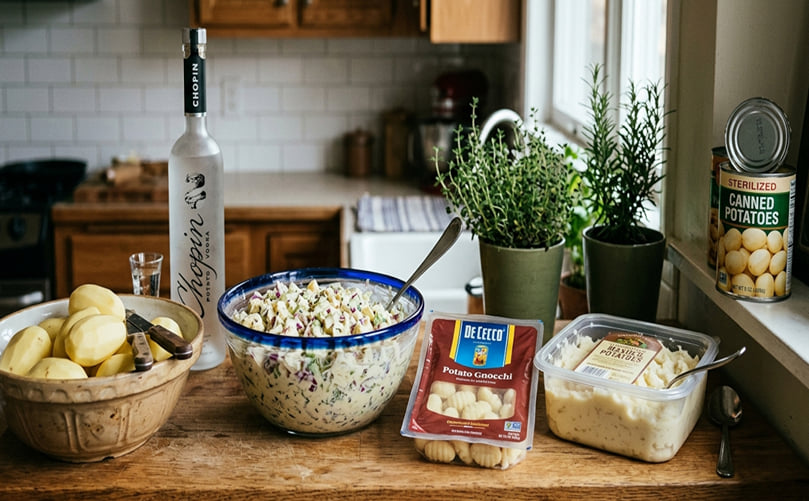
Beyond Fries: Exploring the Expanding World of Value-Added Potato Products
Other Value-Added Potato Product Categories
Peeled Potatoes: The Functional Intermediate
Peeled potatoes represent a critical semi-processed product designed primarily to reduce labor in institutional kitchens and foodservice operations. By eliminating the time and effort required for peeling these products enable greater efficiency in restaurants, catering units and processing facilities. However, their biggest technical challenge lies in enzymatic browning caused by polyphenol oxidase activity. To address this, processors typically apply anti-browning treatments such as ascorbic acid or sulfite-based solutions.
From a storage perspective peeled potatoes are highly perishable and require strict refrigerated conditions. Vacuum packaging and modified atmosphere packaging can significantly extend shelf life while maintaining visual and textural quality. These products often serve as a starting point for further processing into fries, cubes or ready meals making them a crucial link in the potato value chain.
Sterilized Canned Potatoes: Shelf Stable Convenience
Sterilized canned potatoes are designed for long-term storage and maximum convenience. These products undergo high temperature retort processing to achieve commercial sterility allowing them to be stored at ambient conditions for extended periods. Typically packed in brine, canned potatoes maintain basic flavor and structural integrity, although the intense heat treatment often results in a softer texture compared to fresh or minimally processed alternatives.
Despite this textural limitation canned potatoes play a significant role in food security systems, emergency supplies and regions with limited cold chain infrastructure. Their reliability, long shelf life and ease of use make them a dependable option for both households and institutional use.
Refrigerated Mashed Potatoes: Ready-to-Heat Solutions
Refrigerated mashed potatoes are high-moisture, ready-to-eat or ready-to-heat products that cater to the growing demand for convenience foods. These products are typically stored at 0–4°C and require a consistent cold chain to ensure safety and quality. Their texture ranging from creamy to slightly coarse is influenced by potato variety, dry matter content and processing conditions.
Formulations often include dairy ingredients such as butter and cream, along with stabilizers and emulsifiers to maintain consistency during storage and reheating. These mashed potatoes are widely used in ready meals, airline catering and quick service restaurants, where uniform quality and ease of preparation are essential.
Gnocchi: Traditional Craft Meets Industrial Scale
Gnocchi are traditional potato-based dumplings that originated in Italian cuisine but have gained global popularity. Made primarily from mashed potatoes, flour and occasionally eggs, gnocchi rely heavily on the quality of the raw potatoes, particularly their dry matter content. High starch potatoes are preferred as they produce a lighter more cohesive dough and a desirable soft texture after cooking.
While artisanal gnocchi are handcrafted, modern industrial production uses extrusion systems to ensure uniform size and shape. These products are available in fresh, chilled, frozen and shelf stable formats, allowing manufacturers to target diverse markets. Their adaptability to different sauces and cuisines further enhances their commercial appeal.
Potato Vodka: From Starch to Spirit
Vodka derived from potatoes represents a unique non-food application of this crop. The production process involves converting potato starch into fermentable sugars, followed by fermentation, distillation and filtration. Compared to grain-based vodka, potato vodka is often associated with a richer mouthfeel and subtle flavor differences making it attractive in premium and craft segments.
The quality of the final product depends on raw material selection, fermentation efficiency and distillation precision. Craft producers increasingly emphasize origin, sustainability and small batch techniques to differentiate their offerings in a competitive spirits market.
Potato Salad: Ready-to-Eat Freshness
Potato salad is a widely consumed ready-to-eat product that combines cooked potatoes with various dressings such as mayonnaise, mustard or vinaigrette. Its appeal lies in its versatility with numerous regional variations incorporating herbs, spices, vegetables and proteins.
From a processing perspective potato salad is highly perishable and requires strict refrigeration to maintain safety and quality. Shelf life is influenced by factors such as pH, moisture content and microbial load. Advanced packaging techniques including modified atmosphere packaging are often used to extend freshness. These products are commonly found in deli counters, retail packaged foods and catering services.
Evolving Consumption Trends in Value-Added Potato Products
The market for value-added potato products is being strongly driven by the global shift toward convenience and time saving food solutions. Rapid urbanization, changing lifestyles and increasing workforce participation have accelerated demand for ready-to-eat and ready-to-heat products such as refrigerated mashed potatoes and potato salad. Consumers are prioritizing ease of preparation without compromising on taste and quality making these formats increasingly relevant across both developed and emerging markets.
Foodservice remains a major consumption channel, with hotels, quick service restaurants (QSRs), cloud kitchens and catering operations relying heavily on semi-processed and ready-to-use potato products. Items like peeled potatoes and pre-prepared mashed potatoes help reduce labor costs, improve kitchen efficiency and ensure consistency in large-scale operations. This operational convenience is a key factor driving adoption across institutional buyers.
At the same time, premiumization is reshaping the category. Consumers are showing growing interest in high quality, indulgent and differentiated offerings such as gourmet mashed potatoes with butter and herbs, artisanal Gnocchi with unique flavors and craft style Vodka derived from potatoes. This trend is encouraging manufacturers to innovate with ingredients, textures and flavor profiles to capture higher value segments.
Regional preferences also play an important role in shaping demand. For example, Gnocchi holds strong cultural and commercial significance in European markets, while Potato salad is widely consumed across North America and parts of Europe in both retail and foodservice formats. In contrast, emerging markets are witnessing increasing adoption of these products as cold chain infrastructure and modern retail expand.
Overall, the category continues to evolve as a dynamic segment within the potato industry, balancing convenience, quality and innovation to meet diverse consumer and market needs.
From Processing to Market: What Defines Product Success
Across all these products, several common factors determine success, with raw material selection forming the foundation of product performance. Different applications demand specific potato characteristics: high dry matter and low reducing sugars are preferred for products like Gnocchi and mashed preparations to achieve desirable texture and structure, while varieties with stable cell integrity and lower disintegration tendencies are better suited for canning. In addition, factors such as tuber size uniformity, maturity and storage history significantly influence processing behavior and final product consistency.
Processing methods whether peeling, thermal sterilization, cooking and mashing, fermentation or mixing play a decisive role in defining product quality. Each step must be carefully controlled to balance microbial safety with minimal loss of sensory attributes. For instance, excessive heat during sterilization can compromise texture, while inadequate control during fermentation or chilled processing can affect both safety and flavor development. Process optimization, therefore, becomes critical in maintaining consistency at scale.
Equally important are packaging and storage conditions, which directly impact shelf life and product stability. These range from ambient, shelf stable systems used for canned products to strictly control cold chain environments required for refrigerated mashed potatoes and Potato salad. Advanced packaging technologies such as vacuum sealing and modified atmosphere packaging (MAP) are increasingly used to limit oxidation, control microbial growth and preserve freshness.
Quality attributes including texture, flavor, color stability and overall shelf life must be consistently managed to meet both consumer expectations and regulatory standards. Issues such as enzymatic browning, moisture migration and microbial spoilage require targeted interventions at different stages of processing and storage.
From a market perspective these products strongly align with global trends toward convenience, ready-to-eat meals and premiumization. The growing demand for time saving food solutions, coupled with the expansion of foodservice sectors and modern retail has accelerated their adoption. At the same time, there is increasing interest in clean label formulations, improved nutritional profiles and sustainable processing practices. Together, these factors highlight not only the adaptability of potatoes across diverse applications but also their strategic importance in meeting the evolving needs of global food systems.


