

Introduction: The Andean Potato and Its Silent Pest
Potatoes (Solanum tuberosum) originated in the Andes over 8,000–10,000 years ago and remain a dietary staple, providing up to 80% of calories for millions of highland inhabitants across Bolivia, Peru, Ecuador, Colombia and Venezuela. The region hosts over 4,000 native varieties adapted to diverse altitudes and climates contributing about 15% of global potato production (approximately20 million tons annually). These smallholder farming systems, often on plots smaller than 0.25 ha face numerous biotic stresses with the Andean Potato Weevil (APW) complex (Premnotrypes spp., Rhigopsidius spp.) being the most destructive insect pest at altitudes above 2,800 m.
The APW complex causes severe tuber damage resulting in 16–100% yield losses if uncontrolled, rendering produce unmarketable and worsening poverty and food insecurity. Larval tunneling promotes secondary infections by bacteria and fungi, while adult weevils defoliate plants. Co-evolved with potatoes, these flightless insects synchronize their life cycles with the rainy season migrating on foot from overwintering sites to infested fields.
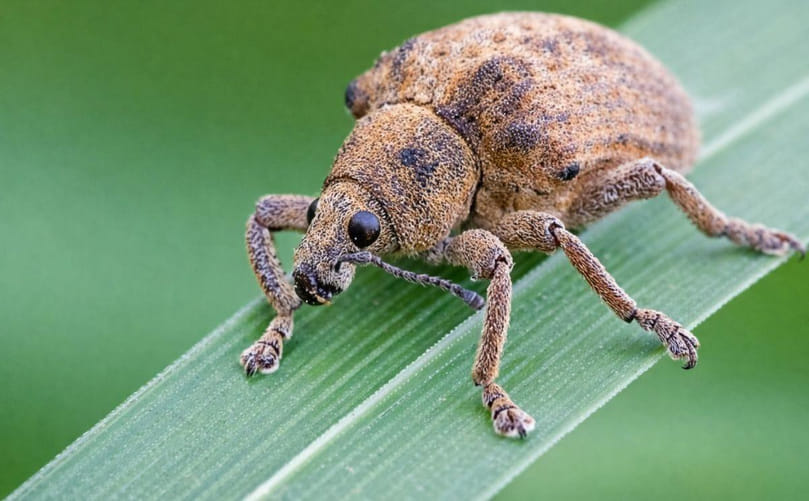
Adult Andean Potato Weevil – Primary Pest of Highland Potatoes
History: From Indigenous Lore to Scientific Recognition
The Andean Potato Weevil (APW) co-evolved with wild potatoes in the Andean highlands with the greatest diversity of Premnotrypes species found in Peru and Bolivia. Indigenous Quechua and Aymara traditions even personify the pest: in Chumbivilcas, Peru, the "Gorgojo de los Andes" myth tells of disobedient sons transformed into weevils that plague potato fields reflecting millennia of local awareness. Traditionally, farmers managed the pest using crop rotation, raised fields (waru waru) and manual collection of adults and larvae.
Scientific recognition of APW began in 1913 when infested tubers were shipped to the United States. W. Dwight Pierce described the genus Premnotrypes in 1914 with P. vorax as the type species. Later, Kuschel (1956) described P. suturicallus. By the 1970s, surveys by the International Potato Center (CIP) identified APW as a primary constraint to potato production in high altitude regions and detailed studies on its bionomics were conducted in the 1980s. By the 1990s, integrated pest management (IPM) pilot programs began scaling regionally to mitigate its impact.
Global Distribution: Where the Weevil Thrives
The Andean Potato Weevil (APW) complex is endemic to the high-altitude regions of the tropical Andes, spanning approximately 5,000 km from Venezuela in the north to northern Chile and northwestern Argentina in the south. These weevils thrive at elevations between 2,100 and 4,700 m, with peak infestations occurring between 3,000 and 4,000 m, where traditional potato farming predominates.
Species distribution varies geographically:Premnotrypes vorax occurs in northern Venezuela, Colombia, Ecuador and northern Peru; P. suturicallus is concentrated in central Peru (Mantaro Valley, Cusco); P. latithorax dominates southern Peru (Puno) and Bolivia; P. solaniperda overlaps in Peru and Bolivia; Rhigopsidius piercei extends to southern Peru, Bolivia, northern Chile and Argentina and R. tucumanus is found in northwestern Argentina. Phyrdenus muriceus, a more polyphagous species, inhabits lower altitudes and is less specialized on potatoes.
Due to their flightlessness and adaptation to cold, high elevation climates, natural spread beyond the Andes is limited. No established populations exist outside South America though occasional interceptions via international potato trade have occurred. The primary risk for human assisted spread is through infested tubers carrying larvae prompting classification as a quarantine pest by EPPO and the European Union with strict phytosanitary regulations to prevent introduction.
Climate change may drive upslope and latitudinal shifts. Since the 1950s, Andean temperatures have increased 0.03–0.04°C per year, potentially pushing weevils to 3,500–4,200 m and enabling expansion into western valleys and new highland pockets in Colombia and Venezuela. While eastern habitats may contract due to warming and altered rainfall, landscape features such as fallow lands or proximity to infested fields influence local spread, with weevils dispersing on foot up to 300 m. These changes could expose previously unaffected potato growing areas, increasing risks for smallholder farmers already vulnerable to climatic variability.
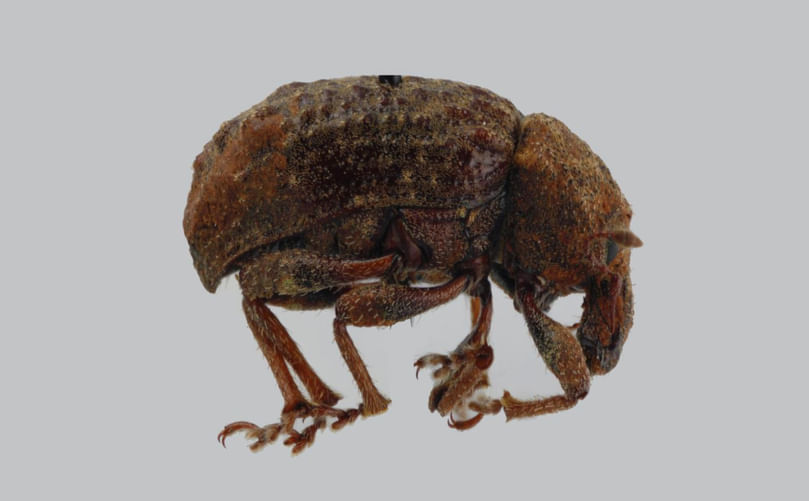
Andean Potato Weevil
Host Range: Who’s on the Menu
The Andean Potato Weevil (APW) complex is oligophagous, feeding primarily on plants within the Solanaceae family with the potato (Solanum tuberosum) serving as its principal host, where both adults and larvae complete their life cycle. Adults feed on foliage and stems, while larvae bore into tubers causing the most severe damage.
Within the complex, host use varies by species. Premnotrypes species are highly specialized on cultivated and wild potatoes such as S. acaule and S. brevicaule, although reduced development and fitness occur on these wild hosts. Occasional infestations are observed on other Andean tuber crops such as ulluco (Ullucus tuberosus) and oca (Oxalis tuberosa), as well as tomato (S. lycopersicum), though full life cycles are rarely completed and infestation levels remain minimal compared to potatoes.
In contrast, Phyrdenus muriceus and Rhigopsidius tucumanus exhibit a more polyphagous nature feeding on various cultivated and wild Solanaceae including certain weed species that can act as reservoirs during the off-season. No development occurs on non-Solanaceous crops such as cereals or legumes, which are therefore effective for crop rotation to disrupt the pest cycle.
Host selection is influenced by chemical cues such as plant volatiles [(Z)-3-hexen-1-ol] and physical traits like tuber size, skin texture and soil depth. Genomic analyses reveal the presence of 32 gustatory receptors (GRs) and 39 olfactory receptors (ORs) in APW species, highlighting their sensory adaptation to Solanaceae hosts. Effective management thus requires controlling alternative hosts and removing crop residues or volunteer plants that sustain residual populations.
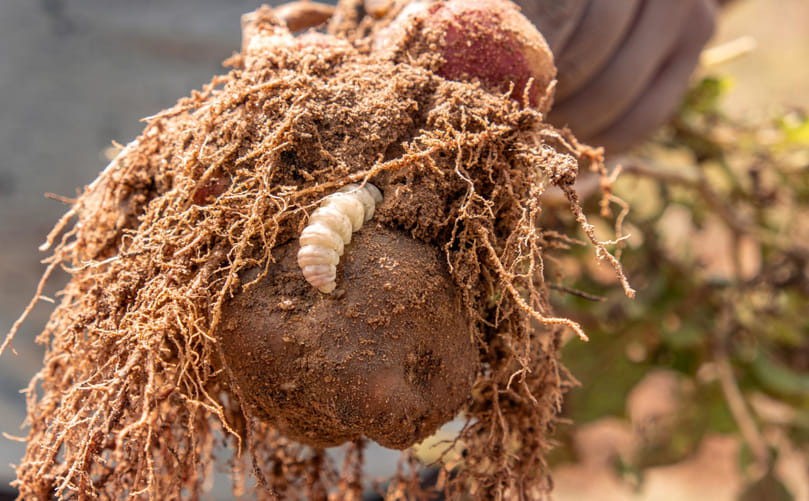
Andean Potato Weevil Feeding on Potato: Host Interaction and Damage
Economic Impact: Counting the Cost
The Andean Potato Weevil (APW) complex causes devastating economic losses across the Andean highlands, where potatoes are both a staple food and the primary income source for smallholder farmers. In untreated fields, yield losses can reach 80–100%, rendering tubers unmarketable due to larval tunneling and secondary rot. Even with insecticide use, average yield loss remains around 18.3%, ranging from 16–45% depending on species, region and management intensity. Infestations are typically higher at field edges (25.1%) compared to centers (16.1%), influenced by proximity to storage areas (which increase damage by 4–5%) or previous potato fields (adding 2–3%).
In Peru, direct economic losses are estimated at USD 276 per hectare, while in Colombia, annual insecticide costs for APW control exceed USD 22 million. Post-harvest losses can surpass 50%, as damaged tubers rapidly rot reducing both marketable yield and seed quality. Infested seed tubers can cut subsequent yields by up to 31%.
For smallholders cultivating plots typically under 0.25 ha control measures consume 7.5–21% of total production costs. Under projected climate change scenarios, economic losses could rise to USD 2,300 per hectare in vulnerable regions. These impacts disrupt local food systems, increase poverty and threaten potato genetic diversity in its center of origin.
While farmer training in Integrated Pest Management (IPM) has demonstrated potential to reduce damage, persistent field degeneration and declining yields in nearly half of the cases underscore the need for sustainable, community-based and adaptive pest management strategies.
Biology & Life Cycle: Life of a Flightless Destroyer
The Andean Potato Weevil (APW) complex is highly adapted to the cool, high-altitude environments of the Andes. Most species exhibit a univoltine life cycle (one generation per year) lasting 185–300 days in the drier southern regions, while 2–3 generations annually may occur in the wetter northern Andes, particularly for Premnotrypes vorax. The life cycle is synchronized with the potato growing season and rainy period (e.g., October–May in Peru).
Adult weevils emerge from overwintering sites in soil or infested tubers with the onset of rains. They are flightless, nocturnal and show sexual dimorphism females (6.8–8.0 mm) are larger than males (5.6–7.5 mm). Their dark brown to black exoskeleton provides soil camouflage. Adults feed on potato foliage and stems can live 136–730 days and migrate up to 300 m on foot.
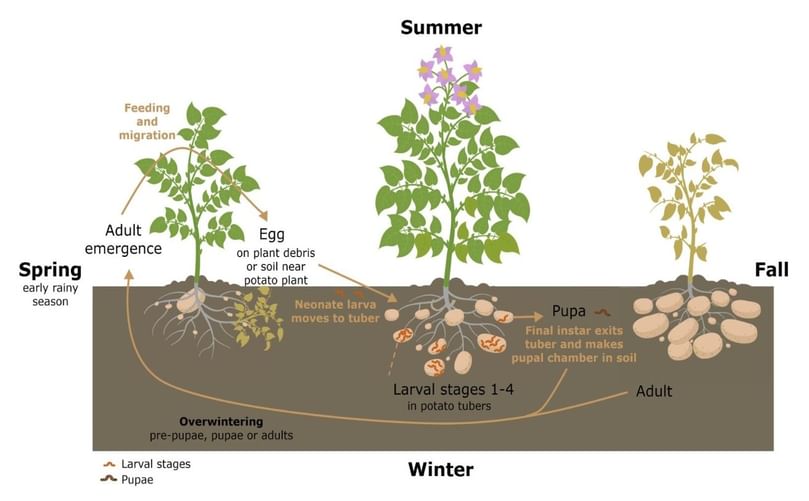
After a pre-oviposition period of 9–45 days, females lay 107–934 eggs in clusters within plant debris, dry stems, weeds or soil near potato plants. Eggs (1–1.5 mm) hatch in about 33 days at 10.5°C. Larvae (4–5 instars) immediately bore into tubers feeding for approximately 46 days and creating frass filled tunnels. A pre-pupal dormancy in the soil lasts about 43 days, followed by pupation in earthen chambers for roughly 54 days; however, Rhigopsidius spp. pupate inside tubers.
Optimal development occurs between 11–15°C with survival possible down to –1.8°C. Adults or pre-pupae overwinter during dry periods, ensuring synchronization with the next crop cycle. Genomic studies show high heterozygosity (7.6–8%) and genome sizes ranging from 623 Mb to 1.55 Gb, reflecting adaptive diversity within the complex. Species specific differences occur P. vorax develops faster (185–300 days), while P. latithorax and P. suturicallus can cause extensive damage by defoliating young potato plants.
Symptoms & Damage: Signs of Infestation
Field symptoms of Andean Potato Weevil (APW) infestation are primarily caused by adult feeding, which produces characteristic semi-circular or half-moon shaped notches along the margins of potato leaves giving them a scalloped appearance. Severe defoliation can lead to plant stunting, reduced photosynthetic activity and overall vigor loss, although adult feeding is generally less economically damaging than larval activity. In most species, these foliar notches are diagnostic, except in Rhigopsidius tucumanus, which feeds internally within stems causing wilting, dieback or plant collapse. Adults are nocturnal, hiding in soil cracks during the day, which makes direct detection difficult.
The most destructive stage is the larva, which burrows into tubers soon after hatching, creating irregular, frass filled tunnels that may traverse the entire tuber. Early infestations often show few external signs but as larvae mature, 2–3 mm circular exit holes appear where they emerge to pupate in the soil. In R. tucumanus, pupation occurs within the tuber intensifying internal decay. These tunnels facilitate infection by secondary pathogens such as Erwinia spp. (bacterial soft rot) and Fusarium spp. (dry rot), resulting in blackening, foul odor and rapid storage spoilage.
Infested seed tubers rot quickly causing poor germination and stand establishment losses of up to 31% in subsequent seasons. Damage severity increases with delayed harvesting as tuber infestation rises by 6.8–29.5% for every 10 days post-maturity due to continued exposure to migrating adults and larvae.
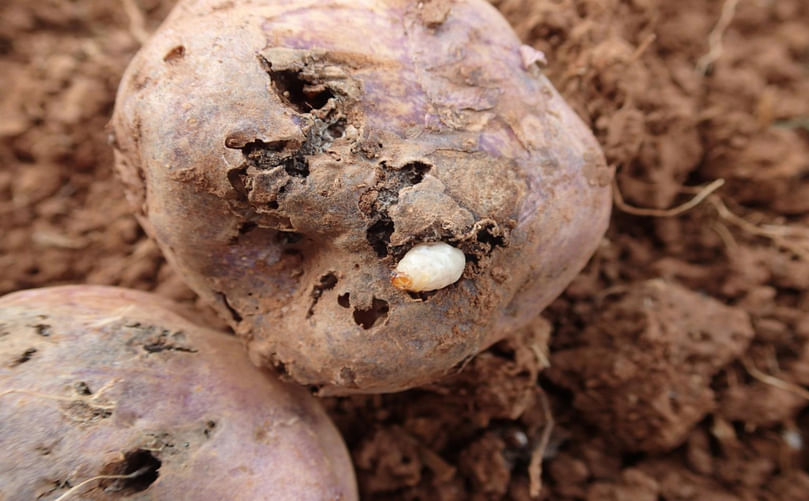
Damage to potato tubers caused by Andean potato weevil larvae.
Landscape proximity to overwintering sitessuch as previous potato plots or storage areas significantly increases border infestations (up to 25.1%, compared to 16.1% in field centers). Because adults are flightless, they disperse only short distances (≤300 m) by walking.
Economically, damage renders tubers unmarketable due to both aesthetic defects and storage rot. The internal tunneling becomes especially visible when tubers are cut or peeled making them unsuitable for sale or consumption. Losses are most severe in smallholder systems, where infested tubers are often stored for extended periods compounding both yield and post-harvest losses.
Prevention & Good Practices: Staying One Step Ahead
Effective prevention of Andean Potato Weevil (APW) infestations depends on proactive, integrated measures that disrupt adult migration, eliminate overwintering sites and maintain strict field hygiene.
Clean Seed and Field Hygiene
- Always use certified, pest free seed tubers from reliable sources as infested seed is a primary route for early-season outbreaks.
- After harvest, destroy crop residues, volunteer plants and infested tubers by burning, deep burial (>30 cm) or thermophilic composting, preventing larval and pupal survival.
- Winter plowing exposes soil dwelling stages to predators, sunlight and frost, killing 50–90% of larvae and pupae.
Physical and Natural Barriers
- Install plastic sheet barriers (40–50 cm high, buried 10 cm deep) around fields 10 days before planting. Support with stakes every 3–4 m and attach a raffia strip at the top to prevent adult climbing. These barriers can reduce damage by 70–93%, often outperforming insecticides while conserving beneficial beetles (Carabidae).
- Natural barriers, such as streams, trenches or ditches, further limit adult migration into fields.
Cultural and Ecological Practices
- Companion planting with mashua (Tropaeolum tuberosum) or lupin (Lupinus mutabilis) confuses and repels weevils, reducing field entry.
- Deploy food baits insecticide treated potato plants placed strategically around field edges to attract and kill migrating adults.
- Conduct weekly monitoring during the rainy season (peak migration) by shaking foliage onto sheets, using pitfall traps or scouting for characteristic leaf notches.
- Early intervention includes manual collection of adults at night or introducing natural predators such as chickens or toads to reduce surface populations.
Post-Harvest and Quarantine Practices
- Store harvested tubers in diffused-light storage structures, which inhibit sprouting and allow easy inspection.
- Regularly inspect and remove infested tubers to prevent re-infestation.
- Implement strict quarantine measures including inspection of imported seed and restrictions on tuber movement from infested to clean areas.
Crop Rotation and Timing
- Adopt crop rotation with non-host plants (e.g., cereals, legumes) for at least two years to break pest cycles.
- Synchronize planting and harvest with local climate to minimize overlap with peak adult migration and oviposition.
Integrated application of these preventive practices offers the most sustainable and environmentally sound defense against the Andean Potato Weevil, reducing reliance on chemical controls while preserving natural enemies and soil health.
Future Threats: Climate Change and Rising Risks
Climate change presents a major emerging threat to the management of the Andean Potato Weevil (APW) complex, primarily through temperature-driven range expansions and ecological disruptions. Climate models under both moderate (SSP 4.5) and high emission (SSP 8.5) scenarios for 2050 and 2090 predict upslope migrations beyond the current 2,800–4,700 m range and latitudinal shifts southward, expanding suitable habitats across the western Andes and coastal inter-valley regions, while contracting in the eastern zones.
Species responses are likely to be uneven: Premnotrypes vorax may expand into Colombia and Venezuela, whereas P. latithorax and related species could lose range in Peru and Bolivia. Long-term warming trends in the Andes (0.03–0.04°C per year since 1975) could enable the pest to establish at 3,500–4,200 m elevations, exposing new highland potato areas to infestation.
Rising temperatures and shifting rainfall patterns may accelerate reproductive cycles, transforming currently univoltine species into multivoltine populations (2–3 generations per year). Such changes could increase pest abundance and outbreak frequency by up to 20%, driven by faster development rates and lower overwintering mortality. Meanwhile, altered climatic conditions could desynchronize pest activity with potato phenology and the life cycles of natural enemies, amplifying crop vulnerability.
Globalization of the seed potato trade further elevates the risk of human assisted dispersal as larvae concealed within tubers could introduce APW into non-endemic, high-altitude regions including parts of Europe or Asia despite existing quarantine barriers.
A compounding challenge is the growing resistance to commonly used insecticides, particularly carbamates and organophosphates (e.g., carbofuran), resulting from prolonged misuse. Climate induced temperature increases may further reduce pesticide efficacy, undermining chemical control reliability. These pressures underscore the urgent need for adaptive Integrated Pest Management (IPM) strategies that incorporate resilient potato varieties, biological control agents, improved monitoring systems and climate smart agricultural planning to safeguard Andean food security.
Management Challenges: Why Controlling APW is Hard
Effective management of Andean potato weevils (APW) in highland agroecosystems remains a formidable challenge due to the pest’s cryptic biology, socioeconomic constraints and environmental variability. The concealed larval feeding within tubers complicates early detection as infestations typically become evident only during harvest or storage when control options are no longer effective. Accurate monitoring demands intensive sampling often 69 to 177 soil samples per field for reliable population density estimates requiring substantial labor, time and technical expertise that are often unavailable in remote farming regions.
Chemical control continues to dominate management efforts but faces critical limitations. The use of highly hazardous insecticides (WHO classes Ia/Ib) achieves only partial efficacy, typically reducing damage by 16–45%, while promoting resistance development and non-target impacts on beneficial organisms such as carabid beetles, which are natural weevil predators. Moreover, the timing of insecticide applications is difficult to optimize due to the pest variable migration behavior and climatic fluctuations leading to inconsistent results.
Cultural practices such as crop rotation, field barriers and field sanitation though proven effective are labor intensive and financially burdensome, especially for smallholders cultivating plots of less than 0.25 ha. The effectiveness of plastic barriers depends heavily on material quality and correct installation, often requiring collective community coordination for large scale deployment.
Biological control options, including entomopathogenic nematodes and fungi remain limited by the lack of cold tolerant strains and inconsistent field performance under high altitude, low temperature conditions typical of the Andean region.
Adoption of Integrated Pest Management (IPM) remains below 50%, hindered by multiple factors complexity of implementation, limited access to training, low literacy and language barriers among indigenous communities. These socioeconomic challenges are compounded by poverty, limited extension support and misinformation, which collectively contribute to unsafe pesticide use and poor pest control outcomes.
Additionally, fragmented landscapes and uncoordinated crop rotations facilitate pest persistence as weevils migrate from infested volunteer plants or alternate hosts in neighboring plots (e.g., Olluco, oats). The absence of consistent government enforcement of quarantine and field sanitation measures further weakens management efficacy.
Finally, climate change introduces new uncertainties shifting the pest distribution and potentially reducing the effectiveness of traditional control methods in rainfed, high-altitude systems (2,800–4,200 m). Together, these constraints underscore the need for locally adapted, community-based IPM programs that integrate ecological, technical and social dimensions of pest management for long-term resilience.
"Protecting our potatoes today safeguards the food security of tomorrow."