

Potato Wart: A Persistent Soil Borne Threat to Global Potato Production
Potato wart, also known as potato wart disease, black wart, black scab, cauliflower disease, potato tumour, potato canker or warty disease, is a soil borne fungal infection of cultivated potatoes (Solanum tuberosum). The disease is recognised by irregular, cauliflower like galls or warts on tubers, stolons and underground stems. These abnormal growths result from hypertrophy (cell enlargement) and hyperplasia (cell proliferation) triggered in host tissues by the pathogen, which redirects the plant's resources into gall tissue instead of marketable tubers.
The causal organism is Synchytrium endobioticum, an obligate biotrophic chytrid fungus that depends entirely on living host cells and cannot be grown on artificial culture media. That single biological fact shapes everything about the disease: it cannot be cultured for routine testing, it cannot be attacked with conventional fungicides, and it survives between potato crops as thick walled resting spores rather than as a growing colony. Those spores stay viable in soil for at least 30 years and can be found as deep as 50 cm, which is why national programmes plan around quarantine periods measured in decades rather than seasons.
Yield losses in a susceptible crop under favourable conditions can reach 100%, because developing tubers are replaced outright by wart tissue and whatever remains is deformed, spongy and unmarketable. S. endobioticum poses no risk to human health or food safety, yet it triggers some of the strictest plant health measures applied to any crop pathogen: zero tolerance thresholds, field quarantines lasting 20 to 50 years, and suspension of seed potato certification. For most outbreaks the indirect cost of those measures far exceeds the value of the crop actually lost.
Infected seed tubers, and soil travelling with them, are the main pathway for long distance spread, so the disease bears directly on the seed potato trade and on variety and seed certification systems. With global potato output at around 390 million tonnes from roughly 17 million hectares and potatoes feeding well over a billion people, a pathogen that can remove land from potato production for a generation carries weight out of all proportion to the area it currently occupies. Current global potato statistics put that exposure in context.
The pathogen is listed as an A2 quarantine pest by the European and Mediterranean Plant Protection Organization (EPPO) and is regulated as a Select Agent in the United States, where it is one of a small group of high consequence plant pathogens added to the federal list under the Agricultural Bioterrorism Protection Act. It is treated as a harmful organism in 99 countries.
Management rests on resistant varieties, certified seed and strict phytosanitary discipline. Chemical eradication is not a realistic option: no plant protection product reliably kills resting spores in field soil, and the compounds once tried for the job were abandoned as both ineffective and environmentally damaging. Potato wart is therefore managed as an exclusion and containment problem, handled alongside the other soil borne threats covered in PotatoPro's guides to potato pests, diseases and physiological disorders and crop protection.
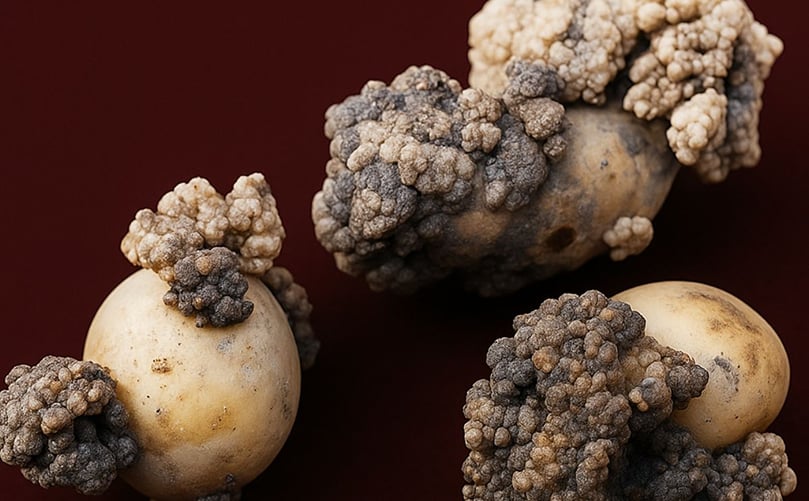
Severe Potato Wart Symptoms Affecting Tuber Development
Key characteristics of potato wart and its causal organism
| Common names | Black wart, black scab, cauliflower disease, potato canker, potato tumour, warty disease |
|---|---|
| Causal organism | Synchytrium endobioticum (Schilberszky) Percival, 1909 |
| Classification | Fungi, Chytridiomycota, Chytridiomycetes, Synchytriaceae; traditionally placed in Chytridiales, with molecular evidence supporting the order Synchytriales |
| Lifestyle | Obligate biotroph; holocarpic and endobiotic; no mycelium or hyphae; cannot be cultured on artificial media |
| Resting spores (winter sporangia) | Thick walled, golden to dark brown, mostly spherical, about 50 µm in diameter (range 25–75 µm) |
| Zoospores | 200–300 released per sporangium; uninucleate, with a single posterior flagellum shed after the spore penetrates a host cell |
| Soil survival | At least 30 years; regulators plan on 40 years or more, and release without soil testing requires 50 years in the European Union |
| Depth in soil | Resting spores recovered to about 50 cm |
| Germination threshold | Soil temperature above 8°C with sufficient moisture; infection favoured below about 20°C |
| Climatic suitability | Annual rainfall of roughly 700 mm or more, cool summers and cold winters |
| Host range | Potato is the only cultivated host; several wild Solanum species are susceptible, and a wider range of solanaceous plants only under artificial inoculation |
| Tissues infected | Meristematic tissue only — tuber eyes, stolon tips, sprouts and stem bases; true roots are not infected |
| Pathotypes | Numbered to 39(P1), with pathotype 1(D1) dominant worldwide and most others confined to parts of central and eastern Europe |
| Potential yield loss | Up to 100% in a susceptible crop with high inoculum |
| Regulatory status | EPPO A2 list; EU quarantine pest under Regulation (EU) 2019/2072; US Select Agent; harmful organism in 99 countries |
Historical Background and Origin of Potato Wart Disease
Potato wart is believed to have originated in the Andean region of South America, where S. endobioticum co-evolved with wild and cultivated Solanum species over thousands of years alongside the domestication of the potato. Within that native range the pathogen caused little economic damage, because locally adapted host populations carried a broad base of resistance and crops were grown in genetically diverse mixtures rather than as uniform stands of a single cultivar. Bolivia, Peru, Ecuador and the Falkland Islands are all treated as part of the pathogen's possible native area in pest risk assessments.
The pathogen was introduced into Europe in the 1880s, most plausibly with Andean potato germplasm imported for breeding after the Irish potato famine of 1845 to 1849 exposed how vulnerable Europe's narrow potato gene pool was to Phytophthora infestans. Infected tubers, or soil travelling with them, carried a pathogen that European agriculture had no resistance to and no name for.
The organism was first described scientifically by the Hungarian botanist Károly Schilberszky, who named it Chrysophlyctis endobiotica in 1896. John Percival transferred it to the genus Synchytrium in 1909, giving the combination Synchytrium endobioticum (Schilberszky) Percival that remains in use. Early twentieth century work on its cytology and life cycle, including the doctoral research of the New Zealand scientist Kathleen Maisey Curtis in 1919, established the unusual alternation of summer and resting sporangia that still underpins how the disease is managed.
Spread across Europe was rapid, and the two world wars accelerated it. Food shortages encouraged growers to plant whatever seed could be obtained, often without inspection and often from districts already infested, and the pathogen moved with that seed into countries that had been free of it. By the middle of the twentieth century potato wart had become one of the first plant diseases anywhere to be subject to international quarantine legislation, and statutory controls have now been in force in one form or another for close to a century.
Potato wart reached North America early in that expansion. It was confirmed in Newfoundland in 1909, identified by the Dominion botanist H. Güssow, and in 1912 legislation barred the movement of Newfoundland soil and produce into the rest of Canada. That restriction has never been lifted: more than a century later, ground transport leaving the island is still checked for soil and prohibited material. In the United States the disease appeared in Pennsylvania, Maryland and West Virginia, where sustained eradication programmes eventually succeeded; the pathogen has not been detected in the United States since 1994, and EPPO records it there as eradicated. Small outbreaks were also recorded in Nova Scotia in 1941 and on the Labrador North Shore in 1957.
Elsewhere, the pathogen travelled with seed potatoes into South Africa, New Zealand and the Himalayan potato districts of South Asia, and it was found in central Anatolia in Turkey at the end of 2003. In India it is confined to the hills of West Bengal and Sikkim and remains under domestic quarantine; a survey published in 2021 confirmed wart in 12 localities of the Darjeeling and Kalimpong hills and found infected tubers in harvested lots and local markets, which the authors read as a sign that surveillance needed to be more regular.
The most consequential recent chapter opened in Canada. Potato wart was detected on Prince Edward Island for the first time in 2000, and the province has lived with regulated fields, quarantine and periodic trade disruption ever since. Today the geography of potato wart is patchy rather than continuous, and that patchiness is a direct record of where seed potatoes and farm machinery once moved, not of where the climate happens to suit the pathogen.
Dated milestones in the recognition and spread of potato wart
| Date | Event |
|---|---|
| 1880s | Pathogen introduced into Europe, most plausibly with Andean breeding germplasm imported after the Irish potato famine |
| 1896 | Károly Schilberszky describes the organism as Chrysophlyctis endobiotica |
| 1909 | John Percival transfers the species to Synchytrium; the disease is confirmed in Newfoundland, the first North American record |
| 1912 | Canada bars movement of Newfoundland soil and produce to the rest of the country — a restriction still in force |
| 1919 | Kathleen Maisey Curtis completes doctoral research on the pathogen's life history and cytology |
| 1941, 1957 | Localised Canadian outbreaks in Nova Scotia and on the Labrador North Shore |
| 1994 | Last recorded detection of potato wart in the United States |
| 2000 | First detection on Prince Edward Island, Canada |
| 2002 | United States adds the pathogen to its federal list of agricultural Select Agents |
| 2003 | First detection in Turkey, in central Anatolia; pathotype 38(Nevşehir) later described from the region |
| 2021 | Detections on two Prince Edward Island farms close the United States border to the province's potatoes |
| 2022 | EU replaces Directive 69/464/EEC with Commission Implementing Regulation (EU) 2022/1195 |
| 2025 | Canada's National Potato Wart Response Plan takes effect, replacing the 2009 long term management plan |
| 2026 | A new Prince Edward Island detection in the fifth national survey leads the United States to tighten, rather than reimpose, import restrictions |
Causal Organism and Taxonomic Classification of Synchytrium endobioticum
Synchytrium endobioticum sits in the phylum Chytridiomycota, a basal fungal lineage defined by motile, flagellated zoospores and the absence of true hyphae. It is placed in the class Chytridiomycetes and the family Synchytriaceae; traditionally assigned to the order Chytridiales, it is now generally referred to the order Synchytriales on molecular grounds. The genus Synchytrium contains roughly 200 described species, all of them endobiotic and holocarpic parasites of higher plants, meaning the entire thallus is eventually converted into reproductive structures rather than producing them from a persistent vegetative body. Of those species, only S. endobioticum is of major agricultural importance, and its narrow specialisation on potato is the reason.
The pathogen has no mycelium and forms no hyphae at any point in its life cycle. It exists either as a motile zoospore, as a thallus inside a living host cell, or as a resting spore. Genome sequencing has shown a compact genome that retains the capacity to break down complex plant sugars such as starch and cellulose but has lost genes for synthesising purines and pyrimidines, which the fungus must therefore obtain from its host. That loss is the molecular signature of obligate biotrophy, and it explains in concrete terms why no one has ever cultured the organism: the growth medium would have to supply building blocks the pathogen can only take from living potato tissue. Comparison with the related saprophyte S. microbalum shows a reduced complement of hemicellulose degrading enzymes, consistent with a shift away from free living decay.
Two spore types matter in practice. Thick walled resting spores, also called winter sporangia, are the survival and dispersal stage: mostly spherical, golden to dark brown, ridged, and about 50 µm across with a range of 25 to 75 µm. Thin walled summer sporangia, formed inside infected tissue during the growing season, drive the repeated secondary infection cycles that make a gall enlarge so quickly. Each sporangium releases a flush of uninucleate zoospores, each carrying a single posterior flagellum that is shed the moment the spore penetrates a host cell. Published figures for zoospore diameter differ considerably between sources, and the measurement is of little practical use, since detection work relies on the much larger and more distinctive resting spores.
Infection is confined to actively dividing meristematic tissue, which is why tuber eyes and stolon tips are attacked and true roots never are. The pathogen manipulates its host through secreted effector proteins, the best characterised being AvrSen1, which is recognised by the potato resistance gene Sen1 and triggers a hypersensitive response that aborts the infection. Natural variants of AvrSen1 escape that recognition, and this single gene for gene interaction is the clearest mechanistic account available of why resistance based on one gene eventually fails.
Sexual reproduction has never been observed directly but is inferred from the pairwise fusion of zoospores under water stress, which produces zygotes that develop into resting spores. The practical consequence is that recombination cannot be ruled out, and recombination is one of the routes by which new virulence combinations appear.
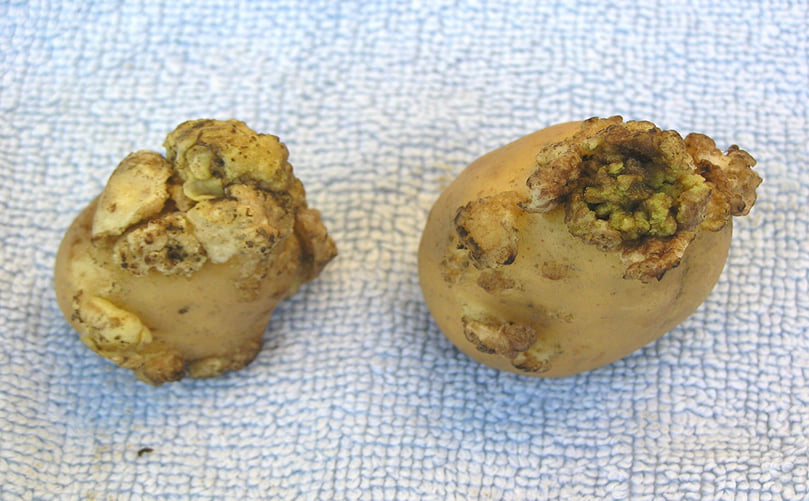
Typical Symptoms of Potato Wart Disease in Solanum tuberosum Tubers
Disease Cycle and Epidemiology of Potato Wart Disease
The cycle begins and ends with the resting spore. These structures persist in soil and in decomposing wart tissue through years and decades without a host, and they tolerate desiccation, freezing and most chemical treatments. In spring, when soil temperature rises above about 8°C and moisture and aeration are adequate, a proportion of them germinate and each releases 200 to 300 motile zoospores.
Those zoospores swim only through continuous films of water, and only for a short distance — a few centimetres at most, over a window of roughly two hours. They locate and penetrate epidermal cells of meristematic tissue: tuber eyes, stolon tips, sprouts and stem bases. Once inside, the pathogen develops into a thin walled summer sporangium, which releases a further generation of zoospores into the surrounding tissue. Under cool, moist conditions this secondary cycle can repeat every 10 to 12 days through the growing season. Each round recruits more host cells into the gall, and because gall tissue acts as a powerful nutrient sink, a wart can enlarge dramatically within weeks while the tubers it has displaced never form.
When conditions turn against the pathogen — soil drying, plant senescence — zoospores fuse in pairs to form zygotes, and these develop into new thick walled resting spores inside the host tissue. As galls mature and decay, in the field or in store, those spores are released back into the soil and the cycle closes. A single season of heavy infection can therefore recharge a field's inoculum reserve for decades.
Only a small fraction of the resting spore population germinates in any given season, which is why outbreaks are typically patchy rather than uniform across a field, and why a field can test clean one year and positive the next. That same staggered germination is what defeats crop rotation as an eradication tool: a non-host break removes the current year's germinating spores from the equation but leaves the reservoir largely intact.
Two features of that cycle shape the epidemiology of potato wart more than anything else. The first is latency: infection is confined to underground organs, so a field can carry the pathogen through a full season while the crop looks entirely normal from the headland, and the grower learns of it at harvest or at grading. The second is inoculum arithmetic. Continuous potato cropping lets each infected crop reload the soil with resting spores faster than natural decline removes them, so disease pressure climbs with every short rotation, while a long break with non-host crops erodes the reserve only gradually. Together these explain the characteristic pattern of potato wart outbreaks: sudden in appearance, patchy in distribution, and far older than the season in which they are found.
Soil survival of potato wart resting spores set against the statutory restriction periods applied in the European Union and Canada
Symptoms and Disease Identification of Potato Wart Disease
Symptoms are almost entirely below ground, which is the single most important practical fact about diagnosing potato wart. Galls develop on tubers, stolons and underground stems wherever meristematic tissue is exposed to infection: tuber eyes, stolon tips, sprout buds and stem bases. True roots are never infected. A crop can therefore look completely healthy from the headland and still be carrying a notifiable quarantine pathogen, and in partially resistant varieties the warts may be so small that they are missed altogether.
The earliest visible stage is a soft, pulpy, white to cream coloured swelling that resembles normal host tissue and cuts more easily than healthy tuber flesh. As infection cycles repeat, the swelling enlarges into an irregular, rough, convoluted mass that gives the disease its cauliflower comparison. Galls range from pinhead size to structures of several centimetres, large enough to cover an entire tuber surface; advanced infections leave tubers spongy and so distorted that they are no longer recognisable as potatoes.
Colour follows age. Young galls stay white or pale, and turn green where they are exposed to light and form chlorophyll. With maturity the tissue browns and finally blackens as it degenerates, and that decaying tissue is what releases the next generation of resting spores into the soil. Where infection strikes early in tuber development, tuber formation may be suppressed completely and the yield from that plant is simply absent rather than reduced.
Above ground symptoms are uncommon and never diagnostic. Heavily infected plants may show slightly reduced vigour, distorted shoots, or small greenish yellow wart like swellings at the stem base, but none of this separates potato wart from a dozen other problems. Because symptoms appear late, detection often happens at harvest, at grading, or in store, where galls can continue to enlarge under moist conditions. Post harvest inspection consequently does real diagnostic work rather than simply confirming what the field already showed.
Field diagnosis rests on recognising the galls, but confirmation requires the laboratory. Microscopy shows solitary, thick walled, golden to dark brown resting spores of a size and appearance that no look-alike disorder produces, and molecular testing confirms identity. Several other problems are mistaken for potato wart often enough to be worth knowing in detail.
Distinguishing potato wart from disorders that resemble it
| Disorder | Cause | How it differs from potato wart |
|---|---|---|
| Powdery scab | Spongospora subterranea | Raised pustules that rupture to release a powdery mass of clustered spore balls, rather than solid proliferating gall tissue; roots are also affected, forming galls that potato wart never produces |
| Potato smut | Thecaphora solani | Dark, powdery spore masses develop inside tuber tissue instead of an external cauliflower like outgrowth |
| Bud proliferation, or "false wart" | Physiological | Clusters of small sprouts or knobs at the eyes with normal internal tissue and no resting spores on microscopic examination |
| Root knot nematode damage | Meloidogyne spp. | Small, smooth surface swellings; sectioning reveals nematode females and egg masses, not fungal thalli |
| Common scab | Streptomyces spp. | Corky, superficial or pitted lesions on the tuber surface with no proliferation of tissue into gall masses |
| Secondary growth and knobbing | Irregular growing conditions | Smooth, tuber like outgrowths of normal flesh and skin, usually across a whole crop rather than in field patches |
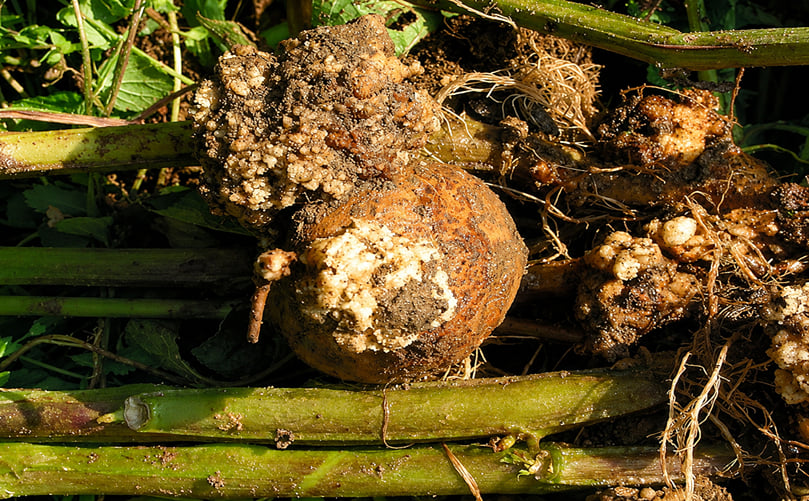
Severe Expression of Potato Wart on Tubers Caused by Synchytrium endobioticum
Pathotypes of Synchytrium endobioticum and Why They Matter
S. endobioticum is the sole causal agent of potato wart; no other Synchytrium species produces comparable symptoms on potato or carries a similar economic threat. Within the species, however, virulence varies enough to decide which varieties can be grown where, and pathotype identity is therefore a regulatory question as much as a scientific one.
Pathotypes are defined by their reactions on a standard set of differential potato cultivars and are numbered, in the European system, up to 39(P1). Pathotype 1(D1) was the first described, is the most widespread worldwide, and in most affected countries is the only one present; it serves as the reference pathotype for resistance screening. The other pathotypes of practical importance in Europe are 2(G1), 6(O1), 8(F1) and 18(T1), and these matter because they infect varieties bred for resistance to pathotype 1(D1). Pathotype 38(Nevşehir) was described from central Anatolia in Turkey after the disease was found there in 2003, and 39(P1) was characterised in Poland.
The geography of the so-called higher pathotypes is striking: they are concentrated in the rainy, mountainous districts of central and eastern Europe, the Alps and the Carpathians among them, where cool, wet soils favour both persistence and repeated infection cycles. Those are precisely the conditions under which a pathogen population is pushed hardest against whatever resistance is deployed against it.
Identification still depends on bioassay. The Glynne–Lemmerzahl method uses controlled tests in which eye plugs or tubers are exposed to inoculum, and the Spieckermann method uses soil infestation assays; both are described in EPPO diagnostic protocols, and both take weeks to months to complete. Differential varieties used in resistance testing include 'Deodara' for pathotype 1(D1), 'Producent' for 2(G1) and 'Talent' for 18(T1). European Union rules require resistance testing to run for two years in most cases, or one year for an extremely susceptible variety, using at least 40 tubers or eye plugs per variety in two replicates with a positive control, and varieties are then classed as highly resistant, resistant, slightly susceptible or extremely susceptible.
Molecular work has made the population structure legible. Simple sequence repeat marker analysis separates European and North American isolates into a small number of genetic clusters, a pattern consistent with a limited number of historical introductions followed by regional evolution and human mediated movement rather than with continuous natural spread. Comparative genomics of isolates differing in pathotype shows that the differences sit in the effector genes, so a pathotype is not simply a stronger strain but one carrying a variant the host's immune receptor no longer recognises. For breeders that turns resistance breakdown from a field observation into something they can screen for before a variety is released.
EPPO guidance prioritises detection of the four principal pathotypes 1(D1), 2(G1), 6(O1) and 18(T1) for regulatory monitoring, and the finding of a higher pathotype typically triggers stricter containment because the varieties available to a region may offer no protection against it. Mixed pathotype populations can occur in a single field, which complicates both diagnosis and the choice of variety for a buffer zone.
Host Range of Potato Wart and Susceptible Plant Species
Potato is the only cultivated host of S. endobioticum under natural conditions, and that narrow host range is the main reason containment is even conceivable. Within its native Andean range and in Mexico, several wild Solanum species are infected, among them S. acaule, S. chacoense, S. commersonii, S. demissum, S. stoloniferum and S. vallis-mexici. These wild hosts matter epidemiologically because they can maintain the pathogen where no potato crop is grown, and they matter to breeders because they are the source of most useful resistance.
Under artificial inoculation the apparent host range widens considerably within the Solanaceae. Resting spores have been produced in tomato (Solanum lycopersicum), bittersweet nightshade (S. dulcamara), black nightshade (S. nigrum), tobacco (Nicotiana tabacum), Datura species and others, usually with weak infection and few or no visible symptoms. Datura metel is listed as a host in EPPO records. Natural field infection of these plants is extremely rare, and none is regarded as a meaningful inoculum source; the experimental host range is relevant mainly because tomato is used as a bait plant in viability testing.
No non-solanaceous host has been confirmed. Crop rotation with cereals, maize or brassicas therefore reduces inoculum, although the longevity of resting spores means it cannot eliminate it. Where wild Solanum populations persist, as in parts of the Andes and Mexico, even that partial control is weakened, because the pathogen has somewhere to live between potato crops.
Global Distribution and Spread of Potato Wart Disease
Potato wart has a fragmented rather than continuous world distribution. It is recorded on every potato growing continent, yet in almost every country it is confined to demarcated zones held under quarantine, and the map reflects the history of seed potato movement far more faithfully than it reflects climatic suitability. Several countries that once had the disease no longer do.
Europe carries the widest recorded occurrence, with the pathogen present in some two dozen countries and territories. In most of them it occupies defined infested zones under statutory restriction rather than being generally distributed. Seven European countries — Austria, France, Hungary, Latvia, Portugal, Slovenia and Switzerland — are recorded as having eradicated it, as is Northern Ireland within the United Kingdom, which demonstrates that eradication is achievable where infestation is caught early and contained rigorously.
In the Americas the pathogen persists within its probable native range in Bolivia, Peru and the Falkland Islands, and in Canada in Newfoundland and on Prince Edward Island, both under strict regulatory control. The United States is recorded as having eradicated it from Pennsylvania, Maryland and West Virginia, and has had no detection since 1994. Chile is likewise listed as eradicated, and Mexico as no longer present.
Across Asia, occurrences are concentrated in cool, high altitude districts: Bhutan, China, Nepal, and in India the hills of West Bengal and Sikkim. In Africa the pathogen is recorded in South Africa under restricted distribution and in Tunisia with few occurrences, while several other African records are considered invalid or unreliable. In Oceania, New Zealand is the single record. Because surveillance intensity varies enormously between countries, absence of records should not be read uncritically as freedom from the pathogen, particularly where no survey has been conducted.
Countries and territories where potato wart is recorded present or absent, grouped by world region
How the pathogen gets from one place to another is almost entirely a question of human activity. Long distance dissemination happens through infected seed and ware tubers in trade, and through soil adhering to planting material; EPPO records 16 interceptions of infected potatoes in European Union trade between 1998 and 2017. Local spread follows machinery, tools, vehicles, footwear, tare soil, irrigation runoff, discarded potatoes, processing water and manure from animals fed infected tubers. Unaided movement contributes almost nothing by comparison. What makes the human pathways so costly is the durability of what they carry: a consignment of soil weighing a few grams can seed a field that stays regulated for the rest of a grower's working life.
International quarantines and trade restrictions have sharply limited large scale expansion, and the pattern of the last several decades is one of containment and local eradication rather than advance. Periodic re-emergence in regions believed to be under control, as on Prince Edward Island, shows that the risk does not disappear: it is managed, continuously, and it reappears wherever surveillance finds what earlier surveillance missed.
(Click picture to watch video)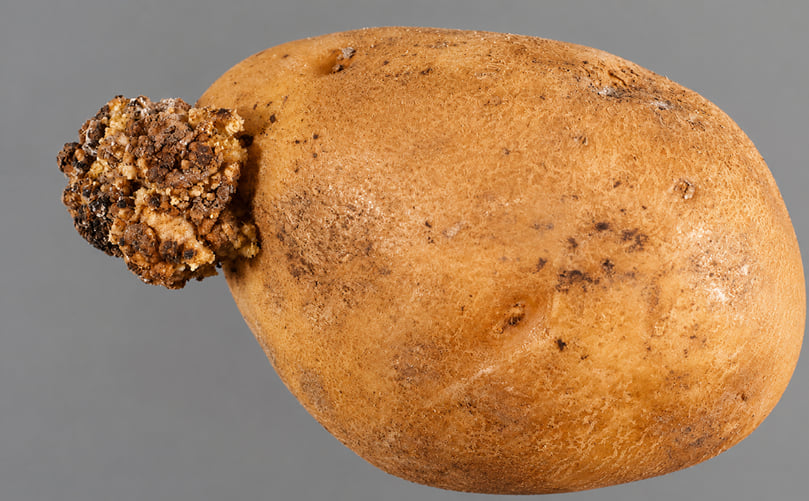
Spread Pathways of Potato Wart Disease Through Seed Tubers and Soil
Factors Influencing Potato Wart Disease Severity
Severity is set by the interaction of environment, host genotype, inoculum density, pathotype and agronomy, and of these the first is the most decisive. Cool, moist soil is what the pathogen requires, and regions without it rarely see severe disease even when the pathogen is present.
Resting spores germinate above about 8°C and infection proceeds best below roughly 20°C, so districts with cool summers, cold winters and persistent soil moisture are the ones where potato wart becomes an epidemic rather than an incident. Annual rainfall of around 700 to 800 mm or more is associated with establishment and sustained infection, and poor drainage or heavy irrigation at tuber initiation sharply increases severity by maintaining the water films that zoospores need to move at all. Waterlogged and compacted soils favour the disease; freely draining soils suppress it. Soil pH is largely irrelevant as a predictor, since infection has been recorded across a range of roughly pH 3.9 to 8.5, although adequate soil oxygen and the presence of nitrates are known to stimulate resting spore germination.
Host genotype is the other decisive factor, and it behaves as a switch rather than a dial. On a susceptible variety the same inoculum and the same weather that would pass unnoticed elsewhere produce heavy galling and deformed tubers, while an effective resistance gene suppresses infection almost entirely. The qualifier matters: resistance holds against the pathotypes a variety was screened on, so the severity a grower experiences depends on which pathotype is in that particular field.
Inoculum density links directly to cropping history. Fields with high resting spore concentrations, whether from an earlier infestation or from repeated potato cropping, show greater incidence and severity, while long rotations with non-host crops gradually erode the viable spore population. Continuous potato production or short rotations do the opposite. Agronomic detail matters at the margins: heavy, moisture retentive soils, deep planting that prolongs exposure of developing tissue to infested soil, and early season infection of sprouts that reduces emergence all increase losses.
In practice, the worst outbreaks combine cool, wet soils in northern or mountainous districts with a susceptible variety, high inoculum density and an aggressive pathotype. Remove any one of those and the disease becomes markedly less damaging, which is the logic behind integrating resistant varieties, rotation, drainage and soil hygiene rather than relying on any single measure.
Economic Impact of Potato Wart: Yield, Quality and Trade Losses
The economics of potato wart are unusual, because the direct crop loss is often the smaller part of the bill. Yield reductions of around 50% occur in moderately infested fields and total failure is possible where tubers are replaced outright by gall tissue, but many detections involve little or no visible crop damage at all. What follows the detection is what costs money.
Infected tubers are deformed, spongy and prone to rapid decay and secondary microbial infection, which rules them out for fresh markets, processing and seed alike. Under zero tolerance rules, affected lots are rejected whatever the level of infection, and losses can continue after harvest because warts enlarge in moist storage. Yet the defining cost is the loss of the land itself: once a field is restricted, resting spore longevity means potato cultivation may be prohibited for 20 to 50 years. Growers switch to less profitable crops or leave production, and the opportunity cost accrues for a generation. Governments carry the parallel cost of surveillance, diagnostics, containment, compensation and enforcement.
Trade disruption is the sharpest shock. A single detection can close an export market within days, and the loss is borne by an entire production region rather than by the farm concerned. Prince Edward Island is the clearest case study available, and the detail is worth following closely because it shows how a pathogen that damaged almost no crop still cost an industry tens of millions of dollars.
Potato wart was first found on the Island in 2000, and the United States closed its border on 31 October that year, a dispute that cost Island farmers tens of millions of dollars before most restrictions on that crop were lifted the following spring. The 2021 detections were far more expensive. The United States stopped accepting Island potatoes on 21 November 2021, roughly 250 to 300 million pounds of unsold potatoes were destroyed over the winter that followed, and the Island's potato industry put its lost revenue above 50 million dollars. Table potatoes regained access the following April; seed potatoes never did.
Since 2000 potato wart has been detected in 38 Island fields across all three counties. More than 48,000 soil samples were analysed in the investigation following 2021, confirming four further detections in 2022 and 2023, and the federal government has invested more than 24 million Canadian dollars in tools, research and expanded surveillance. In May 2026 the fifth national survey, drawing on about 2,200 soil samples collected at the 2025 harvest, confirmed one detection in a previously unregulated field on a farm that does not export and uses its own seed; United States industry groups called for the fresh potato ban to be reinstated, and in August 2026 APHIS instead tightened import requirements with effect from 5 October.
Potato wart detections, quarantine measures and trade decisions on Prince Edward Island, 2000 to 2026
Those figures are worth setting against the scale of the industries at stake. Canada produced a record 127 million hundredweight of potatoes in 2024, and United States industry bodies put their national potato sector above 100 billion dollars in annual economic activity while estimating that a domestic outbreak would cost growers more than 225 million dollars a year in direct export losses alone. Beyond the farm gate, potato wart disrupts seed supply chains, constrains breeding and germplasm exchange and injects uncertainty into trade, which is why regions free of the disease invest heavily in staying that way.
How to Control Potato Wart: Management Strategies
Management of potato wart is built on exclusion and containment rather than cure. Because resting spores survive for decades and no curative treatment exists, eradication from an infested field is extremely difficult and sometimes impossible, so the realistic objective is to stop the pathogen arriving, and to stop it leaving where it already is.
Chemical control deserves to be addressed first, because it is the option growers ask about and the one that does not work. Mercury compounds, sulfur, copper formulations, chlorine based disinfectants and formaldehyde were all tried historically; none eliminated resting spores from field soil and several caused serious environmental and soil damage, so they were abandoned. Modern soil fumigants such as metham sodium offer partial suppression at best and are not considered practical or sustainable, given cost, environmental risk and inconsistent performance. Biological and amendment based approaches — chitin, urea, organic fertilisers, crab shell meal — have shown effects on spore activity in experiments but remain too variable in the field to be relied on. No plant protection product is approved for treating infected tubers.
Resistant varieties: Growing resistant varieties is the most effective and the most sustainable tool available. Resistance prevents the pathogen establishing in host tissue, which both protects the crop and limits the recharging of soil inoculum, and in many countries only officially recognised resistant varieties may be planted in buffer zones around infested land.
Breeding programmes have drawn on resistance genes designated Sen1 to Sen5, most of them derived from wild relatives such as S. acaule and S. vernei. For a grower the practical question is not which gene a variety carries but which pathotypes it has been screened against and passed, because a variety rated resistant in one country may meet a pathotype in another that its resistance was never tested on. Early breeding produced varieties resistant to the dominant pathotype 1(D1) with real success; the emergence of pathotypes such as 18(T1) and 38(Nevşehir) is what forced the shift towards stacking several resistance loci rather than relying on one. Resistance is verified by standardised bioassays, the Glynne–Lemmerzahl and Spieckermann methods among them, under controlled infection conditions, and a variety's rating is always pathotype specific.
Phytosanitary measures: Certified, disease free seed from non-infested land is the single most effective barrier to introduction, and in most production systems it is mandatory. Sanitation of machinery, tools, vehicles and footwear prevents the movement of infested soil, using approved cleaning and disinfection agents, and movement of soil, rooted plants and agricultural waste out of infested zones is heavily restricted. Manure from animals fed infected potatoes must be composted appropriately or avoided, because resting spores survive digestion. Processing regulations may require steaming, incineration or burial with slaked lime to destroy viable spores in waste, and the handling of processing waste has become a specific focus of recent trade requirements.
Cultural practices: Long rotations with non-host crops such as cereals, maize or brassicas gradually reduce the viable spore population, though complete elimination is unlikely, and avoiding continuous potato cropping is essential to prevent inoculum building up. Field selection matters: freely draining soils reduce the water films zoospores need, while heavy or poorly drained soils promote infection. Measures that limit soil erosion, including cover cropping and careful water management, reduce local movement of contaminated soil. Soil amendments should be treated as supportive at most. Regular survey and early detection remain central, since a detection found early is a containment problem and one found late is a trade problem.
Regulatory and quarantine measures: Regulation is the backbone of potato wart management worldwide, and the measures are unusually long lived because the pathogen is. Infested fields are scheduled and potato cultivation prohibited; buffer zones may permit only specified resistant varieties; infected crops are destroyed by approved methods; and movement of potatoes, soil, machinery and plant material from infested areas is controlled. Fields are released only after extended monitoring has established the absence or non-viability of resting spores, and the timescales involved are set out in the section that follows.
Regulatory Status and Quarantine Rules for Potato Wart
Few plant pathogens carry a regulatory footprint as heavy as this one, and the reason is not the damage a crop suffers but what a detection obliges a country to do afterwards. Land leaves production for decades, no treatment shortens that, and trading partners may act on the status of a region rather than the condition of a consignment. Potato wart therefore sits in the top tier of every major plant health framework, and the practical consequences differ enough between them to be worth setting out separately.
The European Union framework changed recently, and references to the old legislation are now out of date. Council Directive 69/464/EEC, which governed potato wart for more than half a century, was repealed with effect from 1 January 2022, and the measures now in force are set out in Commission Implementing Regulation (EU) 2022/1195, adopted on 11 July 2022. On confirmation of the pathogen, authorities must demarcate an area without delay, comprising an infested zone containing at least the infested production site and a surrounding buffer zone. No specified plants may be planted, grown or stored in the infested zone, and soil and machinery movement must be controlled. Within the buffer zone, only specified plants of a resistant variety may be grown, and not for planting.
The release timescales in that regulation are the clearest statement anywhere of how long a potato wart detection lasts. Full revocation of measures requires at least 20 years since the last detection, with gapless crop records and either two negative bioassays on susceptible cultivars or one negative bioassay plus microscopic examination finding no viable resting spores. Where that testing route is not used, the minimum is 50 years. Partial revocation for defined parts of an infested zone is possible after at least 10 years, and if the conditions are not met the case may be reconsidered after a further two years at minimum. Soil sampling is done in units of 0.33 hectares, with 60 subsamples per unit taken to 20 cm depth and pooled into roughly three samples per hectare. After revocation, the first crop of susceptible plants must be inspected at harvest before it leaves the demarcated area. Member States run annual risk based surveys and report by 30 April each year, and notify newly resistant varieties by 31 January.
Canada's framework was also rewritten recently. The National Potato Wart Response Plan took effect on 5 March 2025, replacing the 2009 Potato Wart Domestic Long-term Management Plan, and applies to new detections anywhere in Canada except Newfoundland and Labrador. It classifies land in detail — index field, adjacent field, primary and secondary contact field, field of concern, quarantine disposal site, and restricted non-agricultural land — and attaches different measures to each. A field becomes an index field when a symptomatic tuber is found or two resting spores are confirmed by two independent methods; a single confirmed spore makes it a field of concern. An adjacent field is one bordering an index field with no barrier wider than 15 m.
The consequences for an index field run across four decades. No potatoes, root crops or propagative plants may be grown for 20 years, after which soil is analysed and, where spore counts are below five per gram, bioassayed; resistant varieties may then be permitted. A review for non-host crops and propagation becomes possible at 27 years after three resistant crops with clean post-harvest sampling and a negative bioassay, and a review for resistant table stock at 40 years after final sampling and bioassay. Partial release for documented non-host use requires 50 years. Seed potato production on an index field is prohibited indefinitely, even after the 40 year review, and seed grown on restricted fields can no longer be certified at all. The plan also requires growers of restricted fields to prepare and carry out preventive control plans, and it sits alongside the Potato Wart Order restricting movement of potatoes, equipment and soil, plus field and tuber inspection and the annual National Potato Wart Survey.
United States requirements show what a quarantine status looks like once it reaches a loading dock. Rather than a simple open or shut border, imports from a regulated province run on a standing set of conditions: fresh potatoes must be washed, sprout treated, inspected, certified, traceable to both production site and packing facility, and meet United States No. 1 grade, while field grown seed potatoes are prohibited outright. The requirements added for October 2026 extend that logic past the border itself: bulk importers taking containers of 50 pounds or more must hold compliance agreements covering waste handling, culls and potato waste may no longer go to animal feed and must be sent to approved disposal, and labelling obligations widen so that repacked consignments stay traceable. The pattern is instructive. Where a pathogen moves in soil and waste rather than in the commodity itself, importing countries increasingly regulate what happens to the by-products after arrival, not only what crosses the line.
Across all three systems the same logic applies. Because the pathogen outlasts any realistic planning horizon, regulators substitute time and testing for treatment, and the economic burden of that substitution falls mainly on growers whose land is restricted rather than on the trade as a whole.
How Potato Wart Is Detected and Diagnosed
Diagnosis combines visual assessment, microscopy, bioassay and molecular testing, because no single method answers all the questions that a detection raises. Field inspection identifies suspect galls on tubers, stolons and underground stems, but look-alike disorders make laboratory confirmation essential, and a negative visual inspection proves very little given how often infection is latent.
Soil testing is the backbone of surveillance. Resting spores are extracted by wet or dry sieving — the Pratt method using chloroform, or a calcium chloride variant — or with an automated Hendricks centrifuge, and concentrated for microscopic examination. Under light microscopy the pathogen is recognised by thick walled, golden to dark brown resting spores of about 50 µm. Sampling strategy determines whether any of this works: tare or grid sampling must be representative, and Canadian practice requires that the method follow whichever approach produced the original sample.
Finding a spore and knowing whether it is alive are different problems, and viability is the harder one. Bioassays using susceptible host plants, the tomato bait plant test and the Spieckermann pot test among them, confirm infectivity by producing wart formation, typically over six to eight weeks. This is why bioassay survives in protocols despite its cost: a dead spore and a live one look identical under a microscope and amplify identically by PCR, so only a host plant can answer the question that actually decides whether a field stays restricted.
Molecular diagnostics have improved sensitivity and speed considerably. Real time PCR assays targeting ITS or 18S rDNA regions give high sensitivity and specificity, and quantitative PCR allows inoculum density to be estimated. Confirmation thresholds are deliberately conservative: Canadian practice requires either a symptomatic tuber or two resting spores confirmed by two independent methods, typically morphology and molecular analysis. What molecular methods cannot yet do reliably is distinguish living spores from dead ones, which is why bioassay remains in the protocols despite taking months, and viability assays based on metabolic activity or DNA integrity are an active research target. Pathotype determination still depends on differential cultivar bioassays that can take up to three months.
Newer approaches are being explored to shorten that timeline, including profiling of volatile organic compounds by gas chromatography mass spectrometry as a rapid, non-invasive screen. For now, the combination of representative sampling, microscopy, molecular confirmation and bioassay remains the only route to a defensible diagnosis, and the low germination rate of resting spores keeps every step slower than growers and regulators would like.
Management Challenges in Controlling Potato Wart
The difficulties in controlling potato wart are biological first and institutional second, and they compound each other.
Resting spore longevity is the root problem. Nothing a grower can do to a field reaches the spores. They shrug off desiccation, freezing and chemical treatment, and they sit well below the depth any surface measure could reach. Eradication from an established field is therefore close to impossible, and every detection becomes a commitment measured in decades rather than seasons.
The absence of chemical options removes the response that growers of most other diseases can fall back on. Historical treatments failed and damaged the soil; modern fumigants suppress rather than eliminate and are impractical on cost and environmental grounds; biological amendments remain inconsistent in the field. There is simply no product that converts an infested field into a clean one.
Pathotype diversification steadily erodes the one tool that does work. Many pathotypes overcome the resistance genes deployed in commercial varieties, and the selection pressure that produces them is heaviest exactly where it is least welcome: in intensive potato monocultures with short rotations, such as starch potato systems, where the same resistance is exposed to the pathogen season after season. Mixed pathotype populations within a single field complicate both diagnosis and variety choice.
Detection is late by nature. Symptoms are underground, latent infection is common, and outbreaks are often discovered at harvest or in store, by which time seed, machinery and soil may have moved. Spore viability cannot yet be determined quickly, so a detection can trigger years of bioassay before anyone knows whether the pathogen found was alive.
The regulatory and economic consequences then take over. Detection triggers land use restrictions that may run beyond 20 years, movement controls, loss of seed certification and crop destruction, with substantial losses for growers and regional economies through foregone production, compliance costs and restricted market access. Restrictions on access to infested sites can also slow the epidemiological research that would improve control, which is an awkward feedback loop. Compensation frameworks have not always kept pace: Canada's Potato Wart Compensation Regulations date from 2003 and are under review.
Breeding is slow for reasons intrinsic to the crop. Potato is a tetraploid with complex genetics, and resistance must be combined with yield, processing quality, storage performance and market acceptance, so moving a resistance gene into a commercially viable variety takes many years. Meanwhile growing trade volumes raise the risk of movement across borders, and shifting climate patterns may alter which regions are suitable for establishment.
Research Advances and the Future of Potato Wart Control
Research has moved quickly in the last decade, mostly by routing around the fact that the pathogen cannot be cultured. Genomics, molecular diagnostics and soil microbiome work have each opened approaches that were unavailable when potato wart management was first codified.
Genome sequencing of multiple S. endobioticum isolates has made effector biology accessible. The characterisation of AvrSen1, and of the natural variants that evade recognition by Sen1, gives the first concrete molecular explanation of why single gene resistance breaks down, and comparative genomics between isolates of different pathotypes is clarifying evolutionary relationships and likely migration pathways. Because the fungus cannot be grown in culture, this sequence based route is effectively the only way to study its pathogenicity mechanisms in detail.
Population genetics has become practical through marker development. Simple sequence repeat marker panels group isolates into distinct genetic clusters, which supports inference about population structure, virulence evolution and regional spread, and feeds directly into decisions about which resistance to deploy where.
Resistance breeding has advanced with the mapping of the major wart resistance genes Sen1 to Sen5, several of which encode TNL type immune receptors. The broad spectrum gene Sen2 on chromosome XI is a priority target, and marker assisted selection now accelerates introgression into elite material. Stacking multiple resistance genes, rather than deploying them one at a time, is the consensus strategy for durability, and hybrid breeding systems are being explored to shorten the cycle. Genome editing approaches are under investigation for the same purpose, with the usual caveat that regulatory acceptance differs sharply between markets.
Microbiome research is the newest line of work. High resolution profiling, including full length 16S rRNA sequencing on nanopore platforms, has begun to characterise the microbial communities associated with disease suppressive soils, and functional analysis suggests that particular microbial networks may inhibit pathogen development. This is promising rather than proven: field validation over multiple seasons is the necessary next step before any biological control product could be built on it.
Diagnostic development is focused on the two gaps that matter most in regulation. Standardised quantitative PCR allows sensitive detection and approximate quantification of pathogen DNA, but distinguishing viable from non-viable spores remains the critical unsolved problem, since it determines how long a field stays restricted. Work on viability assays, on faster bioassay systems, and on volatile organic compound profiling by gas chromatography mass spectrometry all addresses that bottleneck. Suppression research continues on biopesticides, phosphite based treatments and organic amendments such as chitin, where the limiting factor is field consistency rather than laboratory effect.
The direction of travel for policy is towards harmonisation: internationally agreed methods for assessing spore viability and common quarantine thresholds would reduce the divergence between national systems that currently complicates trade. Multi-omics work combining genomics, transcriptomics and metabolomics aims to resolve the parts of the pathogen's biology that remain genuinely unknown, including what triggers resting spore germination and how reproduction actually proceeds. Those are not academic questions: a reliable germination trigger would transform viability testing, and a reliable viability test would shorten quarantines by decades.