

Potato Thrips: Why They Matter in Modern Potato Production
Potato thrips are among the most destructive insect pests affecting potatoes (Solanum tuberosum) worldwide. They cause direct damage by feeding on plant tissues and indirect damage by transmitting plant viruses in certain production systems.
Importance in potato production: Thrips are generally considered minor to moderate pests of potatoes, but they can become major economic pests under favorable conditions, particularly during warm, dry weather. Their feeding damages leave by reducing chlorophyll content and photosynthetic capacity, leading to reduced plant vigor, stunted growth and lower tuber yields. In seed potato production, thrips are especially important because they can transmit viruses that reduce seed quality, certification standards and marketability.
Global distribution: Several thrips species infest potato crops worldwide with the most economically important being Frankliniella occidentalis (western flower thrips), Thrips tabaci (onion thrips) and in some regions, Frankliniella fusca (tobacco thrips). Frankliniella occidentalis has spread to more than 50 countries across multiple continents and is now regarded as a globally invasive pest. Thrips outbreaks are most common in warm, dry climates and in protected cultivation systems such as greenhouses and screenhouses.
Economic impact: Both direct feeding injury and virus transmission contribute to economic losses. Feeding causes leaf silvering, bronzing, reduced photosynthesis and premature leaf senescence, while virus transmission can result in severe crop damage depending on the virus involved. In heavily infested fields, yield losses can range from 30% to 70% under favorable conditions for thrips development, particularly when infestations occur early and remain unmanaged. Additional costs arise from regular monitoring, insecticide applications and resistance management programs.
Why growers should monitor them: Early detection is essential for effective thrips management. Thrips have short life cycles, high reproductive potential and often remain hidden within folded leaves, flowers or soil during parts of their development, making infestations difficult to detect until damage becomes apparent. Regular field scouting and the use of monitoring tools such as sticky traps enable growers to identify infestations early, minimize virus transmission, prevent population outbreaks and reduce the risk of insecticide resistance developing through unnecessary or poorly timed pesticide applications.
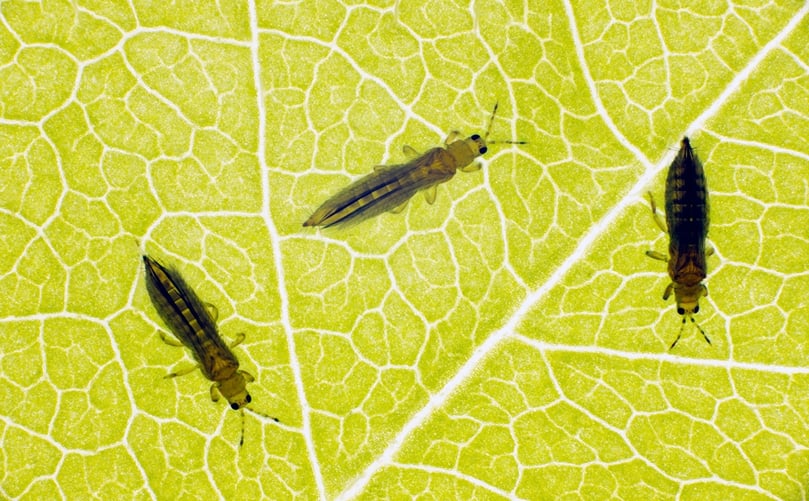
Adult Potato Thrips on Potato Foliage
What Are Potato Thrips?
Potato thrips are tiny, slender insects belonging to the order Thysanoptera, a name derived from the Greek words meaning "fringed wings." Most economically important species attacking potatoes belong to the family Thripidae. These insects are sap feeding pests that damage potato plants by piercing leaf and flower tissues and sucking out cell contents. Besides causing direct feeding injury, several species are important vectors of plant viruses.
Common Thrips Species Affecting Potatoes
Several thrips species infest potato crops although their abundance and economic importance vary by region.
Thrips tabaci (Onion Thrips): A cosmopolitan species found in potato growing regions worldwide. Adults are usually pale yellow to light brown, although darker forms also occur. This species feeds on a wide range of crops and is an important vector of several plant viruses.
Frankliniella occidentalis (Western Flower Thrips): One of the most economically important and highly invasive thrips species. Adults vary in color from yellow to dark brown depending on age, season and environmental conditions. It has a very broad host range (highly polyphagous) and is the dominant thrips species in many temperate regions and protected cultivation systems. In some potato growing areas, such as the Pacific Northwest of the United States, it accounts for more than 90% of the thrips population found on potato crops.
Frankliniella schultzei (Common Blossom Thrips): Also known as the tomato or cotton thrips, this species is widespread in tropical and subtropical regions, particularly in Africa, Asia and parts of South America. It damages potatoes through feeding and can transmit important plant viruses.
Thrips palmi (Melon Thrips): An important pest in tropical and subtropical regions, particularly in Asia. Although primarily associated with cucurbits and solanaceous vegetables, it may also infest potato crops under suitable conditions.
How Potato Thrips Differ from Other Thrips
Potato infesting thrips differ from other thrips species in their host preference, feeding behavior and ability to transmit plant viruses. Species such as Frankliniella occidentalis are highly efficient vectors of economically important viruses making them particularly damaging in potato production. Adult potato thrips are typically 1–2 mm long, slender and possess the characteristic fringed wings that distinguish the order Thysanoptera. Their body color ranges from pale yellow to dark brown depending on the species and life stage. Unlike predatory thrips, which feed on mites and other small insects, potato thrips are plant feeding pests that extract cell sap from leaves, stems, flowers and young tissues, resulting in direct crop damage and increased disease risk.
Distribution of Potato Thrips Across Major Potato Growing Regions
Thrips species affecting potatoes, particularly Frankliniella occidentalis (western flower thrips), Thrips tabaci (onion thrips) and Frankliniella schultzei, exhibit a broad global distribution due to their invasiveness and adaptability. Among these, F. occidentalis, native to western North America, has spread to at least 57 countries across nearly all continents since the late 1970s. It thrives in both open field and protected cultivation systems because of its polyphagous nature, high reproductive rate and ability to spread through the movement of infested plant material.
In Europe, F. occidentalis is well established in protected cultivation in countries such as the Netherlands, Spain and the United Kingdom with outbreaks more common in the warmer southern regions.
In North America, it is widespread throughout the United States, particularly in the western states and the Pacific Northwest as well as in parts of Canada, where it is the dominant thrips species infesting potato crops.
In Asia, Thrips tabaci and Thrips palmi are widely distributed, while F. occidentalis has invaded many regions, including China, India and Southeast Asia.
In Africa, Frankliniella schultzei and T. tabaci are common on potato crops, particularly in subtropical and tropical regions such as South Africa and Kenya.
In South America, which is considered a potential origin for some Frankliniella species, potato growing highlands experience infestations from multiple thrips species.
Australia has established populations of invasive thrips across several states, where they continue to present management challenges in potato and other vegetable crops.
Across these regions, thrips outbreaks are most frequent in warm, dry climates and intensive production systems, where environmental conditions favor rapid population growth and population buildup.
Identification of Potato Thrips
Accurate identification of potato thrips requires magnification using a hand lens or microscope because of their small size (0.5–2 mm) and subtle morphological differences. Adults are slender, elongated insects with two pairs of narrow wings fringed with long hairs although some forms may be wingless. Their coloration varies depending on species and sex. Adult Western flower thrips range from pale yellow and orange to dark brown or black, whereas Onion thrips are typically pale yellow to light brown. Distinguishing characteristics include asymmetrical rasping sucking mouthparts, short antennae with seven or eight segments and a narrow, tapering abdomen. Males are generally smaller and lighter in color than females.
Egg Identification: Eggs are extremely small, translucent to creamy white and kidney shaped or elliptical. Females insert them individually into soft plant tissues such as leaves, stems or flower parts using a saw-like ovipositor making the eggs difficult to observe without magnification. Tiny oviposition scars may occasionally be visible on the plant surface.
Larval Identification: Thrips pass through two active larval instars. Larvae are wingless and pale white to yellowish orange with relatively large heads and prominent red eyes. They resemble miniature adults but lack wings and reproductive structures. The first instar is smaller and less pigmented than the second. Both larval stages are highly active feeders and are responsible for most feeding damage.
Prepupal and Pupal Identification: The prepupal and pupal stages are non-feeding and relatively inactive. Prepupae possess short developing wing pads, while pupae have longer wing pads and antennae folded backward over the head. These stages are commonly found in the soil, plant debris, leaf litter or other sheltered locations rather than on actively growing plant tissues.
Field Symptoms Supporting Identification: Field identification is often aided by characteristic feeding damage. Thrips feed by rasping the plant surface and sucking out cell contents, producing silvery or bronze discoloration, fine scarring, distorted young leaves and black fecal droplets on leaves and flowers. Because adult coloration overlaps among species, definitive identification often requires microscopic examination of diagnostic structures such as body setae and antennal segments or molecular identification methods. Blue sticky traps and routine leaf inspections are valuable tools for early detection and monitoring.
Life Cycle of Potato Thrips
Potato thrips undergo incomplete metamorphosis consisting of six developmental stages: egg, first larval instar, second larval instar, prepupa, pupa and adult. Under favorable environmental conditions, the complete life cycle is typically completed within 10–21 days although development is strongly influenced by temperature.
Egg Stage: Females insert eggs individually into tender plant tissues, where they remain protected until hatching. Depending on temperature, the incubation period generally lasts 2–4 days under warm conditions (approximately 25–30°C).
Larval Stages: After hatching, larvae pass through two actively feeding instars that together last approximately 3–12 days. These stages account for most crop injury because larvae continuously feed on plant cells while moving across leaves, flowers and developing shoots. Development slows considerably below approximately 10–15°C.
Prepupal and Pupal Stages: Following larval development, thrips enter the prepupal and pupal stages, which are non-feeding resting phases lasting approximately 2.5–13 days. These stages usually occur in the soil, crop debris, leaf litter or other protected sites, where the insects complete their transformation into adults.
Adult Stage and Reproduction: Newly emerged adults begin feeding soon after emergence and reproduce rapidly under favorable conditions. Adult females generally live for 20–45 days or longer and may lay between 50 and 300 eggs during their lifetime. Many species, particularly Frankliniella occidentalis, can reproduce through parthenogenesis, enabling rapid population establishment even from a single female.
Influence of Temperature: Temperature is the primary factor governing thrips development and population growth. Development is fastest under warm conditions, with F. occidentalis requiring approximately 268 degree-days above a developmental threshold of 7.9°C to complete development from egg to adult. At around 27°C, the life cycle may be completed in approximately 10 days, whereas cooler temperatures substantially prolong development.
Generations per Year: Thrips produce multiple overlapping generations each year. Greenhouse populations or those in tropical and subtropical regions may complete more than 10–15 generations annually, while outdoor populations in temperate climates generally produce only 3–5 generations. Adults and in some cases, pupae survive unfavorable periods by overwintering in crop residues, weeds or protected habitats allowing populations to re-establish rapidly when environmental conditions become favorable.
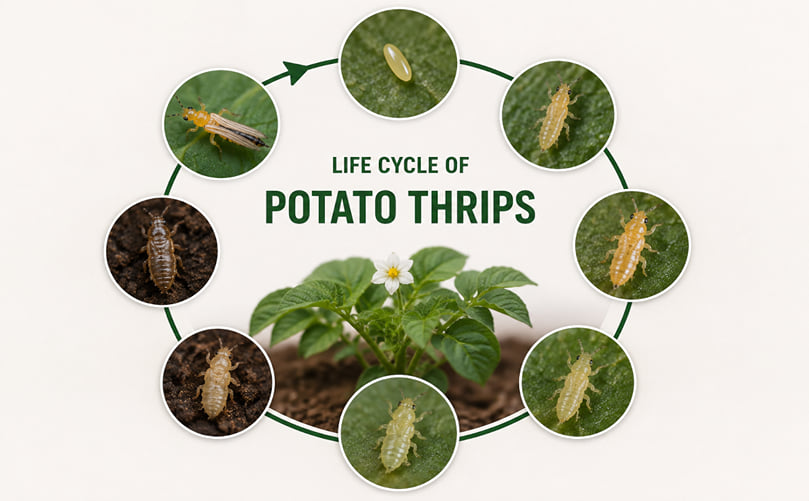
Potato Thrips: Egg to Adult Life Cycle
Alternative Hosts and Reservoir Plants of Potato Thrips
Potatoes are an important host for several thrips species, but most economically significant thrips are highly polyphagous and can survive and reproduce on hundreds of cultivated and wild plant species. This broad host range enables populations to persist throughout the year and readily move between crops as host availability changes.
Cultivated Crop Hosts: In addition to potatoes, thrips infest numerous economically important crops. Solanaceous hosts include tomato, pepper, eggplant, and tobacco, where adults and larvae feed on leaves, flowers and developing fruits. Onion thrips commonly infest onion, garlic and other Allium crops, while Common blossom thrips are frequently associated with cotton, legumes, cereals and various vegetable crops. Western flower thrips has an exceptionally wide host range, attacking vegetables, field crops, ornamentals and fruit crops.
Weeds as Reservoir Hosts: Many weed species serve as important alternative hosts allowing thrips populations to survive between cropping seasons and acting as reservoirs for both thrips and plant viruses. Common weed hosts include nightshades (Solanum spp.), pigweed (Amaranthus spp.), lambsquarters (Chenopodium spp.), dandelion (Taraxacum spp.), mallows (Malva spp.), chickweed (Stellaria media) and Galinsoga species. These weeds are particularly important around field margins, irrigation channels and greenhouse surroundings, where they support early season population build-up before thrips migrate into potato crops.
Host Preference and Seasonal Movement: Thrips preferentially colonize young, succulent plant tissues and flowers, where they obtain abundant nutrients for feeding and reproduction. Flowering ornamentals such as chrysanthemum and gerbera are highly attractive to F. occidentalis and can act as important population sources near potato production areas. Seasonal movement between cultivated crops, weeds and ornamental plants enables continuous population development and facilitates the spread of economically important plant viruses.
Symptoms and Damage Caused by Potato Thrips
Thrips damage potato plants by rasping the epidermal cells with their asymmetrical mouthparts and sucking out the cell contents. This feeding destroys chlorophyll containing cells, reducing photosynthesis and progressively affecting plant growth, tuber development, yield and quality. The severity of damage depends on the thrips species, infestation level, crop growth stage and environmental conditions, with warm, dry weather favoring rapid population growth.
Feeding Injury and Initial Symptoms: The earliest signs of thrips infestation appear on young, tender leaves as silvery or pale patches, fine streaks and tiny white speckles caused by the collapse of damaged epidermal cells. Irregular, shiny scars are often more evident on the undersides of leaves where thrips commonly feed. Small black fecal droplets (frass) are frequently found near feeding sites and help distinguish thrips damage from spider mite injury, which is typically accompanied by webbing. Early infestations are usually localized but become more widespread as thrips populations increase.
Progression of Plant Damage: As feeding continues, leaves develop bronze or reddish-brown discoloration, while the margins curl or cup inward. Young leaves and growing points become distorted or twisted, reducing normal plant development. In flowering potato crops, particularly seed potato production, flowers may become scarred, deformed or drop prematurely. Under severe infestations, necrotic brown or black lesions develop on leaves and stems, foliage yellows and dries prematurely, leaves shrivel, canopy development declines and plants become severely stunted. Feeding wounds may also provide entry points for secondary pathogens.
Effects on Plant Growth and Tuber Development: Continuous feeding reduces the effective leaf area available for photosynthesis, lowering chlorophyll content and carbohydrate production. Consequently, plants exhibit reduced vigor, slower vegetative growth, restricted canopy development and greater susceptibility to drought and other environmental stresses. Although thrips do not feed directly on potato tubers, reduced carbohydrate translocation limits tuber initiation and bulking, resulting in fewer tubers, smaller tubers, slower tuber growth and occasionally irregular tuber shape, particularly when infestations occur early in the growing season.
Impact on Yield and Tuber Quality: The economic impact of thrips depends on infestation intensity, environmental conditions and crop growth stage. Early season infestations generally cause the greatest losses because they suppress plant growth throughout the production cycle. Certain thrips species also transmit economically important plant viruses, further reducing productivity and seed quality. In addition to lowering total yield, thrips infestations reduce tuber dry matter accumulation, tuber uniformity and overall marketability. In seed potato production, virus transmission and poor tuber quality may affect certification standards, while in fresh market and processing potatoes, reduced tuber size and uneven yields decrease commercial value.
Virus Transmission by Potato Thrips
Thrips are important vectors of several economically significant plant viruses making virus transmission one of the most serious consequences of thrips infestations in potato production. Among the various species, Western flower thrips is one of the most efficient vectors of tospoviruses, particularly Tomato spotted wilt virus and Impatiens necrotic spot virus. However, vector efficiency varies considerably among thrips species and not all species transmit viruses with the same effectiveness.
Virus Acquisition and Transmission: Thrips acquire viruses only during their larval stages while feeding on infected plants. Virus acquisition can occur within approximately 30 minutes to several hours of feeding. After entering the insect, the virus replicates within the thrips and survives through the prepupal and pupal stages into adulthood. Adults that acquired the virus as larvae remain infectious throughout their lives and transmit the virus to healthy plants through their saliva during feeding. In contrast, adults that first feed on infected plants do not become effective virus vectors.
Monitoring and Scouting for Potato Thrips
Regular monitoring is essential for detecting thrips populations before economic damage occurs. An effective scouting program combines routine field inspections with sticky traps to monitor population trends and support timely management decisions.
Field Scouting: Inspect crops at least once each week, increasing scouting frequency during warm, dry weather and early crop growth stages when populations can increase rapidly. Examine the undersides of leaves, young shoots and flowers using a hand lens, as these are the preferred feeding sites for thrips. Gently tapping leaves over a white sheet of paper or tray helps dislodge adults and larvae for easier detection. During scouting, record both the number of thrips and the presence of feeding symptoms such as silvering, bronzing, leaf distortion and black fecal droplets.
Sticky Trap Monitoring: Blue sticky traps are highly attractive to many thrips species, including Frankliniella occidentalis, whereas yellow sticky traps capture a broader range of flying insects. Position traps slightly above the crop canopy in a representative grid throughout the field or greenhouse, using approximately one trap per 1,000 ft² (about 93 m²) with higher trap densities in high-risk areas. Inspect and replace traps weekly or every three to four days during periods of high thrips activity. Trap counts are useful for monitoring population trends and detecting migrations from surrounding weeds or neighboring crops although they should not be used as the sole measure of field infestation.
Sampling and Action Thresholds: Management decisions should combine sticky trap counts with direct plant inspections. Economic thresholds vary according to potato variety, crop growth stage, production system, local pest pressure and the risk of virus transmission. Seed potato crops generally require much lower thresholds because of their strict virus tolerance. As a general guideline, management is often initiated when trap catches reach approximately 5–15 adult thrips per trap per week although locally validated thresholds should always be followed. Integrating scouting data with weather conditions, historical pest records and the presence of nearby host plants improve the accuracy of treatment decisions.
Integrated Pest Management (IPM) for Potato Thrips
Integrated Pest Management (IPM) is the most effective and sustainable approach for managing potato thrips. It combines preventive, biological, mechanical and chemical strategies to maintain thrips populations below economic thresholds while reducing pesticide use, delaying insecticide resistance, conserving beneficial organisms and minimizing environmental impacts.
Cultural Control: Cultural practices form the foundation of IPM by reducing pest establishment and limiting population growth. Effective weed management eliminates alternative hosts and virus reservoirs such as nightshades (Solanum spp.), pigweed (Amaranthus spp.), lambsquarters (Chenopodium spp.) and mallows (Malva spp.). Crop rotation with non-host crops helps interrupt the thrips life cycle, while sanitation practices including the removal of crop residues, volunteer plants and heavily infested plant material reduce overwintering sites.
Maintaining adequate soil moisture through proper irrigation reduces plant stress making potato plants less susceptible to severe thrips damage. Where appropriate, reflective mulches, such as silver or UV-reflective films, discourage thrips from landing on plants and have been shown to reduce infestations in several cropping systems. When available, selecting potato varieties with lower susceptibility or tolerance to thrips feeding can further reduce crop losses.
Biological Control: Numerous natural enemies contribute to suppressing thrips populations. Important predators include minute pirate bugs (Orius spp.), predatory mites such as Amblyseius cucumeris and Neoseiulus barkeri, lacewings, lady beetles and rove beetles. Biological control can be enhanced through conservation practices that preserve these beneficial organisms within the production system.
Microbial biological control agents also play an important role. Entomopathogenic fungi such as Beauveria bassiana and Metarhizium brunneum infect and kill thrips, while beneficial nematodes such as Steinernema feltiae are particularly effective against soil dwelling stages under greenhouse and protected cultivation. Early introduction of biological control agents generally provides the best long-term suppression.
Mechanical and Physical Control: Mechanical methods provide additional support within an IPM program. Reflective mulches reduce adult colonization, while insect proof netting or floating row covers help prevent thrips from reaching young crops where practical. In greenhouse and small-scale production systems, vacuum removal may reduce adult populations. Trap crops and border plantings can also divert thrips away from the main potato crop, reducing infestation pressure.
Integrated IPM Strategy: Successful IPM depends on combining preventive cultural practices, biological control, physical barriers and carefully timed interventions based on regular crop monitoring. This integrated approach suppresses thrips populations, reduces virus transmission, delays insecticide resistance and promotes long-term sustainable potato production.
Chemical Control of Potato Thrips
Chemical control should be used only when monitoring indicates that thrips populations have reached economically damaging levels. Insecticides are most effective when integrated with other IPM practices rather than used as a standalone management strategy.
Spinosyns (IRAC Group 5), including spinosad and spinetoram, provide excellent control of larval stages and possess translaminar activity that improves control of concealed thrips.
Diamides (IRAC Group 28), such as cyantraniliprole, provide effective control of several sucking and chewing insect pests, including thrips.
Pyrethroids (IRAC Group 3A), including lambda-cyhalothrin, provide rapid knockdown of adult thrips but are less reliable in areas where resistance has developed.
Neonicotinoids (IRAC Group 4A), including imidacloprid, thiamethoxam and dinotefuran, provide systemic protection but should be used carefully because of resistance concerns and potential impacts on pollinators.
Insect Growth Regulators (IGRs), including novaluron, interfere with insect development by disrupting molting and are most effective against immature stages.
Additional options include Avermectins (IRAC Group 6) such as abamectin, Ketoenols (IRAC Group 23) such as spirotetramat and selected microbial insecticides and biopesticides where registered.
Resistance Management: Thrips have a well-documented ability to develop insecticide resistance. To preserve product effectiveness, insecticides with different IRAC modes of action should be rotated throughout the season, avoiding consecutive applications of products from the same group. Integrating chemical control with biological control and cultural practices further reduces resistance selection pressure.
Application Best Practices: Successful chemical control depends on thorough spray coverage, particularly on the undersides of leaves where thrips commonly feed. Applications should target the most susceptible larval stages whenever possible, using recommended label rates, spray volumes, pre-harvest intervals (PHI) and resistance management guidelines. Regular evaluation of treatment performance helps identify declining efficacy and supports timely adjustments to management programs.
Thrips Management in Greenhouse Potatoes
Greenhouse conditions favor rapid thrips development because of warm temperatures and continuous cropping. However, they also allow more precise pest management through integrated control strategies.
Climate Control: Maintain slightly higher humidity, as thrips prefer dry conditions and ensure good ventilation without creating entry points for insects.
Biological Control: Biological control is highly effective in greenhouse production. Common natural enemies include predatory mites (Amblyseius cucumeris and Neoseiulus barkeri), minute pirate bugs (Orius spp.), entomopathogenic fungi (Beauveria bassiana) and beneficial nematodes (Steinernema feltiae). Preventive releases along with banker plants or habitat plants, improve long-term control.
Monitoring: Use blue sticky traps at multiple locations and canopy heights for early detection and population monitoring. Regular inspections help identify infestations before they become established.
Screening and Exclusion: Install fine mesh screens on greenhouse vents and doors to prevent thrips entry. Carefully inspect incoming planting material and treat it, when necessary, such as with horticultural oils or Beauveria products.
Sanitation: Maintain strict sanitation by removing crop debris, weeds, volunteer plants and heavily infested material. Clean and disinfect the greenhouse between production cycles to reduce carryover populations.
Chemical Control: Use insecticides only as a backup when necessary. Select products compatible with biological control agents, rotate insecticides with different modes of action to delay resistance and target soil dwelling pupal stages with soil drenches where appropriate.
Integrated Greenhouse Management: Combining biological control, sticky traps, sanitation, exclusion measures and targeted chemical applications provides effective thrips management while minimizing pesticide use.
Climate Change and Potato Thrips
Climate change is expected to increase the importance of thrips as potato pests by creating environmental conditions that favor their survival, reproduction and spread. Warmer winters improve overwintering survival, while longer growing seasons allow more generations to develop each year. Rising temperatures also enable thrips to expand into higher latitudes and elevations where they were previously less common.
Effects of Climate Change: Higher temperatures and prolonged dry conditions accelerate thrips development and population growth. Drought stressed potato plants become more susceptible to feeding damage, while changing rainfall patterns and extreme weather events can influence pest outbreaks. Increased thrips activity may also elevate the risk of virus transmission, particularly in regions where virus vector species are established.
Adaptation Strategies: Adapting to climate change requires strengthening integrated pest management through improved monitoring, predictive forecasting models, resilient potato varieties and diversified pest management strategies. These approaches help reduce the impact of changing climatic conditions while maintaining sustainable potato production.
Recent Research and Innovations in Potato Thrips Management
Recent advances in research and technology are improving the precision and sustainability of potato thrips management by reducing reliance on conventional insecticides and supporting earlier pest detection.
RNA Interference (RNAi) Technology: RNA interference (RNAi)-based pesticides use double-stranded RNA (dsRNA) to silence essential genes in target insects. Although this technology is still under development for thrips management, it offers the potential for highly specific control with minimal effects on beneficial organisms and the surrounding environment.
Precision Agriculture and Artificial Intelligence: Precision agriculture combines drones, multispectral imaging, artificial intelligence (AI) and machine learning to detect early thrips infestations, map pest populations, predict outbreaks and support targeted pesticide applications based on environmental and field data.
Smart Monitoring Systems: Internet of Things (IoT) enabled smart traps automatically monitor thrips populations and transmit real-time data for rapid decision making. AI-assisted image analysis further improves the accuracy and efficiency of pest monitoring.
Biological Control Innovations: Improved microbial insecticides, including enhanced formulations of beneficial fungi together with semiochemical-based push-pull strategies using attractants and repellents are expanding environmentally friendly options for thrips management.
Emerging Technologies: Additional innovations include improved pesticide formulations for better spray coverage, gene editing technologies to develop thrips resistant potato varieties and integrated Decision Support Systems (DSS) that combine monitoring, weather and pest data to optimize management decisions.
Future Outlook: These emerging technologies are expected to support more sustainable, data driven potato thrips management by improving pest detection, reducing insecticide use, delaying resistance development and strengthening adaptation to climate change.