
California’s expanding sweet potato sector is seeing rising interest in purple and specialty varieties, driven by ongoing research, new breeding collaborations, and growing consumer demand.
California Sweet Potato Industry Sees Rising Interest in Purple Varieties Amid Market Challenges

Alongside a roasted turkey and stuffing, a traditional Thanksgiving meal in the United States usually includes sweet potatoes glazed with butter and brown sugar and topped with toasted mini marshmallows. While most sweet potatoes are yellow or orange, purple sweet potatoes are starting to add a touch of royal color to the holiday dining table.
There is growing interest in purple sweet potatoes among both growers and consumers, particularly in California, where the crop is being tested and expanded for fresh market sales and specialty uses.
Scott Stoddard, University of California Cooperative Extension farm advisor in Merced County:
"There is a lot of interest in the purple sweet potato. It is creating buzz, something new to talk about."
(Click picture to watch video)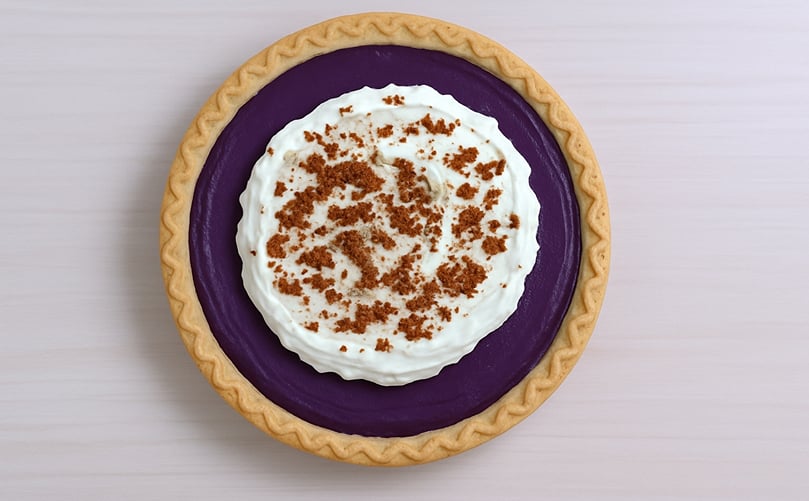
Make the season bright with the purple sweet potato
When West Coast consumers go to a grocery store to buy sweet potatoes for Thanksgiving, many will be choosing roots grown from clones of mother plants propagated at UC Davis Foundation Plant Services and selected in field trials led by Stoddard. These selections aim to combine distinctive color, attractive appearance and acceptable yield for commercial growers.
Stoked for Stokes and other purple varieties
Five years ago, only a handful of growers were experimenting with purple sweet potatoes in California. Today, an estimated 1,000 acres of purple sweet potatoes are in the ground across the state.
Stoddard estimates that at least six purple varieties are currently being grown. However, growers tend to be cautious about sharing their exact selections as they look to capitalize on unique traits and market differentiation.
Scott Stoddard:
"Right now, it is the wild, Wild West. Nobody will tell you what they are growing. It is like, 'my purple is better than your purple.'"
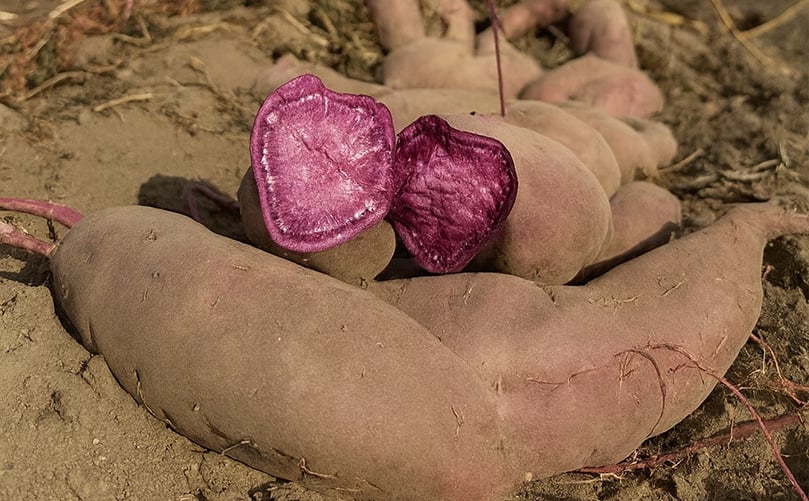
Regal Purple from South Carolina
Two purple-skinned varieties with purple flesh, Stokes Purple and Ben Yagi, are owned by A.V. Thomas Produce Company. Another is a promising, unpatented experimental line that Stoddard refers to as Purple Rayne. Additional experimental varieties include Purple Majesty, Purple Splendor and Regal Purple, each with different characteristics in terms of color, shape and eating quality.
Farmers in Hawaii also grow Okinawan, a sweet potato with white skin and purple flesh, but in California the variety has not yielded well enough to be economically sustainable under local conditions.
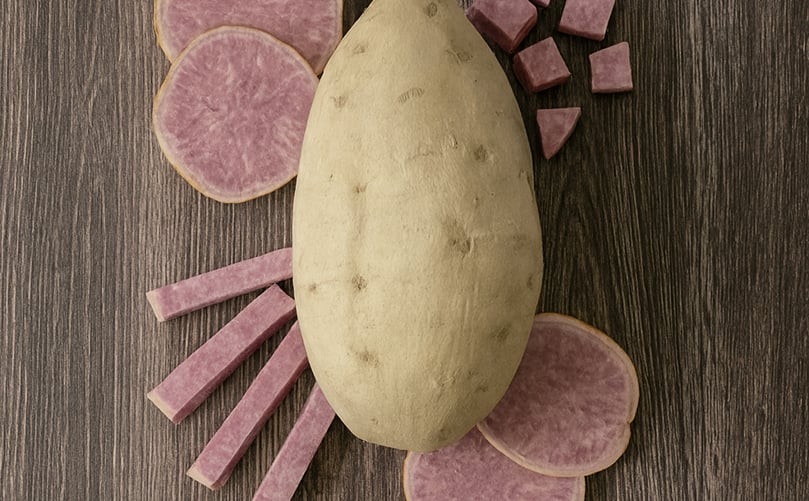
Okinawan
Scott Stoddard:
"The purple/purple trend, with varieties that have purple skin and purple flesh, started with Stokes."
Educating retailers and consumers on cooking purple varieties
Introducing these unusually colored sweet potatoes required education and patience at the retail level. Cooking time and texture differ from conventional orange-fleshed varieties, which can surprise consumers who are unfamiliar with the new types.
Jeremy Fookes, Director of Sales, A.V. Thomas Produce Company:
"The first couple of years were a challenge. Stokes has to be cooked longer in order to make it moister inside, otherwise it can be chalky or pasty if you do not cook it long enough."
To support sales and marketing, A.V. Thomas Produce Company partnered with Frieda's Specialty Produce in Anaheim, a company recognized for promoting distinctive and specialty fruits and vegetables in the U.S. market.
In 2023, the Netflix documentary "Live to 100: Secrets of the Blue Zones" highlighted purple sweet potatoes, particularly for their content of anthocyanins, a phytonutrient associated with potential health benefits. The exposure helped raise consumer awareness of purple sweet potatoes as a colorful and nutrient-dense option.
Jeremy Fookes:
"After that documentary, requests for our purple sweet potatoes really took off."
A.V. Thomas Produce Company now grows more than 500 acres of Stokes Purple organically in California. The premium variety is sold through major supermarket chains and independent retailers across the United States and is also exported to markets in the Middle East.
Sweet potato industry slumps after the pandemic
California sweet potato growers, who account for around 25% of U.S. sweet potato production, have faced a challenging period since the COVID-19 pandemic. Changes in foodservice demand and shifting consumer habits created uncertainty, even as production costs continued to rise.
In California, approximately 85% of sweet potatoes are sold on the fresh market, with the remainder directed to processing for French fries, baby food and other products.
Scott Stoddard:
"We thought sweet potato fries would take off. It was ramping up, then quit and flatlined."
At the same time, growers have had to contend with higher input costs for labor, fertilizer and compliance with new regulations. Sweet potatoes are a labor-intensive crop that requires careful handling from field to packinghouse.
Scott Stoddard:
"Every sweet potato is touched by a hand. Sweet potatoes are dug out by a machine harvester, but individually placed by hand into bins. Later, those bins are brought out of storage, then packed by hand into a box that goes to the store."
Most California sweet potatoes are produced in Merced, Stanislaus and Kern counties. Over the last five years, acreage in the state has decreased from more than 21,000 acres to about 18,000 acres as some growers shifted to other crops. Four sweet potato packing sheds have closed during that period.
Decades-long quest for improved sweet potato varieties
California growers see opportunity in improved varieties with better storage, disease resistance and differentiation on the market. Stoddard has devoted much of his career to evaluating and identifying such lines.
When he joined UC Agriculture and Natural Resources in 2002 as a vegetable crops advisor for Merced County, Stoddard surveyed local growers about their priorities. One of the top requests was to find a replacement for the widely grown red variety Diane.
Scott Stoddard:
"Diane yields well, but it is susceptible to root knot nematodes and does not store well."
Stoddard spent years evaluating new red-skinned candidates. Burgundy, released in 2014, initially appeared promising in field trials, but performance in commercial operations fell short of expectations.
Scott Stoddard:
"It was not successful as it did not yield for anybody even though my field plot data said otherwise."
In 2021, another red-skinned variety with bright orange flesh, Vermillion, was released as an alternative to Diane. Vermillion is now planted on an estimated 10% to 15% of California sweet potato acreage.
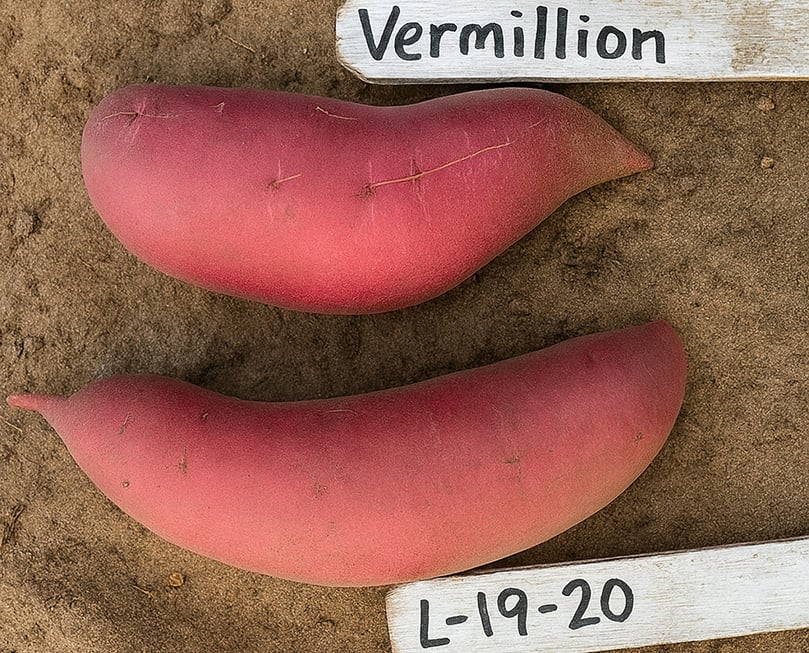
Color comparison of Vermillion, top, to a new experimental variety L-19-20
Scott Stoddard:
"Some growers really like it because it stores well. If you have a good storing variety, it pays dividends in June. But some have problems getting it to yield so they do not like it. So my quest continues."
Collaboration with LSU breeder expands variety options
Because California does not have its own sweet potato breeding program, Stoddard collaborates closely with Louisiana State University professor and sweet potato breeder Don La Bonte. Each year, La Bonte sends about 30 promising lines from the LSU program to California for evaluation under local conditions.
Scott Stoddard:
"Four of the six most important commercial sweet potato varieties grown in California started with the LSU breeding program. I stick them in the ground in May and see what comes out."
Stoddard and cooperating growers test about 40 new lines annually, narrowing them down based on shape, color, flavor, yield potential and storage performance. Only three to five lines typically advance to a second year of trials.
One of the most successful examples of this collaboration is Bellevue, an orange-skinned, orange-fleshed variety first created in 2006 and formally released in 2015. Bellevue now represents roughly 15% of California sweet potato acreage and is known for its bright color, good yields and resistance to root knot nematodes.
However, Bellevue is sensitive to harvest conditions. Stoddard’s research has shown that harvesting in cold conditions can cause cracking, reducing pack-out and marketability. He advises growers to harvest Bellevue before mid-October and in the warmer afternoon hours whenever possible.
In addition to California, Bellevue is grown in Canada, the Netherlands, Portugal, Spain, Egypt, Australia and New Zealand, reflecting its adaptability and international appeal.
Diversifying beyond orange-fleshed varieties
Bellevue, Vermillion and Diane together account for about two-thirds of sweet potato production in California. Other important varieties include Murasaki and Bonita, both with white flesh and distinct eating qualities.

Murasaki
At the same time, Stoddard believes that purple-fleshed varieties offer an important opportunity to differentiate California production from other regions.
Scott Stoddard:
"We are moving away from orange flesh varieties. We are not growing varieties that others can grow."
California has also built a strong niche in organic sweet potato production. Climate and pest conditions in the state allow growers to produce organic sweet potatoes more consistently than some competing regions.
Scott Stoddard:
"We are about the only production area that can grow organics profitably. We frequently do not have to use insecticides in California."
Many growers rely on dry fallowing — leaving fields unplanted in alternate years — to suppress nematodes, grubs and other soil-borne pests rather than using chemical controls.
Getting the best flavor from sweet potatoes
When cooking yellow or orange sweet potatoes, Stoddard recommends baking them for about one hour at 375°F (190°C) to caramelize the natural sugars and bring out their full flavor and sweetness. Purple varieties, especially Stokes Purple, require a different approach in the kitchen.
Jeremy Fookes:
"While Ben Yagi Purples cook like other moist flesh varieties, the Stokes Purple sweet potato should be cooked low and slow. You only get caramelization through the low heat, slow baking process, whether it is foil-wrapped on a barbecue or in a pan in the oven."
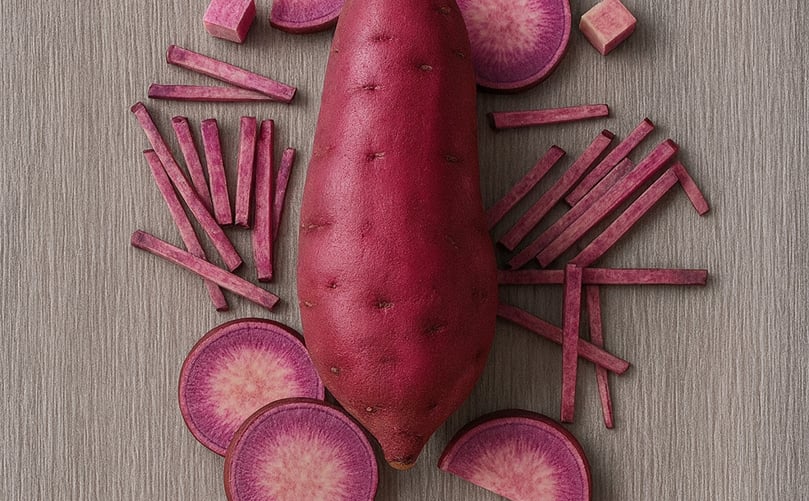
Ben Yagi
Fookes typically bakes Stokes Purple for 90 minutes to two hours at 250–275°F (120–135°C) and does not recommend microwaving sweet potatoes, as the faster cooking process does not develop the same depth of flavor.
With renewed interest from consumers, attractive new varieties and strong research partnerships, purple sweet potatoes and other specialty types may help California growers write the next chapter in the state’s sweet potato story.
¿Te gustaría recibir noticias como esta por correo electrónico? ¡Únete y suscríbete!
Get the latest potato industry news straight to your WhatsApp. Join the PotatoPro WhatsApp Community!
Empresa Destacada

Noticias relacionadas

Septiembre 28, 2026
México: menor oferta de papa podría impulsar los precios durante el invierno
En México, el cierre de cosechas, los menores rendimientos y la reducción de la superficie sembrada podrían restringir la oferta de papa y generar presión al alza sobre los precios entre diciembre de 2026 y febrero de 2027.

Septiembre 28, 2026
España: la sequía reduce la cosecha de patatas en 2026
La producción española de patata caerá entre un 8% y un 10% en 2026, hasta unos 1,8 millones de toneladas, con descensos de hasta 35% en Andalucía debido principalmente a la sequía y los menores rendimientos.

Septiembre 23, 2026
Chile: buscan mejorar el diagnóstico molecular de la sarna polvorienta y la sarna común en papa
En Chile, el proyecto SCAB-ID 2.0 busca validar un sistema de qPCR multiplex capaz de detectar y diferenciar simultáneamente la sarna polvorienta y la sarna común de la papa, con miras a transferirlo a laboratorios de diagnóstico agrícola.