
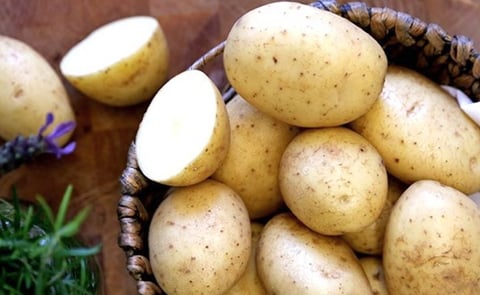
Industry leaders debate the future of Maris Piper at the British Potato Industry Event, weighing declining retail share and quality concerns against the variety’s resilience, low seed costs and continued grower support.
Future of Maris Piper under the spotlight during GB Potatoes industry debate

Maris Piper future debated at British Potato Industry Event. "Maris Piper has had its day; or has it?" That was the provocative title of a GB Potatoes debate at the British Potato Industry Event, where industry leaders discussed whether the long-standing variety still has a place in modern potato production.
Case against Maris Piper
Arguing that the stalwart’s days are numbered was Katy Pook, Head of Brand & Marketing at Greenvale. She noted the variety’s near 70-year history and explained it was originally bred to resist the most common type of Potato Cyst Nematode (PCN).
Katy Pook, Head of Brand & Marketing at Greenvale:
"It would be fair to say that the food and farming industry looked a little different then than it does now."
She added that the sector has evolved significantly, shifting from thousands of small multi-crop growers supplying local markets to today’s national distribution networks and highly industrialised supply chains.
Katy Pook:
"When Maris Piper arrived in the market in 1966, the variety Majestic accounted for 60% of the market, but its vulnerabilities to pests and disease and the rise of newer varieties led to its demise – does not that sound familiar?"
Although Maris Piper became popular due to reliable yields, PCN resistance and versatility, she argued that modern pressures are exposing its weaknesses.
Katy Pook:
"The sector is more industrialised, there are bigger and more complicated machines, greater pressure from pests and diseases with fewer chemical control options and more volatile weather against a background of greater assurance demands."
At the start of the 2000s, Maris Piper accounted for almost a quarter of the UK potato area. Today it represents around 10%, while its fresh retail volume share has declined from 19.5% to 16.5% over the past four years.
Katy Pook:
"Importantly, consumers complain of poor quality, bruising and too much waste at certain times of the year. From March to July Maris Piper’s complaint share is typically 40% of all complaints received – around double its share of units."
Research from Greenvale also suggested most shoppers would switch varieties if Piper was unavailable.
Katy Pook:
"Ninety-three percent of consumers who buy Maris Piper would simply buy other varieties if it was not available on the shelves."
Defence of the variety
Defending Maris Piper was Gordon Stark, Director at Taygrow, who argued the variety still plays a critical role in the market.
Gordon Stark, Director at Taygrow:
"Maris Piper has seen off lots of different varieties. It has navigated its way through the chipping market, the packing market and even grown as a salad at one time. It was bred for PCN resistance, specifically rostochiensis. Now there has been an increase in pallida over the years."
He said breeding progress would address pallida while Piper could remain part of resistance strategies against rostochiensis.
Gordon Stark
"With the development of new varieties, pallida will be looked after and you will see an increase in rostochiensis and Piper will be part of the resistance armoury to that strain."
Between 500,000 and 700,000 tonnes are still grown annually, with approximately 60 million tonnes produced over the last 60 years.
Gordon Stark:
"You look at Piper, it is cheap to plant, you can get any market for it, it has never had a penny of royalties paid on it, and seed rates can be low compared to very high seed costs for other varieties."
He also highlighted strong consumer recognition, with chefs including Delia Smith, Jamie Oliver, the Hairy Bikers and Nigella Lawson regularly recommending the variety.
Although climate change has made production more challenging in England, he noted increased growing in Scotland.
Gordon Stark:
"So it is great for us that you guys cannot grow it anymore. Do not keep growing if you cannot grow it. Do not get ambition and ability mixed up."
Vote outcome
The audience discussed blight resistance, genetic engineering of new varieties, and eating quality comparisons before voting on the motion.
Alex Godfrey, Chair of GB Potatoes:
"I believe those who think Maris Piper has had its day may just have the edge, but it is a narrow victory and I do not doubt the debate will rumble on."
The close result suggested that while the variety’s dominance may be declining, strong support for Maris Piper remains across the industry.
Like to receive news like this by email? Join and Subscribe!
Get the latest potato industry news straight to your WhatsApp. Join the PotatoPro WhatsApp Community!
Highlighted Company

Related News

October 06, 2026
Dutch Potato Organisation Celebrated Potato Tuesday at Utrecht Central Station on October 6
The Dutch Potato Organisation celebrated Potato Tuesday on October 6 at Utrecht Central Station during the Week of Our Food. Visitors can enjoy free recipe booklets and discover the people behind the Dutch potato industry.

October 05, 2026
Punjab Agricultural University Introduces Four Potato Varieties for Higher Yield and Disease Resistance
PAU Ludhiana has released four potato varieties—PP-101, PP-102, PP-103 and PP-104. Yields range from 142–184 quintals/acre, with PP-103 offering early harvest and PP-104 moderate late-blight resistance. Seed is now available.

October 05, 2026
Idaho Potato Harvest Shows Solid Quality but Lower Yields in 2026
Idaho’s 2026 potato harvest is showing solid quality but lower yields, with frost, heat, warm nights and wildfire smoke affecting production. Planted area fell to 298,915 acres as growers report smaller crops.