
News on Zebra Chip disease from the United States

Sponsor of the month (Learn more)
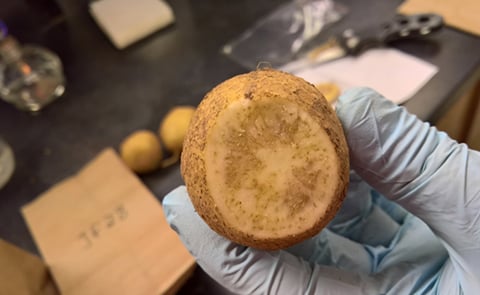
The dark stripes on infected potatoes mark zebra chip disease. It has led to significant economic losses for producers due to reduced crop quality and marketability.
December 15, 2024
AgriLife Research leads collaboration to address zebra chip disease
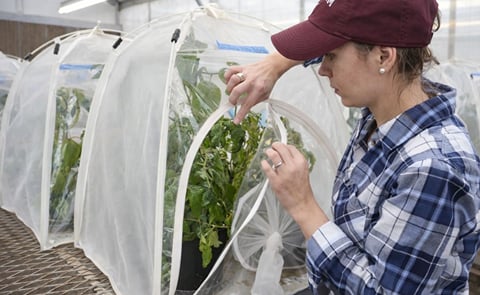
Texas A&M AgriLife Research scientists are working on a new research project to fight plant diseases transmitted by psyllid insects — particularly the zebra chip disease, which has impacted potato production for decades.
Named after the dark stripes that form inside potatoes after they are cut and fried, zebra chip disease is a potentially devastating affliction that can result in yield losses up to 100% for farmers (Courtesy: K. D. Swisher Grimm and S. F. Garczynski)
April 20, 2019
New type of zebra chip disease discovered in potato fields of Oregon
ARS Researchers studied potato tubers from the Klamath Basin in Oregon infected with the causal bacteria of zebra chip disease. They confirmed the presence of the pathogen but did not identify the sample as one of the six known varieties (haplotypes).
Aerial view of a potato field near Rexburg, Idaho. Growers in Idaho say the crop is on track and look forward to warm weather in the weeks ahead.
July 09, 2018
Idaho potato crop on track despite early cool weather
Idaho potato fields looked good as of early July as plants closed in over rows, signaling the tubers are preparing to grow strongly amid the hot-day, cool-night march toward harvest.
From the archive
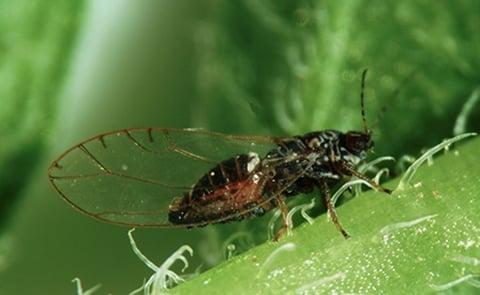
An adult potato psyllid, the insect responsible for the spread of Zebra Chip disease (Candidatus Liberibacter solanacearum) in potatoes
(Courtesy: Don Henne, Texas A&M AgriLife Research)
July 03, 2017
University of Idaho reports light potato psyllid pressure
Pressure from the tiny, winged insects that spread zebra chip disease in potatoes has been light in Idaho this season, emboldening some Idaho farmers to scale back on their pesticide programs.
From the archive
A potato infected with zebra chip presents with dark brown rings that are not harmful to humans, but do cause market losses.
(Texas A&M AgriLife photo by Dr. Fekede Workneh)
April 23, 2017
Variety screening reveals potatoes with resistance to zebrachip disease
The Texas A&M AgriLife Research plant pathology team intentionally infected potato plants with psyllids positive with the bacterium that causes zebra chip disease, in order to identify promising germplasm in the battle against the disease plaguing the US potato industry for the past 15 years.
From the archive
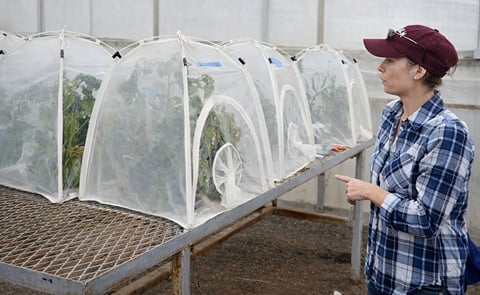
Dr. Ada Szczepaniec discusses her greenhouse study on potato psyllid resistance to neonicotinoid insecticides.
April 02, 2017
Neonicotinoid insecticides losing efficiency in potato psyllid control
The potato industry may be losing a mainstay in the battle against psyllids, according to a recent Texas A&M AgriLife Research study.
From the archive
Sponsored Content
Sponsored Content
Sponsored Content
Adult Potato Psyllid (Bactericera (paratrioza) cockerelli) (Courtesy: Gary McDonald)
August 11, 2016
Potato Psyllid Alert for North Dakota
Potato psyllids have been reported in specific fields in western and central North Dakota. At this point populations are not widespread.
From the archive
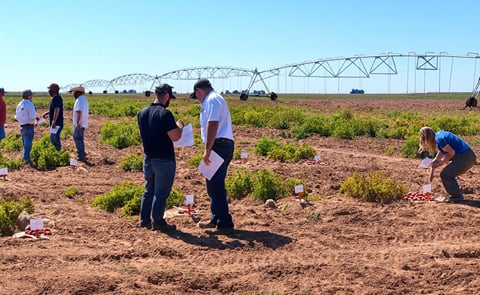
Participants at the 25th annual Texas Potato Breeding and Variety Development Program field day learned that the harvest is underway, that psyllids are threatening unharvested fields and that new varieties are showing lots of promise.(Courtesy: Texas A&
August 01, 2016
Harvest, psyllids & new varieties the hot topics at Texas potato field day
Participants at the 25th annual Texas Potato Breeding and Variety Development Program field day learned that the harvest is underway, that psyllids are threatening unharvested fields and that new varieties are showing lots of promise.
From the archive
Dr. Ada Szczepaniec, Texas A&M AgriLife Research entomologist, examines psyllid activity. (Courtesy: Texas A&M AgriLife Communications photo by Kay Ledbetter)
April 25, 2016
Growing Insecticide Resistance of Potato Psyllids investigated at AgriLife Research
Entomologist Ada Szczepaniec at Texas A&M AgriLife Research is addressing the concern of growing resistance of potato psyllids to the neonicotinoid classification of insecticides.
From the archive
Potato Psyllids in Pacific Northwest declining
January 31, 2015
Potato Psyllids in Pacific Northwest declining
Levels of zebra chip, a crop disease in potatoes spread by potato psyllids and caused by the Liberibacter bacterium, were down signficiantly in the Pacific Northwest.
From the archive
ARS: Potato Psyllids dissected for clues to better controlling it
May 01, 2014
ARS: Potato Psyllids dissected for clues to better controlling it
Researchers at USDA's Agricultural Research Service are leaving no stone unturned when it comes to finding new ways of managing zebra chip disease and the insect that can spread it to potato crops.
From the archive
Potato Psyllid Trapping and Management - Focus on Potato webcast
August 21, 2013
Potato Psyllid Trapping and Management - Focus on Potato webcast
This webcast by the Plant Management Network on Potato Psyllids, responsible for the transfer of the Zebra chip disease consists of two parts:
From the archive
Sponsored Content

Current Selection 41 items. Refine:

You May Also Like

Potato Psyllid
August 07, 2013
Potato psyllids in Pacific North West show far less zebra chip disease this year
About the same number of potato psyllids have been caught on sticky traps in Idaho fields this season as by this time last summer, but far fewer of the tiny, winged insects have tested positive for the Liberibacter bacterium, which causes the crop dise...
From the archive
Research: Infected volunteer potato plants unlikely to spread zebra chip disease
June 05, 2013
Research: Infected volunteer potato plants unlikely to spread zebra chip disease
Volunteer potato plants growing from seed infected with zebra chip are likely too few in number and survive too briefly to contribute to the spread of the crop disease, according to new Oregon State University research findings.
From the archive
Potato Psyllids Have Returned to Magic Valley
April 22, 2013
Potato Psyllids Have Returned to Magic Valley
Potato Psyllids Have Returned to Magic Valley, Idaho Or maybe they just never went away. Psyllids, a tiny insect that can damage potatoes, might be hardier than some people originally thought.
From the archive
Potato Psyllid
March 15, 2013
Potato Psyllids shown to survive harsh Idaho winter, heightening zebra chip concerns
It appears that potato psyllids, the tiny winged insects that can spread zebra chip disease in potato fields, will overwinter in Boise, Idaho, this season, despite the city experiencing one of its coldest Januaries on record.
From the archive
Idaho potato growers accept slight price cut in processing contracts
March 05, 2013
Idaho Potato growers approve contracts with Simplot, McCain
Idaho potato growers at a Monday meeting in Burley approved processing contracts with J.R. Simplot and McCain Foods that both include payment increases averaging 1.6 percent.
From the archive
Idaho potato growers accept slight price cut in processing contracts
February 27, 2013
Idaho Potato Growers to vote on McCain, Simplot contracts
Idaho potato growers will vote Monday in Burley on contracts with McCain Foods and J.R. Simplot Co. paying a 1.6 percent average increase, according to sources involved in negotiations.
From the archive

Frequently Asked Questions

Will PotatoPro edit my article?

Yes. We edit almost all submitted articles for style and layout. If you notice a change you are not happy with, contact us and we will find a solution. If you submit news before its official publication date, you can review the item privately before it goes live.

How can I get more visibility for my company’s news?

Besides free news publishing, companies can list in the PotatoPro directories, become PotatoPro sponsors, or use targeted email blasts, the Event Promotion Package and social media exposure with analytics. Find out why companies advertise on PotatoPro.

Does PotatoPro delete old news? Can I add older news?

No, we do not delete old news. News on PotatoPro goes back to 2006, and we consider it a valuable historical record of developments in the industry. If we missed a key development in the history of your company, we can still add it.

What can I do after my news is published?

Share the article with your colleagues and on the social media channels where you are active, and add it to the “Company in the news” section of your website if you have one. You are also welcome to point other media to the PotatoPro article, as long as they include a clickable link to the item on PotatoPro.

I have created an account, but I am not receiving the newsletters. What should I do?

Log in to your profile and check that you have opted in to the newsletters you would like to receive. Also check your spam or promotions folder and make sure you registered with the right email address. If you still do not receive them, contact us at info@potatopro.com. For sign-in or password issues, see the PotatoPro Login & Account FAQs.

Is reading news on PotatoPro free?

Yes. All news articles on the PotatoPro website are free to read. The PotatoPro app is also free but requires a free PotatoPro account, which also works on PotatoPro AI.

Where is PotatoPro news published and how can I follow it?

News appears on the PotatoPro News page and in the PotatoPro weekly newsletter, which you can receive by creating a free PotatoPro account. It is also available in the PotatoPro app for iPhone and iPad and Android, and shared on LinkedIn, Facebook, Instagram, X, YouTube, Telegram and Bluesky.

My company is not in the PotatoPro directory. Can I still submit news?

Yes. Companies that are not yet listed can still submit news, and they are also welcome to contact PotatoPro to be added to the Company Directory.

In what languages can I submit news?

You can submit news in any language. PotatoPro publishes in English, Spanish, Dutch and Simplified Chinese, and plans to add German, French, Arabic, Hindi and Portuguese in 2027.

How long does it take for news to be published?

It depends on the timing of the news, the editorial workload and how much editing the article needs. News from PotatoPro sponsors may be given priority.

When should I submit my news?

As soon as possible, and ideally on the day the news becomes public, even if it is only a link to material published elsewhere. Extra material such as videos or illustrations can be added later. You can also send news before it is public, as long as you clearly state the embargo date and time, including the time zone.

Can I include links in my news article?

You can include one dofollow link to an external source in the body of the text. Links to your brands, your company profile, previous news and other content about your company on PotatoPro are mostly added automatically.

Can I include a video in my news article?

Yes. We can embed videos hosted on YouTube or Vimeo. For best results, use HD quality or better, include sound, and keep the video professionally edited, ideally 1.5 to 3 minutes long.

What images should I send with my news?

Every news item on PotatoPro must have an illustration at the top, which is also used in article summaries and social media posts. The best top images are closely related to the story, eye-catching and colorful, in landscape format and at least 1,200 pixels wide. Avoid logos, pictures with a prominent logo and images with a lot of text, because Google and Facebook may not display them. Send high-resolution JPG or PNG files that you own or have permission to use, each with a caption and photo credit, and mention if an image was made using AI. Extra images for the body of the article are welcome.

What are the guidelines for writing a news article?

There is no maximum length, but we recommend more than 300 words, and we do not accept articles of fewer than 200 words. An article cannot consist only of a list; it needs paragraphs of text. Provide factual, useful information, keep sentences short, and write in the third person or include quotes attributed to a named person. Self-praise full of superlatives is unlikely to be published without heavy editing. Keep abbreviations to a minimum, and if English is not your first language, we recommend having your text reviewed by a native English speaker.

What type of news does PotatoPro accept?

PotatoPro accepts industry and company news, product launches, new facilities, appointments, technology and research updates, and other developments in the potato and savory snack industries. Submissions should give industry professionals useful information rather than being purely promotional.

How can I submit news to PotatoPro?

Email your article, press release or company announcement to news@potatopro.com. Send the text in a Word or Google document, or in the body of the email, and attach images separately. We may also pick up stories shared on X that tag @PotatoPro.

Is it free to publish news on PotatoPro?

Yes. News about the potato and snack industries is published free of charge if we consider it relevant. All submissions are subject to editorial review and will be edited for style and layout.

Filters

Refine By Topics
Refine By Regions
Refine By Year
Language preferences