
Changing weather patterns linked to El Niño could impact potato yields, quality, storage, and supply chains across key production regions.
NOAA Confirms El Niño as Global Potato Industry Prepares for Weather Risks

The global potato industry is closely monitoring the emergence of El Niño conditions after the U.S. National Oceanic and Atmospheric Administration (NOAA) confirmed that El Niño has developed in the tropical Pacific and is expected to strengthen during the second half of 2026.
According to NOAA's latest ENSO Diagnostic Discussion, El Niño conditions are likely to persist through the Northern Hemisphere winter of 2026–27. The phenomenon, which originates from warmer-than-average sea surface temperatures in the central and eastern equatorial Pacific Ocean, is one of the world's most closely watched climate patterns because of its ability to influence weather conditions across multiple continents.

The global potato industry is closely monitoring the development of El Niño, which NOAA expects to strengthen during the second half of 2026.
For the potato sector, the development comes at a time when climate resilience is becoming increasingly important. Potatoes are grown in more than 150 countries and are among the world's most widely consumed food crops. However, potato production remains highly sensitive to temperature, rainfall, and water availability, making the crop vulnerable to weather-related disruptions.
Weather Variability Could Affect Key Potato Regions
While El Niño does not affect all regions in the same way, climate agencies indicate that it can significantly alter rainfall and temperature patterns around the world.
Historical El Niño events have been associated with drier-than-average conditions in parts of South and Southeast Asia, while some areas of South America have experienced increased rainfall. However, the exact impacts of the 2026–27 event will depend on its intensity, timing, and interaction with regional weather systems.
In Europe and North America, meteorological agencies continue to monitor potential shifts in precipitation and temperature patterns that could influence planting, crop development, irrigation requirements, disease pressure, and harvest operations.
For potato growers, weather extremes can affect tuber initiation, bulking, yield, and quality. Extended periods of high temperatures may reduce productivity, while excessive rainfall can create favorable conditions for diseases such as late blight, one of the most economically significant threats to potato production worldwide.
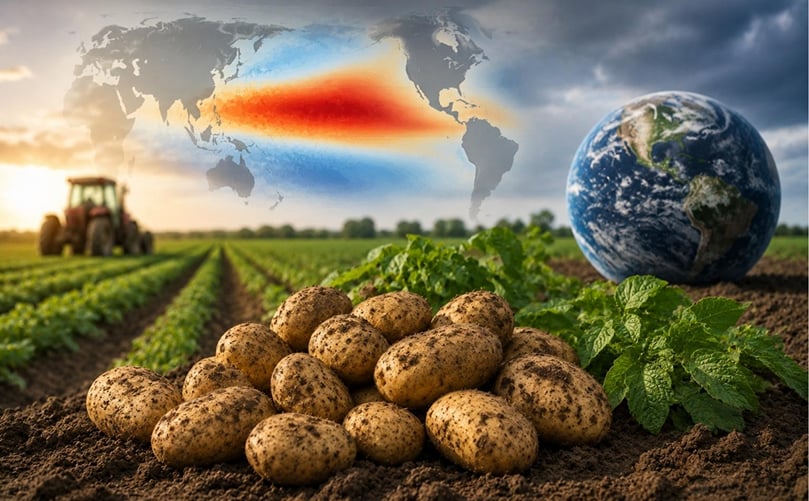
El Niño-related ocean warming may alter rainfall and temperature patterns in major potato-growing regions, affecting crop development and yields.
Potential Implications for Processing and Storage
The effects of weather variability can extend throughout the potato value chain.
Processors depend on a stable supply of high-quality potatoes for products such as French fries, chips, flakes, and starch. Growing conditions can influence tuber size, dry matter content, sugar accumulation, and overall processing quality, potentially affecting manufacturing efficiency and final product specifications.
Storage operations may also face challenges if warmer conditions increase cooling requirements and energy consumption. In regions experiencing excessive rainfall, harvest timing and storage logistics could become more difficult, increasing the risk of post-harvest losses.
Climate Resilience Becomes Increasingly Important
The possibility of increased weather variability is reinforcing ongoing efforts to strengthen resilience across the potato industry.
Breeding programs worldwide are focusing on developing varieties with improved tolerance to heat, drought, and emerging disease pressures. Research organizations, including the International Potato Center (CIP), continue to advance work on climate-resilient potato genetics and sustainable production systems.
At the farm level, growers are increasingly adopting precision irrigation technologies, improved soil management practices, digital monitoring tools, and integrated disease management strategies to help reduce production risks associated with changing weather conditions.
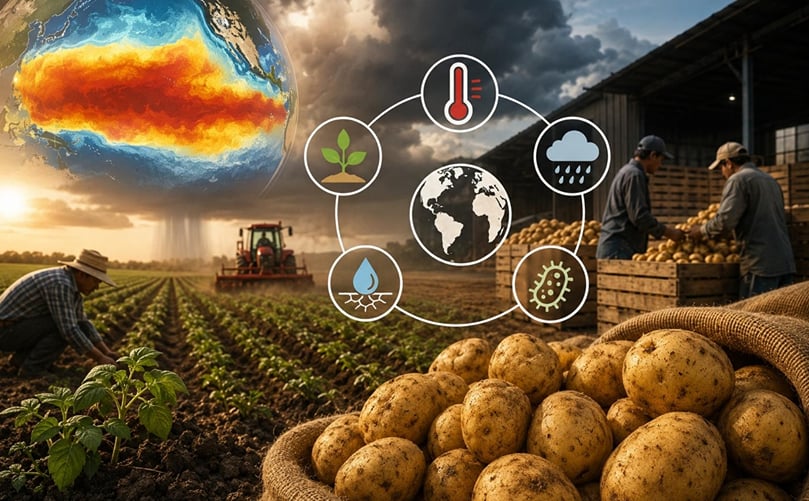
Growers and researchers are investing in climate-resilient potato varieties, precision irrigation, and improved disease management to reduce weather-related risks.
Global Food Markets May Be Better Prepared Than in Previous El Niño Events
Some market analysts note that global inventories of major food commodities remain stronger than during several previous El Niño episodes, potentially providing a degree of resilience to global food systems.
Shirley Mustafa, Economist at the FAO:
"Strong global food inventories may provide a bit of silver lining against some of the production risks associated with El Niño, although regional agricultural impacts remain a concern."
However, potatoes differ from globally traded grain commodities because production and consumption are often concentrated within regional markets. As a result, localized weather disruptions can still have significant effects on potato supplies, processing operations, and market prices, even when broader global food inventories remain adequate.
Looking Ahead: Building Resilience in a Changing Climate
Although the eventual intensity and regional consequences of the 2026–27 El Niño remain uncertain, climate agencies agree that the event warrants close monitoring across the agricultural sector.
For the global potato industry, the focus is increasingly shifting toward proactive risk management through climate-resilient varieties, efficient water use, improved disease surveillance, advanced storage technologies, and more flexible supply chains.
As forecasts continue to evolve, growers, processors, traders, researchers, and policymakers will be watching closely to assess how El Niño develops and what it may mean for potato production, processing, and markets during the coming seasons.
References
- NOAA – El Niño Forms, Expected to Strengthen
- NOAA Climate Prediction Center – ENSO Diagnostic Discussion
- NOAA ENSO Strength Probabilities (June 2026)
- NOAA ENSO Probabilities (June 2026)
- WMO – El Niño/La Niña Update (May 2026)
- WMO – Prepare for El Niño
- Reuters – UN Food Agencies Seek Funding to Shield People from El Niño
- Reuters – Strong El Niño Could Be Amplified by Climate Change
¿Te gustaría recibir noticias como esta por correo electrónico? ¡Únete y suscríbete!
Get the latest potato industry news straight to your WhatsApp. Join the PotatoPro WhatsApp Community!
Empresa Destacada

Noticias relacionadas

Septiembre 28, 2026
México: menor oferta de papa podría impulsar los precios durante el invierno
En México, el cierre de cosechas, los menores rendimientos y la reducción de la superficie sembrada podrían restringir la oferta de papa y generar presión al alza sobre los precios entre diciembre de 2026 y febrero de 2027.

Septiembre 28, 2026
España: la sequía reduce la cosecha de patatas en 2026
La producción española de patata caerá entre un 8% y un 10% en 2026, hasta unos 1,8 millones de toneladas, con descensos de hasta 35% en Andalucía debido principalmente a la sequía y los menores rendimientos.

Septiembre 23, 2026
Chile: buscan mejorar el diagnóstico molecular de la sarna polvorienta y la sarna común en papa
En Chile, el proyecto SCAB-ID 2.0 busca validar un sistema de qPCR multiplex capaz de detectar y diferenciar simultáneamente la sarna polvorienta y la sarna común de la papa, con miras a transferirlo a laboratorios de diagnóstico agrícola.