
Maryluz Contreras from Colpar, Huancayo, shares her potato expertise as project staff and local farmers test and select the most promising varieties near her home. (Courtesy: Michael Major/Crop Trust)
CIP-Asiryq: New Blight-Resistant Potato Boosts Farmer Resilience

The same disease that caused the Irish Potato Famine nearly two centuries ago still devastates potato crops worldwide, inflicting up to USD 10 billion in annual losses. Now, climate change is driving the disease higher into the Andes and threatening the livelihoods of smallholder farmers who grow one of the world’s most important staple foods.
However, ahead of the COP30 UN Climate Change Conference in Brazil, a new disease-resistant potato variety highlights the innovation farmers need to thrive in a changing climate.
Developed by scientists from the International Potato Center (CIP) with the participation of Indigenous communities, the new potato variety, called CIP-Asiryq, resists the disease that struck Ireland, late blight. It requires fewer fungicide sprays, cooks 25% faster than Peru’s popular Yungay variety, and shows strong potential for both table and processing markets.
Dr. Stefan Schmitz, executive director of the Crop Trust:
"Late blight costs billions of dollars every year in lost production. The new resistant variety gives potato farmers an option that can reduce losses, cut costs and strengthen food security in Peru and around the world. It's good news for everyone who likes potatoes."
Rooted in climate collaboration
Pronounced “asir-eek,” the new CIP-Asiryq variety was developed using Solanum cajamarquense, a wild relative of the potato conserved in the CIP genebank in Lima, Peru. This genebank safeguards the world’s largest collection of potato diversity.
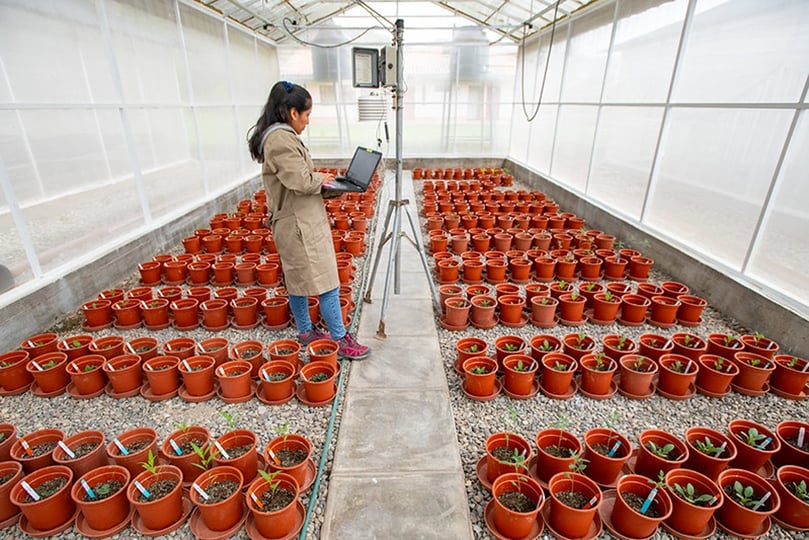
Kristel Hotuya, a Master of Science student at the Universidad Nacional Agraria La Molina in Peru inspects potential new potato varieties. (Courtesy: Michael Major/Crop Trust)
The breakthrough was set in motion during the Crop Wild Relatives project and made possible through the Biodiversity for Opportunities, Livelihoods and Development (BOLD) project, both led by the Crop Trust and funded by the Government of Norway.
Dr. Thiago Mendes, Scientist at the International Potato Center (CIP) and Lead of the BOLD Potato Pre-Breeding Project:
"Late blight has been a huge burden to potato farmers everywhere, so the development of a new resistant variety is a major step forward for food systems – in the Andes and beyond. CIP-Asiryq is also remarkable for its versatility. Farmers in Huánuco noted its potential for both fresh consumption and processing, giving producers more flexibility to meet market demand."
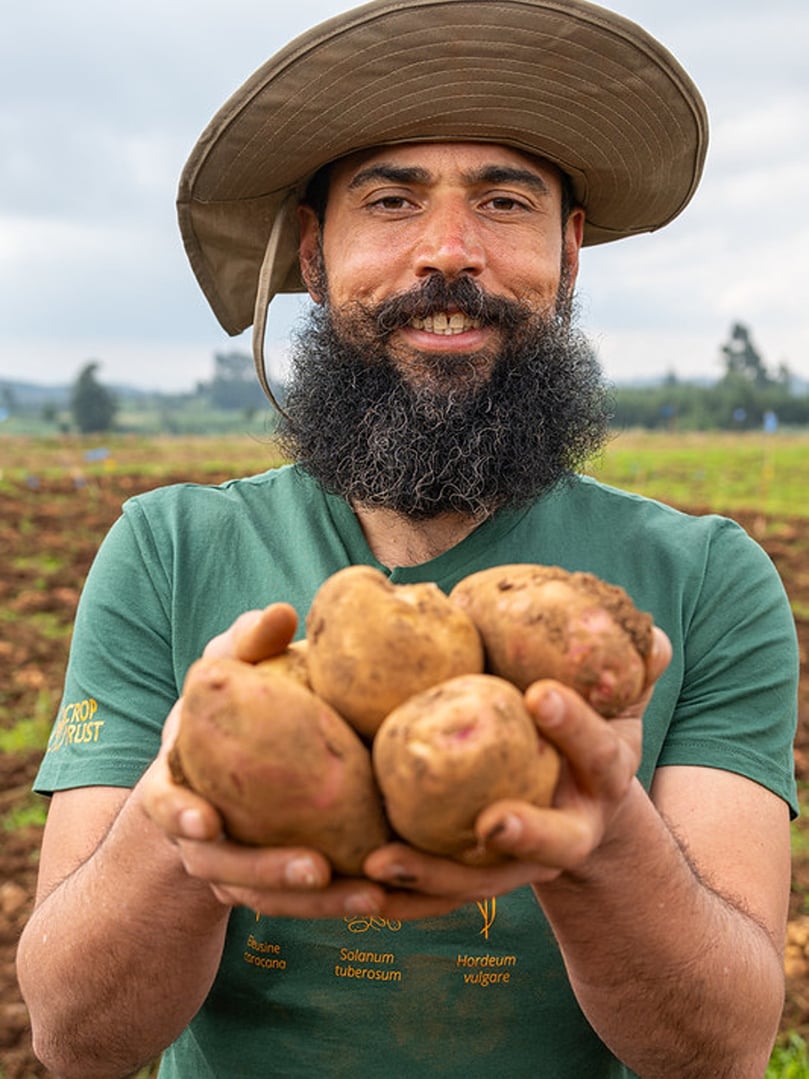
Dr. Thiago Mendes, potato breeder at the International Potato Center (CIP), at Sirikwa Farm in Molo, Nakuru County, Kenya. The Crop Trust's BOLD Project is working with CIP to select potatoes exhibiting late blight resistance. (Courtesy: Michael Major/Crop Trust)
A global problem with a local solution
Late blight is the same plant disease that triggered the 19th century Irish Potato Famine, a crisis that starved Ireland and scarred it forever. In 2025, late blight still costs farmers an estimated USD 3 to 10 billion per year globally. The disease can slash crop yields by 50 to 100% in Peru – even at elevations once thought safe from its ravages.
Farmers can spray fungicides, but according to CIP, agrochemicals can represent 10 to 25% of the total value of a farmer’s potato harvest. Fungicide use significantly reduces family incomes, and it also poses risks to humans and the environment. In humid valleys of the central Andes, farmers spray fungicides up to six times each month to protect their crops.
Besides offering late blight resistance and thus reducing the need for spraying, CIP-Asiryq has strong market potential due to its processing qualities, which meet industry standards for potato chips. This is good for smallholder farmers, for businesses that process and sell potato products, and for consumers who love the many ways potatoes are prepared.
Raul Ccanto, Coordinator of the Agrobiodiversity Area at the Yanapai Group:
"This potato variety was developed for the fresh consumption – not specifically for processing – but some producers do grow for the processing industry. Small-scale farmers will be happy to earn more by selling to this market and so will the processing companies."
Collaboration between CIP, the Yanapai Group and local farmers was essential in the development of the new variety, showing how breeders, communities and genebanks can work together to deliver solutions.
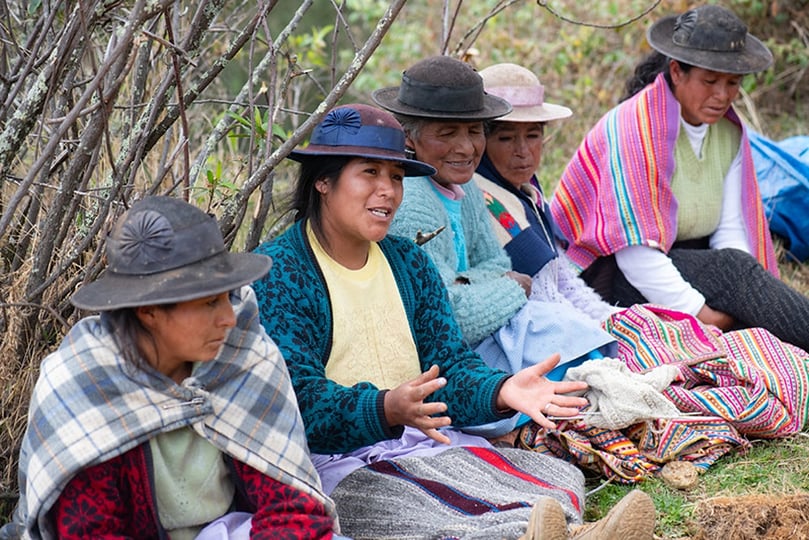
Farmers from Colpar in central Peru share their preferences for potatoes with researchers from the International Potato Center and Grupo Yanapai. Ultimately. the farmers will decide which potato varieties they plant in their fields, so researchers are eager to get them involved early on in the selection process. (Courtesy: Michael Major/Crop Trust)
A growing global impact
CIP-Asiryq also provides hope to farmers in other parts of the world who may be struggling to contain the disease.
Dr. Thiago Mendes:
"The new potato was developed in Peru by identifying wild potatoes with resistance to the disease and incorporating this resistance into cultivated varieties. Those parents are conserved in the CIP genebank, which can share them with potato breeding programs in any country under the rules of the International Treaty for Plant Genetic Resources for Food and Agriculture for use in developing blight-resistant varieties."
Dr. Mendes, now based in Kenya, is using CIP-Asiryq to develop late blight-resistant potatoes adapted to the East African highland through the BOLD project. This adds to the portfolio of successful new variety launches under BOLD, including new varieties of alfalfa in Kazakhstan, durum wheat in Morocco and rice in Vietnam.
Dr. Benjamin Kilian, BOLD project coordinator at the Crop Trust:
"This new wild relative-derived potato variety offers a powerful testament to the real-world impact of global collaboration. Crop diversity is a precious resource that can deliver meaningful climate solutions to farmers – and food systems – all around the world."
Like to receive news like this by email? Join and Subscribe!
Get the latest potato industry news straight to your WhatsApp. Join the PotatoPro WhatsApp Community!
Highlighted Company



Related News

October 06, 2026
Dutch Potato Organisation Celebrated Potato Tuesday at Utrecht Central Station on October 6
The Dutch Potato Organisation celebrated Potato Tuesday on October 6 at Utrecht Central Station during the Week of Our Food. Visitors can enjoy free recipe booklets and discover the people behind the Dutch potato industry.

October 05, 2026
Punjab Agricultural University Introduces Four Potato Varieties for Higher Yield and Disease Resistance
PAU Ludhiana has released four potato varieties—PP-101, PP-102, PP-103 and PP-104. Yields range from 142–184 quintals/acre, with PP-103 offering early harvest and PP-104 moderate late-blight resistance. Seed is now available.

October 05, 2026
Idaho Potato Harvest Shows Solid Quality but Lower Yields in 2026
Idaho’s 2026 potato harvest is showing solid quality but lower yields, with frost, heat, warm nights and wildfire smoke affecting production. Planted area fell to 298,915 acres as growers report smaller crops.