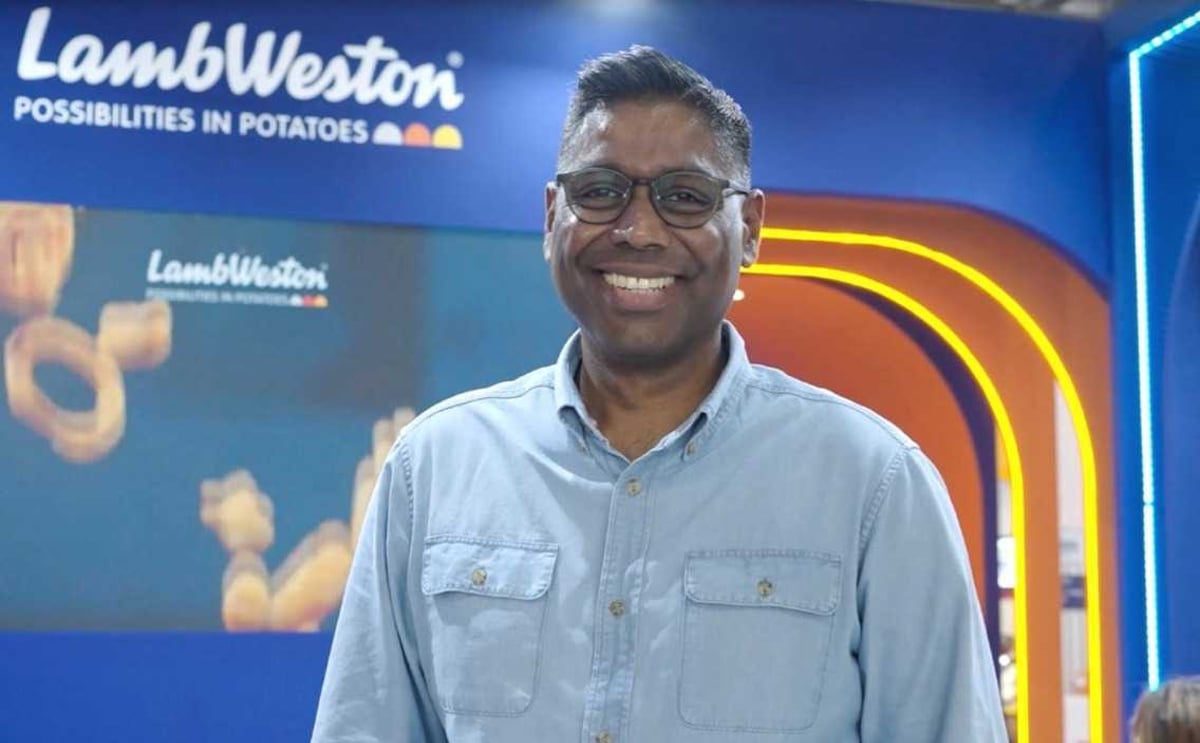
Jeevan Dass, Senior Commercial Director for Asia-Pacific at Lamb Weston, speaking about the company’s first retail entry into Southeast Asia, launched in Singapore.
Lamb Weston’s First Retail Move into Southeast Asia Begins in Singapore
Earlier this year potato processor Lamb Weston celebrated its 75th anniversary and launched its retail range of French fries in Singapore, marking the company’s first retail entry into Southeast Asia. Known globally for its dominance in foodservice and quick-service restaurant supply, the move represents a measured expansion into Asian households rather than a broad retail rollout.
To understand the thinking behind this decision, PotatoPro spoke with Jeevan Dass, Senior Commercial Director for Asia-Pacific at Lamb Weston, about why Singapore was chosen, how the product range was designed, and how the company is approaching retail growth across Asia.
Why Singapore Was Chosen First
Singapore was selected not for its market size, but for its regional influence. According to Dass, Singapore plays a unique role in Southeast Asia’s retail ecosystem. Buyers, distributors, and foodservice operators from across the region routinely observe what appears on Singapore’s supermarket shelves to gauge emerging consumer trends.
Jeevan Dass, Senior Commercial Director for Asia-Pacific at Lamb Weston:
"Singapore is like the gateway for retail. It's the gateway for trends in Southeast Asia."
"There's this thing where some people around Southeast Asia, buyers, consumers, food service partners, when they come to Singapore for a holiday or when they come for business, they actually go into the Singapore supermarkets."
"It's like an encyclopedia for them. They go there, they look for new brands, what's trending, because Singapore always has a bit of a better pulse on consumer trends and consumer insights."
"And so that's one of the reasons why we chose Singapore."
"People come to Singapore, walk to the supermarkets, and see what’s new. It gives a good read on where consumer expectations are moving."
Operationally, Singapore also offered Lamb Weston a strong foundation. The company has maintained a presence in the market for nearly two decades, with sales, marketing, quality teams, and a culinary test kitchen already in place. This allowed the retail launch to be executed without building new infrastructure.
Rather than launching widely, Lamb Weston limited the rollout to a single retail partner, using the initial phase to observe consumer response, in-store sampling performance, and product mix before expanding further.
Retail Entry Without Replicating Foodservice
While Lamb Weston is best known for supplying frozen potatoes to global QSR brands, Dass emphasized that the Singapore retail range was not a direct extension of its foodservice portfolio.
The products launched in Singapore are produced in Europe, where Lamb Weston already has an established retail presence across the United Kingdom, continental Europe, and the Middle East, including Dubai. However, product selection for Singapore was guided by regional consumption habits rather than by transferring U.S. foodservice formats into retail.
Are these products localized for Asian taste preferences?
Not in the way many would expect. The fries launched in Singapore are produced in Europe and follow European standards, lower sodium, cleaner formulations, and a more health-conscious profile. However, product design choices (cuts, shapes, use-cases) are deeply informed by Asian consumption habits.
One example is the introduction of “Dippers,” a scoop-shaped fry designed for sharing and dipping, behaviors commonly observed across Asian markets. At the same time, Twister Fries, which are already familiar to Singapore consumers through quick-service restaurants, were intentionally excluded from the initial retail lineup.
Jeevan Dass:
"We plan the portfolio market by market. What works in one place doesn’t automatically add value in another."
The Bigger Trends Reshaping Frozen Potatoes in Asia-Pacific
From Lamb Weston’s vantage point, three forces are reshaping the category:
- Health-Conscious Choices: Lower salt, lower oil, and air-fryer compatibility are no longer premium features, they are expectations.
- Convenience with Speed: Clear cook times and oven-ready formats are critical for families and working professionals.
- Restaurant-Quality at Home: Consumers increasingly expect foodservice-level outcomes without foodservice infrastructure.
Jeevan Dass:
"For example, in Singapore, you've got a very high penetration of ovens as well as air fryers, and so we see this as a growing trend that we need to ride on, and so this particular coating has been made.So that it actually can perform well in the air fryers and ovens. Now, in addition, some of the other things that we had to take note of is that we needed it to be halal, vegan, and gluten-free."
Frozen potatoes are transitioning from backup meals to planned, experience-driven consumption.
Designed for Ovens and Air Fryers
Although Lamb Weston’s Stealth coating technology was originally developed to address crispness and hold-time challenges in quick-service restaurants, the coating used for the Singapore retail range has been modified.
The retail formulation was designed specifically for ovens and air fryers, appliances that have seen strong adoption in Singaporean households.
The reformulated invisible coating ensures:
- Comparable crispiness to deep frying
- Matching cook times
- No compromise on taste
Jeevan Dass:
"We wouldn’t describe a product as air-fryer friendly unless it genuinely performs like a deep fryer."
In addition to cooking performance, the retail range is gluten-free, vegan, and halal-compliant, criteria Dass described as essential for broad household acceptance across Asia-Pacific markets.
Four SKUs, Distinct Usage Occasions
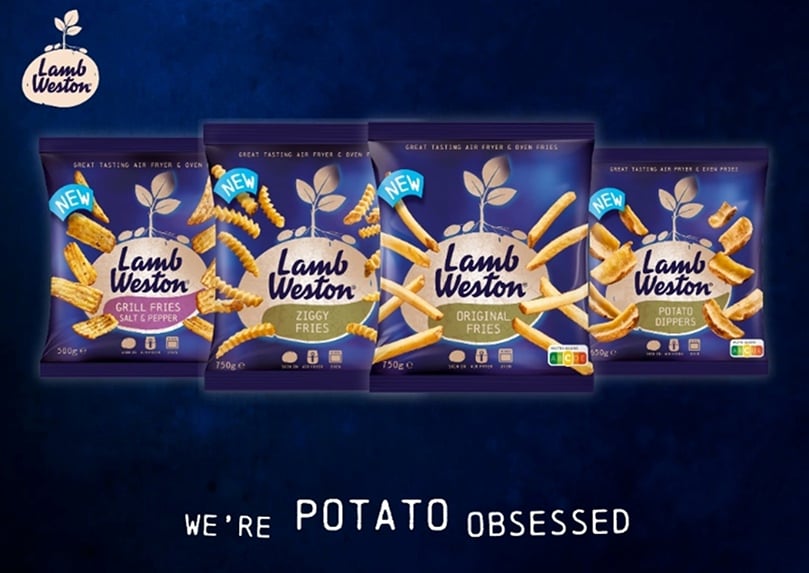
Lamb Weston’s new retail frozen fries range launched in Singapore, featuring Original, Grill, Ziggy, and Dippers, designed for oven and air-fryer cooking.
The Singapore retail launch includes four SKUs: Original, Grill, Ziggy, and Dippers.
Each cut serves a different usage occasion. Ziggy Fries feature deep grooves intended to hold seasoning and flavor powders, while Grill Fries come pre-seasoned beyond salt. Original Fries remain part of the range to cater to consumers who prefer a more traditional option.
Jeevan Dass:
"There will always be consumers who just want something familiar. So we balance exploration with comfort."
Dass added that additional cuts and SKUs are already under consideration as Lamb Weston continues to assess consumer response in Singapore.
Expansion Across Asia, One Market at a Time
Singapore is being used as a reference market before broader expansion.
Following the initial launch, Lamb Weston plans to roll out its retail range in Malaysia, with wider availability expected in early 2026. The Philippines is next in the pipeline. Each market will feature a tailored portfolio rather than a uniform global offering.
Singapore, Dass said, allows the company to refine product mix, packaging, and go-to-market strategy before scaling further.
Sustainability Grounded in Practical Constraints
Lamb Weston’s retail entry in Singapore also reflects the company’s broader sustainability commitments, including its global targets to halve food waste and reduce carbon emissions by 25 percent by 2033.
The new retail packs use 20% thinner and contain at least 60% bio-renewable polyethylene made from used cooking oil, cutting their carbon footprint by around 30% compared to conventional formats.
At the same time, Dass noted that sustainability decisions must account for regional realities. Packaging formats that work in drier climates, such as paper-based freezer bags, may not perform well in Southeast Asia’s humid conditions.
Jeevan Dass:
"Sustainability has to work in practice."
Beyond packaging, Lamb Weston also evaluates sourcing decisions to reduce transportation distances, supplying Asian markets from regional production facilities where possible.
India as a Longer-Term Consideration
While Lamb Weston currently has no production facilities in India, the market remains strategically important. Dass makes one point clear: India would require local operations to be viable at scale.China, by contrast, already hosts two large, state-of-the-art Lamb Weston facilities serving a rapidly growing domestic market.
Jeevan Dass:
"India is not a market I can foresee entering without local operations."
A Measured Retail Approach
Lamb Weston’s entry into Southeast Asia’s retail frozen potato segment is being approached deliberately. Singapore serves as a starting point rather than an endpoint, allowing the company to observe consumer behavior, refine its offering, and adapt its strategy before expanding further across the region.
Jeevan Dass:
"We’re prepared to adjust as we go."
For now, the focus remains on understanding how Asian households engage with frozen potatoes and building retail capabilities accordingly.
Like to receive news like this by email? Join and Subscribe!
Get the latest potato industry news straight to your WhatsApp. Join the PotatoPro WhatsApp Community!
Highlighted Company

Related News

October 09, 2026
From Farm to Fries: The Fry Industry in Kenya Prepares to Welcome the World
Ahead of World Potato Congress 2026, Wanjiru Mambo discusses the growth of Kenya's potato-processing industry, Wedgehut Foods' expansion, supply-chain challenges and opportunities for farmers, local processors and regional markets.

October 08, 2026
Lamb Weston Raises Fiscal 2027 Outlook After Strong First Quarter
Lamb Weston reported Q1 fiscal 2027 net sales of USD 1.67 billion, up 1%, with North America volume growth driving results. The company raised its full-year outlook for net sales, Adjusted EBITDA and Adjusted Diluted EPS.

October 08, 2026
Iscon Balaji Foods Showcases Hungritos Potato Products at MIHAS 2026 in Malaysia
Iscon Balaji Foods showcased its Hungritos frozen potato portfolio at MIHAS 2026 in Malaysia, targeting stronger Southeast Asian exports through its integrated potato processing, Halal production and IQF freezing capabilities.