

Ladybird Beetles in Potato Ecosystems: Natural Enemies of Aphids and Key Drivers of Biological Control
Ladybird beetles (family Coccinellidae) commonly known as ladybugs or ladybirds are among the most important beneficial insects in potato (Solanum tuberosum) agro-ecosystems worldwide. They function as highly efficient natural predators primarily targeting aphids, which are among the most economically damaging pests of potato crops.
Aphids such as the green peach aphid (Myzus persicae) and cotton aphid (Aphis gossypii) cause direct damage through sap feeding leading to weakened plants, distorted growth and reduced tuber quality. More critically, they act as vectors of both non-persistent and persistent viruses including Potato virus Y (PVY) and Potato leafroll virus (PLRV), which can cause yield losses ranging from 20% to 80% depending on the timing of infection and varietal susceptibility.
Both the larval and adult stages of ladybird beetles are highly voracious feeders. A single ladybird can consume 50 or more aphids per day and up to approximately 5,000 aphids over its lifetime. This predation pressure significantly suppresses aphid populations often resulting in substantial field-level reductions and helping to prevent rapid pest outbreaks. By lowering aphid densities, ladybird beetles indirectly reduce virus transmission, improve plant vigor and contribute to higher tuber yield and better quality.
Their importance extends beyond direct pest suppression. Ladybird beetles play a key role in maintaining ecological stability by reducing dependence on synthetic insecticides, thereby helping to slow resistance development, minimize environmental contamination and reduce production costs. In Integrated Pest Management (IPM) systems conservation of ladybird beetles enhances biodiversity and supports more resilient potato production systems.
However, their effectiveness is strongly influenced by management practices as broad-spectrum insecticides and habitat simplification can significantly reduce their populations. Overall, ladybird beetles represent a highly effective biological control agent forming a sustainable foundation for pest management in potato across diverse global production systems.
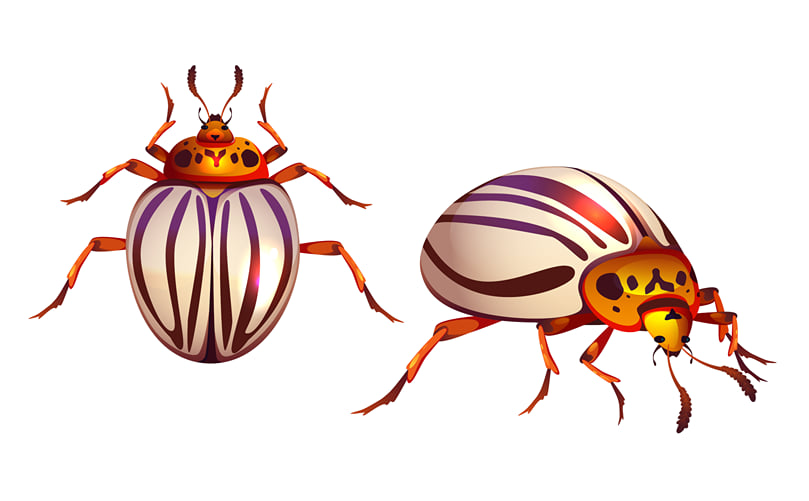
Ladybird Beetles: Natural Predators Protecting Potato Crops
Global Distribution and Ecological Role of Ladybird Beetles in Agricultural Systems
Ladybird beetles (family Coccinellidae) comprise approximately 6,000 described species distributed across all continents except Antarctica. They occur widely in temperate, subtropical and tropical regions, demonstrating strong ecological adaptability. These insects are especially abundant in agricultural landscapes where populations of soft bodied prey particularly aphids are high.
In major potato-growing regions, ladybird beetles are well established across all key production zones:
In Europe and North America, species such as Coccinella septempunctata (seven spotted ladybird) and Hippodamia convergence are dominant. Coccinella septempunctata, originally native to the Palearctic region has become widely established in North America since the 1970s following intentional introduction for biological control.
In Asia including major potato producing countries a high diversity of ladybird species supports strong natural pest regulation. Both native and invasive species occur and complex community interactions contribute to aphid suppression in agricultural systems.
In Africa, South America and Australia, various native and introduced ladybird species contribute significantly to aphid control in potato and other crops, particularly under favorable climatic conditions and diversified cropping systems.
The abundance and distribution of ladybird beetles are strongly influenced by prey availability, climatic conditions, cropping intensity and landscape diversity. Cooler and moderately humid environments often favor aphid outbreaks, which in turn support higher ladybird populations. In intensive potato monoculture systems populations may fluctuate significantly; however, stable populations are more commonly observed in landscapes that include semi-natural habitats, which provide overwintering sites and alternative food resources.
Several species have been introduced for biological control purposes, most notably Harmonia axyridis (Asian multicolored lady beetle). While it is highly effective in pest suppression it has also led to competition with native species in some regions. Additionally, climate change and agricultural intensification continue to influence their distribution patterns with population declines reported in heavily pesticide treated landscapes. Despite these challenges, ladybird beetles remain one of the most widespread and effective groups of beneficial insects in global potato and vegetable production systems.
Identification and Morphology of Ladybird Beetles in Potato Ecosystems
Predatory ladybird beetles (family Coccinellidae) are small, highly recognizable beetles commonly found in agricultural ecosystems. Adults typically range from 0.8 to 18 mm in length with most economically important species measuring between 3–8 mm. They have a characteristic dome-shaped (convex) dorsal surface and a flattened ventral side giving them an oval to nearly circular body appearance. The hardened forewings (elytra) are usually brightly colored commonly red, orange or yellow with black spots or patterned markings that function as aposematic (warning) coloration to deter predators. The pronotum, located behind the head often bears distinctive black or white markings that assist in species level identification.
Key Morphological Characteristics and Immature Stages of Ladybird Beetles
Head: Bears large compound eyes and clubbed antennae, typically with 7–11 segments.
Mouthparts: Strong mandibles adapted for piercing and consuming soft bodied prey such as aphids.
Legs: Short legs with a tarsal formula of 4-4-4 (often appearing as 3-3-3 due to reduced segments), ending in paired claws that aid in gripping plant surfaces and prey.
Color variation: High polymorphism occurs in several species. For example, Harmonia axyridis shows wide color variation ranging from pale yellow to black with numerous spot patterns.
Immature Stages: Larvae are elongated, “alligator like” and dark colored (black, gray or brown), often with orange or yellow markings. They possess well-developed legs, a mobile body and spiny or tuberculate projections. These larvae are highly active predators and often consume large numbers of aphids during development.
Eggs are small (approximately 1 mm), spindle shaped and yellow to orange in color. They are usually laid in clusters near aphid colonies to ensure immediate food availability for emerging larvae.
Critical Distinction Between Predatory and Pest Species
It is important to note that not all ladybird beetles are beneficial. Some species in the subfamily Epilachninae, such as the 28 spotted potato ladybird (Henosepilachna vigintioctopunctata), commonly known as the hadda beetle are serious pests of potato and other solanaceous crops. Unlike predatory species, these beetles feed on plant tissue rather than insects.
Pest species typically have duller coloration more uniform spotting patterns (often 28 spots) and chewing mouthparts adapted for leaf tissue consumption leading to skeletonized leaves. In contrast, predatory ladybirds possess mandibles adapted for capturing and feeding on soft-bodied insect prey such as aphids.
Accurate field identification based on coloration, spot pattern, behavior and feeding type is essential for correct pest management decisions and to avoid confusion between beneficial and harmful species.
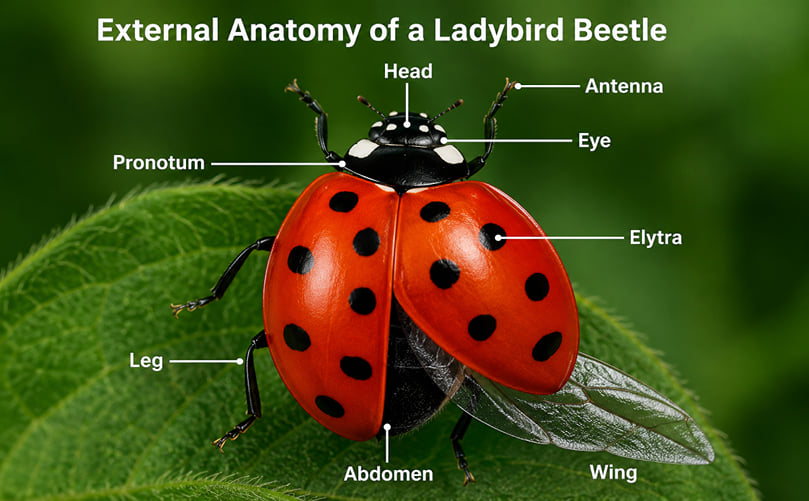
Identification and Morphology of Ladybird Beetles in Potato Ecosystems
From Egg to Predator: The Life Cycle and Development of Ladybird Beetles
Ladybird beetles (family: Coccinellidae) undergo complete metamorphosis (holometabolous development), passing through four distinct life stages: egg → larva → pupa → adult. The duration of each stage is highly temperature dependent with optimal development generally occurring between 20–30°C. Lower temperatures slow development, while extreme temperatures may increase mortality and reduce reproductive success.
Egg Stage: Female ladybird beetles lay spindle shaped, yellow to orange eggs, typically measuring about 1 mm in length, in clusters of 10–30 or more on the undersides of leaves, usually near aphid colonies. This strategic egg placement ensures that newly hatched larvae have immediate access to food. A single female may lay 200–500 or more eggs during her lifetime. The incubation period generally ranges from 3–8 days depending on species and environmental conditions. For example, eggs of Coccinella septempunctata commonly hatch in approximately 4 days under moderate temperatures. Egg hatchability may decline under conditions of prey scarcity or extreme temperatures.
Larval Stage: The larval stage is the most active and predatory phase of the life cycle. Ladybird larvae are elongated, mobile and often described as “alligator like” in appearance with well-developed legs and frequently spiny bodies. Larvae undergo four instars (developmental stages between molts).
The first instar larvae are small, approximately 1–2 mm long and begin feeding immediately after hatching. As development progresses, later instars grow rapidly, reaching approximately 8–10 mm in length by the fourth instar. The total larval period usually lasts 10–20 days depending on species, prey availability and temperature. For example, larvae of Coccinella septempunctata typically complete development in about 10–13 days at 25°C. During this period larvae can consume hundreds to thousands of aphids making them highly effective biological control agents. In conditions of prey scarcity, larvae may also exhibit cannibalism or intraguild predation.
Pupal Stage: After completing the fourth larval instar, the larva attaches itself to a leaf, stem or other surface and enters the pupal stage. Feeding ceases and the insect transforms into a stationary pupa, often displaying orange and black coloration. The pupal stage generally lasts 5–15 days, most commonly around 7–10 days during which extensive internal reorganization occurs before adult emergence.
Adult Stage: Newly emerged adults, known as teneral adults are initially soft bodied and pale in color. Their characteristic body coloration and spot patterns gradually develop and harden within a few hours to several days. Adult beetles feed, mate, disperse and reproduce. Depending on the species and environmental conditions adults may live from several weeks to 1–2 years. Many species survive unfavorable seasons through adult diapause, overwintering in protected locations such as leaf litter, bark crevices or buildings. In warmer potato growing regions, ladybird beetles may complete two to five or more generations per year.
Development is generally faster when prey is abundant and environmental conditions are favorable. In potato ecosystems, synchronization of ladybird beetle emergence with aphid outbreaks significantly improves their biological control efficiency. Overwintering adults emerge during spring, initiating new population cycles and contributing to early season pest suppression.
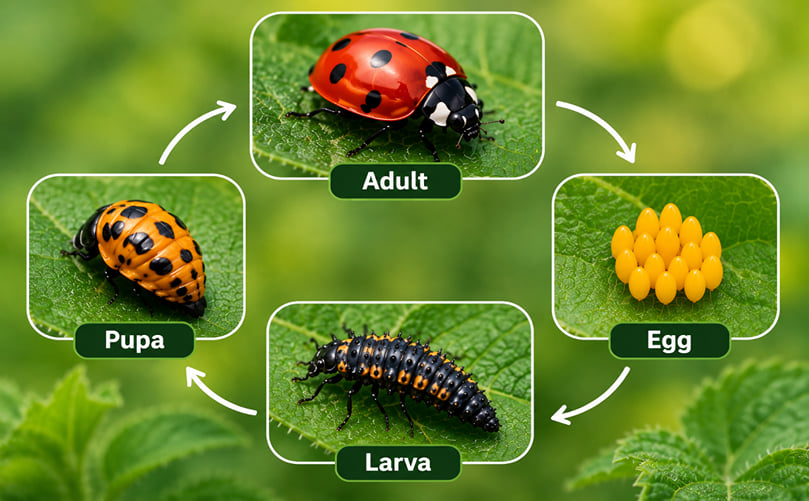
From Egg to Predator: Life Cycle of Ladybird Beetles
Prey Preferences and Host Range of Ladybird Beetles
Most predatory ladybird beetles (family: Coccinellidae) are aphidophagous (aphid feeding) and exhibit flexible, polyphagous feeding behavior, allowing them to exploit a wide range of prey. Although aphids are their preferred food source many species can survive on alternative food resources when primary prey is scarce.
Primary Prey in Potato Ecosystems: In potato ecosystems, ladybird beetles predominantly feed on soft bodied insect pests, particularly aphids. Major prey species include:
The green peach aphid, Myzus persicae is one of the most preferred prey species due to its broad host range and importance as a vector of plant viruses. Another important prey species is the cotton or melon aphid, Aphis gossypii, which commonly infests potato and several other crops. Ladybird beetles also prey upon the potato aphid, Macrosiphum euphorbiae along with other aphid species occurring in potato fields.
Broader Prey Spectrum: Beyond aphids, ladybird beetles consume a broad range of soft bodied arthropods including whiteflies, scale insects, mealybugs, mites, psyllids and the eggs or young larvae of small insects. During periods of prey scarcity many species supplement their diet with pollen, nectar, honeydew (secreted by aphids) and fungal spores, which help sustain survival and maintain populations until prey becomes abundant again.
Ladybird beetles are highly efficient predators. A single larva or adult may consume approximately 50–100 or more aphids per day, while lifetime consumption may exceed 3,000–5,000 aphids depending on species and environmental conditions. Larvae are generally more voracious than adults on a per-day basis. Prey quality strongly influences development as nutritionally suitable prey, particularly aphids, promotes higher survival, faster growth and increased reproductive potential (fecundity) compared to less suitable alternative prey.
This broad prey range makes ladybird beetles effective and resilient biological control agents in potato ecosystems, where pest populations often fluctuate across seasons and crop growth stages. However, they are generally less effective against heavily sclerotized (hard bodied) or chemically defended prey species.
Important Distinction: Predatory vs. Plant Feeding Ladybird Beetles
Not all ladybird beetles are beneficial predators. Some species, such as the 28 spotted potato ladybird, Henosepilachna vigintioctopunctata are phytophagous (plant feeding) and considered agricultural pests. Unlike predatory species that feed on insects by piercing and consuming soft bodied prey, these plant feeding ladybirds chew leaf tissue causing damage to potato foliage and reducing crop productivity.
Predator–Prey Dynamics and Ecological Interactions of Ladybird Beetles in Potato Fields
In potato ecosystems, predator prey interactions involving ladybird beetles (family: Coccinellidae) follow dynamic ecological patterns influenced by prey availability, environmental conditions and habitat complexity. Ladybird populations generally increase after aphid infestations begin, often showing a time lag behind prey population growth. However, once established, they can rapidly suppress aphid populations through both functional responses (increased prey consumption per predator) and numerical responses (increase in predator abundance through reproduction and aggregation). A single colonization event by predatory ladybirds may significantly reduce aphid populations under favorable conditions.
Prey Tracking and Aggregation Behavior: Ladybird beetles actively locate prey rich habitats using chemical and visual cues. They are attracted to aphid honeydew, plant volatiles released from damaged plants and aphid alarm pheromones, which help them identify active feeding sites. Females preferentially lay eggs near aphid colonies, ensuring that newly emerged larvae have immediate access to food, thereby improving larval survival and development.
Alternative Prey and Population Stability: When aphid populations decline, ladybird beetles often shift to alternative prey including whiteflies, insect eggs, mites, mealybugs and other soft bodied arthropods. This dietary flexibility known as prey switching, reduces predator starvation and helps maintain predator populations across different crop growth stages. Supplementary food sources such as pollen, nectar and honeydew may also support survival during periods of low prey abundance contributing to long-term population stability.
Intraguild Predation and Competition: Ladybird beetles may also participate in intraguild predation (IGP), where predators feed on competing beneficial organisms or even members of their own species. This includes cannibalism as well as predation on other natural enemies such as lacewing larvae, syrphid fly larvae and parasitoid larvae or pupae. Larger or invasive species, such as Harmonia axyridis may outcompete or prey upon smaller native ladybird species. Intraguild predation generally increases when aphid populations become scarce and decreases when sufficient prey or alternative food resources are available.
Factors Disrupting Predator Prey Dynamics: Several environmental and management factors can disrupt predator prey balance in potato systems. The use of broad-spectrum insecticides can reduce both aphid and ladybird populations, often resulting in pest resurgence due to the loss of natural biological control. Additionally, climate extremes, habitat simplification through monocropping and landscape fragmentation may negatively affect predator abundance, dispersal and ecological interactions.
In potato production systems, these predator prey relationships contribute significantly to ecological balance and natural pest suppression. Fields with greater habitat diversity and ecological refuges tend to support more stable ladybird populations and improved long-term aphid management. However, under highly disturbed conditions or during sudden aphid influxes, ladybird beetles may not suppress pest populations rapidly enough to prevent early season virus transmission by aphids, particularly in virus sensitive potato crops.
Ecological Interactions of Ladybird Beetles in Potato Ecosystems
Major Ladybird Beetle Species Found in Potato Ecosystems
Several predatory ladybird beetle species (family: Coccinellidae) are commonly found in potato ecosystems worldwide, where they play an important role in suppressing aphid populations and supporting natural pest control. The abundance and dominance of species vary depending on geographic region, climate, cropping system and surrounding landscape conditions.
Major Predatory Ladybird Species in Potato Ecosystems
Coccinella septempunctata (Seven Spotted Ladybird / C-7): The seven spotted ladybird is among the most common and effective predatory species in potato growing systems worldwide. Native to the Palearctic region (Europe and Asia), it has become widely established in North America since the late twentieth century. Adults are easily recognized by their red wing covers with seven black spots. This species is highly adaptable and often dominates ladybird populations in potato fields because of its strong predatory efficiency against aphids.
Hippodamia variegata (Variegated Lady Beetle): This species is commonly observed in many potato growing regions, particularly across Europe, Asia and parts of North America. It is a relatively small but highly efficient aphid predator with variable spot patterns, which may differ among individuals. The species responds rapidly to aphid outbreaks and is frequently associated with potato aphid infestations.
Hippodamia convergens (Convergent Lady Beetle): Native to North America, the convergent lady beetle is abundant in various agricultural ecosystems including potato fields. It can be identified by the two white converging lines on the pronotum behind the head. This species is widely valued for biological control and is commercially available for augmentative release programs against aphids and other soft bodied pests.
Harmonia axyridis (Multicolored Asian Lady Beetle): The multicolored Asian lady beetle is an invasive species in many regions but is also considered a highly effective generalist predator. It exhibits substantial variation in coloration and spot number (polymorphism) and feeds on a broad range of soft bodied pests. Although it contributes significantly to pest suppression in potato fields, its establishment has negatively affected native ladybird diversity in some agricultural landscapes due to competition and intraguild predation.
Coleomegilla maculata (Pink Spotted Lady Beetle): This species is especially important in North American potato systems because it feeds not only on aphids but also on the eggs of the Colorado potato beetle, Leptinotarsa decemlineata. Its broad feeding behavior contributes to multi-pest management making it a valuable biological control agent in potato cultivation.
Other Regionally Important Species: Additional predatory species such as Propylea quatuordecimpunctata and Coccinella transversoguttata may occur in specific potato growing regions. In some production systems, invasive species such as Coccinella septempunctata and Harmonia axyridis have partially displaced native ladybird populations without necessarily reducing overall aphid suppression efficiency.
Important Distinction: Beneficial vs. Pest Ladybird Species
It is important not to confuse beneficial predatory ladybird beetles with plant feeding (phytophagous) species. For example, the 28-spotted potato ladybird or Hadda beetle, Henosepilachna vigintioctopunctata is an agricultural pest that feeds on potato foliage by scraping and skeletonizing leaves, reducing photosynthetic efficiency and crop productivity. Unlike predatory ladybirds, this species damages plants rather than controlling insect pests.
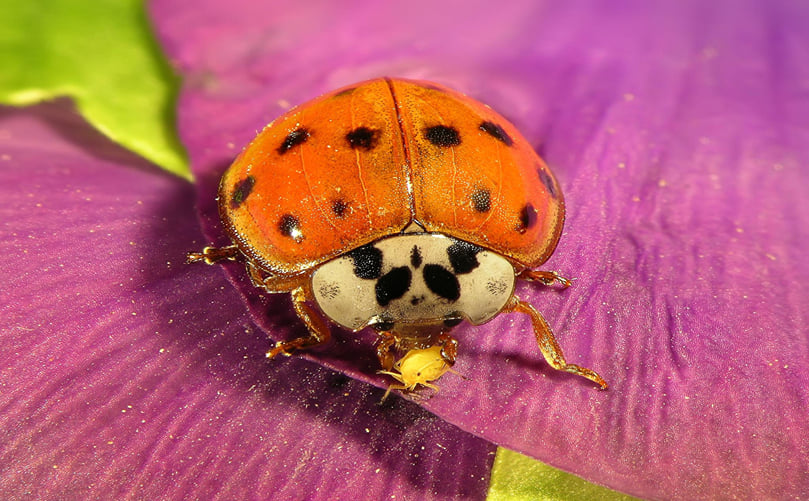
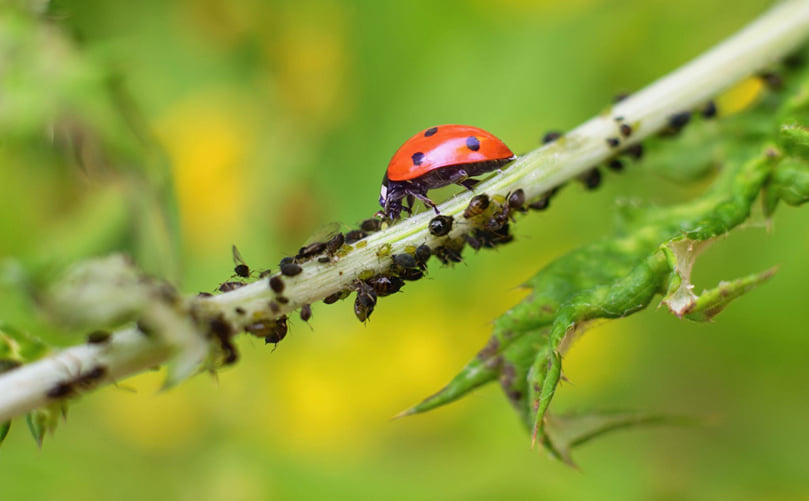
Ladybird Beetles Feeding on Aphids in Potato Fields
Predatory Role of Ladybird Beetles in Potato Pest Management
Ladybird beetles (family: Coccinellidae) are among the most effective natural predators of aphids and other soft bodied insect pests in potato ecosystems. Both adults and larvae actively hunt prey, contributing significantly to biological pest control and reducing dependence on chemical insecticides. Their predatory activity helps maintain ecological balance and protect potato crops from economically important pests.
Feeding Behavior and Pest Suppression: Ladybird beetles primarily feed on aphids, particularly major potato pests such as the green peach aphid, Myzus persicae the cotton or melon aphid, Aphis gossypii and the potato aphid, Macrosiphum euphorbiae. In addition to aphids, many species also prey on whiteflies, scale insects, mites and occasionally insect eggs or small larvae. Certain species, such as Coleomegilla maculata are also known to feed on the eggs of the Colorado potato beetle, Leptinotarsa decemlineata, thereby contributing to broader pest management in potato fields.
Ladybird beetles are highly voracious predators. A single larva or adult may consume approximately 50–100 or more aphids per day, while total lifetime consumption may exceed 3,000–5,000 aphids, depending on species, prey availability and environmental conditions. Species such as Coccinella septempunctata are particularly efficient aphid predators and often play a dominant role in biological control within potato ecosystems.
Role in Virus Management: By suppressing aphid populations, ladybird beetles indirectly contribute to reducing the spread of economically important potato viruses. Aphids serve as vectors for diseases such as Potato virus Y and Potato leafroll virus, both of which can significantly reduce potato yield and tuber quality. Through natural aphid suppression, ladybird beetles help minimize virus transmission and support healthier crop development.
Functional and Numerical Responses: Ladybird beetles exhibit both functional and numerical responses to changes in prey density. They tend to aggregate in areas with high aphid populations and frequently lay eggs near aphid colonies to ensure food availability for emerging larvae. As prey density increases, ladybird populations also increase through reproduction and immigration. Their predatory effectiveness is generally greatest under moderate to high aphid infestations although they may be less effective during very low aphid densities or sudden early season aphid influxes, when pest populations can establish before predator numbers increase sufficiently.
Field studies in potato ecosystems have demonstrated that conserved ladybird populations can substantially reduce aphid infestations, often improving overall plant health, tuber quality and reducing the risk of virus spread. Larvae typically contribute the greatest predatory pressure during peak feeding stages making the early season conservation of ladybird beetles particularly important for effective biological control.
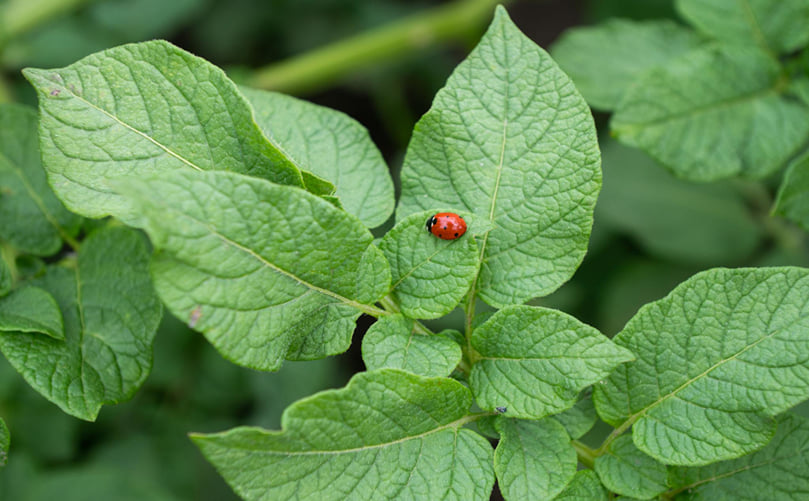
Ladybird Beetle Activity in Potato Fields
Role of Ladybird Beetles in Integrated Pest Management (IPM) of Potato
Ladybird beetles (family: Coccinellidae) play an important role in the Integrated Pest Management (IPM) of potato crops due to their strong predatory capacity, ecological adaptability and compatibility with multiple pest management approaches. As natural enemies of aphids and other soft-bodied pests, they contribute significantly to sustainable potato production by reducing pest pressure while minimizing dependence on chemical insecticides.
Biological Control in Potato IPM: Ladybird beetles form a key component of biological control strategies in potato production systems. By feeding on aphids and other insect pests, they naturally suppress pest populations and reduce the frequency of insecticide applications. Their activity helps delay the development of insecticide resistance in aphid populations while minimizing negative environmental impacts associated with excessive pesticide use. Through continuous predation, ladybird beetles support a more balanced agroecosystem and contribute to long-term pest regulation.
Compatibility with Other IPM Components: Ladybird beetles are highly compatible with other IPM tactics and often function synergistically with additional biological control agents such as lacewings, syrphid flies and parasitoid wasps. They also complement cultural management practices including crop rotation, field sanitation, habitat diversification and intercropping systems, which improve habitat suitability for beneficial insects. This compatibility enhances overall pest suppression efficiency within potato ecosystems.
Monitoring and Decision Making: Effective potato IPM programs require regular field monitoring of both pest and beneficial insect populations. The presence of ladybird adults, larvae and egg clusters should be assessed alongside aphid infestation levels during scouting activities. Economic thresholds for pest management should consider predator abundance before insecticide applications are initiated helping prevent unnecessary pesticide use and conserving beneficial insect populations.
Conservation Strategies for Ladybird Beetles: Conservation biological control practices are essential for maintaining healthy ladybird populations in potato fields. The use of selective or reduced risk insecticides, while avoiding broad-spectrum products during periods of active ladybird presence can help preserve predator populations. In particular, excessive use of broad-spectrum insecticides may negatively affect beneficial insects and disrupt natural pest suppression. Habitat enhancement strategies such as flowering strips, refuges and vegetative diversity can provide nectar, pollen and shelter, improving adult survival and population persistence.
Challenges and Best Management Practices: Despite their effectiveness, ladybird beetles face several challenges in potato production systems. Broad-spectrum insecticides may significantly reduce their populations often leading to aphid resurgence due to the loss of natural enemies. In some cases, augmentative releases of species such as Hippodamia convergens may be used in high value cropping systems or protected cultivation although conservation of naturally occurring populations remains more common in open field potato production.
Overall, integrating ladybird beetle conservation into potato IPM programs strengthens ecological resilience, reduces chemical inputs, lowers pest management costs and supports sustainable agricultural production. Region specific adaptation including consideration of local ladybird species composition and environmental conditions can further improve the effectiveness of IPM strategies in potato ecosystems.
Factors Influencing Ladybird Beetle Populations in Potato Fields
Ladybird beetle populations (family: Coccinellidae) in potato ecosystems are highly dynamic and influenced by a combination of biotic and abiotic factors. Their abundance generally fluctuates in response to prey availability, environmental conditions, habitat quality and agricultural management practices. In most potato fields, ladybird populations tend to increase following aphid outbreaks usually with a short time lag as predator numbers respond to prey abundance.
Prey Availability: The availability of prey is the most important factor influencing ladybird beetle populations. Aphid infestations, particularly those caused by the green peach aphid, Myzus persicae, the cotton or melon aphid, Aphis gossypii and the potato aphid, Macrosiphum euphorbiae, strongly stimulate population growth. Ladybird beetles exhibit both functional responses (increased prey consumption) and numerical responses (increased reproduction and aggregation) when prey density rises. Females frequently lay eggs near dense aphid colonies to improve larval survival. As aphid populations decline, ladybird numbers may also decrease or shift toward alternative prey leading to seasonal population fluctuations.
Pesticide Use: Pesticide application significantly affects ladybird abundance and survival. Broad-spectrum insecticides, including pyrethroids, organophosphates and certain systemic insecticides may cause direct mortality to both adults and larvae while also reducing reproductive performance. Even sublethal exposure can impair foraging efficiency, reproduction and predator behavior. Consequently, the use of selective or reduced-risk insecticides is generally more favorable for conserving beneficial predator populations within potato IPM systems.
Habitat and Landscape Structure: Habitat diversity strongly influences ladybird population stability. Simplified agricultural landscapes dominated by monoculture potato production often provide limited refuges, overwintering sites and alternative food resources. In contrast, diverse landscapes containing hedgerows, grasslands, flowering vegetation and semi-natural habitats support higher and more stable ladybird populations by providing shelter, nectar, pollen and alternative prey. Habitat fragmentation and landscape simplification may negatively affect species diversity and reduce population persistence.
Climatic Conditions: Environmental conditions, particularly temperature, humidity and seasonal extremes, strongly affect ladybird development and survival. Optimal population growth generally occurs between 20–30°C, where reproduction and developmental rates are maximized. Warmer temperatures can accelerate development and increase the number of generations per season; however, heat stress, prolonged drought, cold spells or severe weather events may reduce survival and reproductive success. Overwintering success, especially in species entering adult diapause depends on the availability of protected shelters such as leaf litter, bark crevices or buildings.
Interspecific Interactions: Interactions among predator species also influence ladybird populations. Invasive species such as Harmonia axyridis and Coccinella septempunctata may compete with or displace native species through competition and intraguild predation (IGP). Cannibalism and predation among ladybird larvae and adults may also increase when prey becomes scarce affecting overall population structure and species composition.
Crop Management Practices: Agronomic practices within potato production systems can directly influence ladybird abundance. Frequent tillage, residue removal, intensive pesticide programs and limited flowering vegetation may reduce overwintering success and food availability. In contrast, conservation-oriented practices that maintain habitat diversity and beneficial insect refuges can improve predator survival and ecological stability. Early season aphid infestations and virus outbreaks may also indirectly influence predator dynamics by altering host plant condition and prey availability.
Overall, intensively managed potato production systems often experience boom and bust population cycles, whereas diversified systems with greater ecological complexity tend to support more stable and resilient ladybird populations, improving long-term biological control of aphids and other soft-bodied pests.
Conservation and Management Practices for Ladybird Beetles in Potato Fields
Effective conservation and management of ladybird beetles (family: Coccinellidae) are essential for maximizing their contribution to biological control in potato production systems. Since ladybird beetles provide valuable ecosystem services by naturally suppressing aphids and other soft bodied pests, management strategies should focus on reducing mortality, conserving habitats and enhancing field conditions that support predator survival and reproduction.
Selective Pesticide Use: The careful selection and application of pesticides are critical for conserving ladybird beetle populations. Broad-spectrum insecticides should be avoided during periods of peak ladybird activity, particularly when larvae are actively feeding. Whenever possible, selective or reduced risk insecticides should be used to minimize harmful effects on beneficial insects. Pest management decisions should be based on regular field scouting that considers both pest and predator abundance. In addition, pesticide applications may be timed during the evening or periods of reduced predator activity to lessen direct exposure.
Habitat Enhancement: Habitat diversification significantly improves ladybird beetle survival and population stability. The establishment of flowering strips or border vegetation containing nectar and pollen producing plants such as buckwheat, dill, yarrow, mustard or sweet alyssum can provide supplementary food resources for adults during periods of low prey availability. Maintaining field margins, hedgerows, cover crops and semi-natural vegetation also supports overwintering, shelter and access to alternative prey, strengthening predator persistence within potato ecosystems.
Cultural Management Practices: Agronomic practices can strongly influence ladybird beetle conservation. Reduced tillage systems help protect overwintering sites and improve survival during unfavorable seasons. Crop rotation and crop diversification can reduce pest buildup while simultaneously supporting beneficial insect diversity. In some situations, retaining crop residues may provide shelter and alternative prey resources although residue management should be balanced against potential pest and disease risks.
Augmentative Releases: In certain production systems, particularly high value potato crops or greenhouse cultivation, augmentative releases of predatory ladybird species such as Hippodamia convergens or Coccinella septempunctata may be used to strengthen biological control. However, augmentative releases are generally less common and often less cost effective in open field potato production compared to conservation-based strategies that encourage naturally occurring predator populations.
Monitoring and Decision Support: Regular monitoring of ladybird adults, larvae, eggs and aphid populations is essential for informed pest management decisions. Economic thresholds should incorporate predator abundance so that unnecessary insecticide applications can be avoided when natural enemy populations are sufficient to suppress pest outbreaks. This predator-based decision-making approach improves IPM effectiveness and reduces production costs.
Landscape Level Conservation Approaches: Ladybird conservation is often more successful when implemented at a broader landscape scale. Collaborative management among neighboring farms can help create connected habitats and ecological corridors, improving predator movement and population persistence. Reducing excessive insecticide use across agricultural landscapes further supports stable beneficial insect communities and enhances long-term biological control services.
Overall, conservation and management practices that protect ladybird beetles improve natural pest suppression, reduce dependence on chemical insecticides, lower production costs and contribute to the sustainability of potato production systems while minimizing the risk of pesticide resistance development.
Impact of Ladybird Beetles on Potato Yield and Crop Health
Ladybird beetles (family: Coccinellidae) play an important role in improving potato yield, crop health and tuber quality through their natural suppression of aphids and other soft bodied insect pests. Their contribution is particularly significant in integrated pest management systems where predator populations are effectively conserved. By reducing pest pressure and limiting the spread of aphid transmitted diseases, ladybird beetles help maintain healthier potato plants and improve overall crop performance.
Aphid Suppression and Reduced Feeding Damage: Ladybird beetles are highly effective predators of aphids including key potato pests such as the green peach aphid, Myzus persicae, the cotton or melon aphid, Aphis gossypii and the potato aphid, Macrosiphum euphorbiae. In well managed potato systems conserved ladybird populations can substantially reduce aphid infestations, often leading to marked declines in pest density. Since both adults and larvae consume large numbers of aphids throughout their life cycle, they help reduce direct feeding damage such as sap removal, leaf curling, reduced plant vigor and growth distortion.
Reduction in Virus Transmission: One of the most important benefits of ladybird beetles in potato production is their indirect role in virus management. Aphids act as vectors for major potato diseases such as Potato virus Y and Potato leafroll virus both of which can significantly reduce yield and tuber quality. By suppressing aphid populations, ladybird beetles lower the likelihood of virus spread within potato fields. Reduced virus incidence contributes to healthier foliage, stronger plant vigor, improved photosynthetic efficiency and higher quality tuber development.
Improvements in Yield and Tuber Quality: Healthier potato plants resulting from effective biological control frequently translate into improved tuber yield and size. Reduced pest pressure allows plants to maintain better canopy growth and physiological performance throughout the growing season. In diversified production systems where beneficial insect populations are supported, ladybird beetles contribute to greater yield stability and increased crop resilience against pest outbreaks, particularly during moderate aphid infestations.
Economic and Sustainability Benefits: The conservation of ladybird beetles can also generate important economic benefits for potato growers. Reduced dependence on insecticide applications lowers production costs, labor requirements and environmental impacts associated with pesticide use. In addition, biologically managed systems may support access to premium or sustainability focused markets, where reduced pesticide residues and environmentally responsible production practices are increasingly valued.
Limitations and Constraints: Despite their benefits, ladybird beetles may be less effective under certain conditions. Their impact is often limited during rapid early season aphid invasions, when pest populations establish before predator abundance increases sufficiently. Similarly, heavily disturbed or intensively managed fields with frequent insecticide applications may support lower predator populations, reducing biological control effectiveness. In some potato ecosystems, invasive species such as Harmonia axyridis may replace native species while maintaining aphid suppression although this shift can alter biodiversity and ecological interactions.