

Potato Ring Rot: A High Risk Quarantine Disease in Seed Potato Systems
Potato Ring Rot also known as bacterial ring rot is a highly destructive vascular disease of potato caused by the Gram-positive bacterium Clavibacter sepedonicus. The pathogen colonizes the xylem vessels, disrupting water transport in the plant and leading to progressive wilting, stunting and eventual plant collapse. In infected tubers, it produces a characteristic creamy to yellowish bacterial breakdown of the vascular ring, which may later develop into a cheesy or granular decay, especially under storage conditions.
The importance of the disease is particularly high in seed potato production systems due to strict zero tolerance standards enforced under seed certification schemes. Even a single latent or symptomless infection can result in the rejection of entire seed lots. The pathogen is also difficult to detect in early stages because infections can remain asymptomatic for long periods allowing contaminated material to pass through multiplication stages unnoticed. Its ability to spread through infected seed tubers and contaminated cutting tools, containers and machinery make it one of the most challenging bacterial diseases to manage once introduced into a production system.
Economically, Potato Ring Rot can cause severe direct and indirect losses. Under favorable disease conditions, yield reductions of up to 50% have been reported in historical outbreaks, particularly in regions such as North America and parts of Europe. However, the major economic impact is often not yielding loss but regulatory and market consequences, including loss of certification status, mandatory sanitation protocols, destruction or rejection of seed lots and restrictions on trade and export. Because of its persistence and ease of mechanical transmission, even low-level infections can trigger costly containment measures and long-term production setbacks.
Due to its quarantine importance, Clavibacter sepedonicus is listed as a regulated or quarantine pest in many potato producing regions worldwide, including under European Union plant health regulations and similar frameworks in North America and other seed certification systems. Strict phytosanitary measures are enforced for the movement of seed potatoes and related materials to prevent introduction and spread making exclusion and certification-based control the primary management strategy globally.
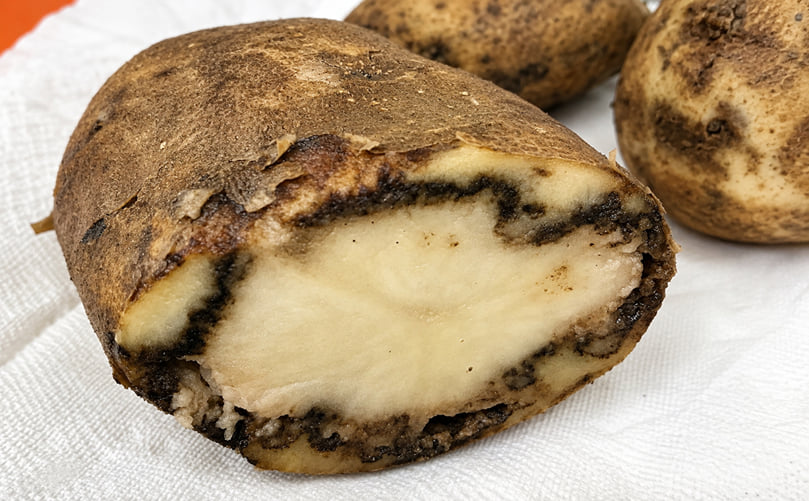
Potato Ring Rot (Clavibacter sepedonicus): Vascular Discoloration in Infected Tubers
Clavibacter sepedonicus Taxonomy and Pathogen Characteristics in Potato Bacterial Ring Rot
Clavibacter sepedonicus is a Gram-positive bacterium responsible for bacterial ring rot of potato. It belongs to the domain Bacteria, phylum Actinobacteria (Actinomycetota), class Actinomycetia, order Micrococcales and family Microbacteriaceae. The pathogen is a short, non-motile, non-spore forming rod (typically 0.5–1.0 µm) and shows a coryneform (club shaped) morphology. It is strictly aerobic but can persist and grow slowly under low oxygen conditions with an optimum growth temperature around 21–23°C.
The taxonomic history of the pathogen reflects major advances in bacterial systematics. It was first described in 1914 as Bacterium sepedonicum following early reports of the disease in Germany (1905–1906). Later, it was reclassified into Aplanobacter and then Corynebacterium. In the 1980s, based on chemotaxonomic traits such as cell wall composition (including 2,4-diaminobutyric acid) and host specificity, it was placed under Clavibacter michiganensis subsp. sepedonicus. More recent genomic approaches including whole genome sequencing, average nucleotide identity (ANI) and digital DNA–DNA hybridization (dDDH), supported its elevation to full species status as Clavibacter sepedonicus in 2018. Phylogenomic analyses confirm it forms a distinct monophyletic lineage within the genus Clavibacter, primarily associated with potato.
The genome is approximately 3.26 Mb in size, along with plasmid elements and reflects strong adaptation to the vascular system of potato. Compared with more generalist relatives, it shows reduced metabolic flexibility, which contributes to its restricted survival outside host tissues and strong dependence on human mediated dissemination. Multilocus sequence analysis (MLSA) using housekeeping genes such as atpD, dnaK and gyrB further supports its phylogenetic placement within the genus.
Economic Impact of Potato Bacterial Ring Rot Caused by Clavibacter sepedonicus
Clavibacter sepedonicus causes significant economic losses primarily through plant wilting, reduced tuber size and number and internal tuber decay. Under severe field conditions, historical reports have recorded yield losses ranging from 15–50% or more. In some heavily affected regions, losses up to around 47% have been documented. In modern certified seed systems, field level losses are often reduced due to strict surveillance, but latent infections remain a major concern because symptomless plants can still produce infected tubers that sustain disease cycles. In ware (table potato) production, losses of around 3% have been reported in affected systems.
The most significant economic burden, however, is regulatory rather than direct yield loss. Many countries enforce zero tolerance policies in seed certification programs, meaning even a single confirmed detection can result in rejection of entire seed lots or farms. This leads to destruction of crops, mandatory sanitation of equipment and storage facilities, loss of certification status and the need to replace seed material. These indirect consequences create substantially higher financial losses than field damage alone.
At a global scale, strict testing and eradication programs particularly in Europe incur substantial annual costs due to surveillance, laboratory diagnostics, compensation schemes and outbreak management. Trade restrictions further amplify economic impacts as infected lots are excluded from export markets affecting international seed potato trade and long-term market reputation. Even in regions with low incidence, the cost of maintaining disease-free status through certification systems represents a continuous economic investment.
Storage losses also contribute to economic damage as infected tubers may develop secondary bacterial soft rots leading to post-harvest spoilage and reduced marketable yield, particularly in export and processing chains.
Global Distribution and Occurrence of Clavibacter sepedonicus in Potato Crops
Clavibacter sepedonicus is primarily distributed in cool potato growing regions of the Northern Hemisphere. It has been reported across many parts of Europe, including countries such as Germany, Poland, Finland, Sweden, Norway, Russia and several Central and Eastern European nations. Some major seed producing regions in Western Europe have achieved effective eradication or extremely low incidence through long-term certification and surveillance programs.
In North America, the pathogen is present in parts of Canada and the United States under strict regulatory control with occasional outbreaks managed through quarantine and eradication measures. Reports from Mexico are sporadic and limited. In Asia, it has been recorded in countries including China, Japan, South Korea, North Korea, Pakistan, Nepal, Kazakhstan and Uzbekistan as well as parts of Russia.
The pathogen is largely absent from the Southern Hemisphere, including South America, Oceania and most equatorial regions, largely due to strict quarantine measures and limited introduction pathways. In Africa, confirmed presence is rare to absent in most regions though continuous monitoring is maintained due to global trade risks.
Several countries have successfully eradicated or significantly reduced incidence through strict seed certification, sanitation protocols and surveillance-based removal of infected lots. However, the pathogen persists in regions where seed systems are less regulated and its spread is strongly associated with cool climates, contaminated seed tubers and human mediated movement of infected material.
Host Range and Host Specificity of Clavibacter sepedonicus
Potato (Solanum tuberosum) is the primary and most economically important host of Clavibacter sepedonicus, where it causes systemic vascular infection leading to characteristic ring rot symptoms in tubers. Natural disease development under field conditions is essentially restricted to potato, which makes it the central focus of quarantine regulations, seed certification systems and disease management programs worldwide. The pathogen’s strong adaptation to potato vascular tissue reflects a highly specialized host pathogen relationship, where systemic movement and tuber colonization are key to its epidemiological success.
Reports of natural infection in other hosts are extremely rare and generally considered incidental or of limited epidemiological significance. Tomato (Solanum lycopersicum) has been reported in isolated cases, including a documented occurrence in Belgium, but without evidence of sustained field spread or major economic impact. Sugar beet (Beta vulgaris) has occasionally yielded bacterial isolation from roots or seed material although these findings have not been consistently associated with typical ring rot symptoms or reproducible disease transmission under field conditions. Eggplant (Solanum melongena) and some other Solanaceae species may show susceptibility under artificial inoculation, but these interactions are largely experimental and do not represent natural disease cycles.
Weeds and rotation crops, including species such as Solanum rostratum, Urtica dioica (stinging nettle) and some Brassicaceae members can sometimes harbor the bacterium under laboratory or artificial conditions. However, their role under field environments is considered negligible with no strong evidence supporting them as epidemiologically important reservoirs. Volunteer potato plants remain the most critical non-commercial host as they can maintain the pathogen between cropping cycles and reintroduce inoculum into production fields. Overall, genomic and ecological evidence indicates that C. sepedonicus is highly host restricted with potato acting as its primary and near exclusive natural host.
Disease Cycle and Survival of Potato Ring Rot Pathogen (Clavibacter sepedonicus)
The disease cycle of Clavibacter sepedonicus begins primarily with infected seed tubers, which serve as the principal source of inoculum in agricultural systems. Once planted, the bacterium colonizes the vascular tissues of the developing plant, moving systemically through xylem associated pathways into stems, petioles, roots and eventually into daughter tubers via stolon connections. In many cases, infected plants remain asymptomatic or show delayed symptom expression allowing latent infections to persist unnoticed across multiple generations and significantly increasing the risk of disease dissemination through certified seed systems.
Spread within and between plants is strongly associated with mechanical activities rather than natural dispersal mechanisms. Operations such as cutting seed tubers, planting, harvesting and post-harvest handling facilitate the transfer of bacterial cells from infected plant material or contaminated surfaces to healthy tubers through wounds. Farm machinery, storage containers, cutting tools and transport equipment act as highly efficient mechanical vectors when sanitation practices are inadequate. As a result, human mediated movement is considered the dominant driver of field-level and post-harvest dissemination.
Survival of the bacterium is primarily maintained in infected tubers, including both visibly symptomatic and latently infected material as well as in dried bacterial exudates composed of polysaccharide rich slime on equipment, storage surfaces and packaging materials. Under cool and dry storage conditions, the pathogen can persist for extended periods ranging from several months to multiple years with reports suggesting survival potential of 2–5 years or more in protected environments. In contrast, survival in soil is generally poor, especially in the absence of host residues and the bacterium declines rapidly under warm, moist conditions. However, infected volunteer potatoes and discarded tubers can bridge seasons and reintroduce inoculum into new cropping cycles.
Disease development is favored by the presence of high inoculum levels and wounding, which significantly enhance infection efficiency during handling and planting. While plant-to-plant spread in the field is limited without mechanical assistance, occasional experimental evidence suggests that certain insects may play a minor role, though this is not considered epidemiologically important under normal agricultural conditions. The persistence and spread of the disease are therefore largely dependent on seed health, sanitation practices and the effective removal of volunteer potatoes and infected plant material from cropping systems.
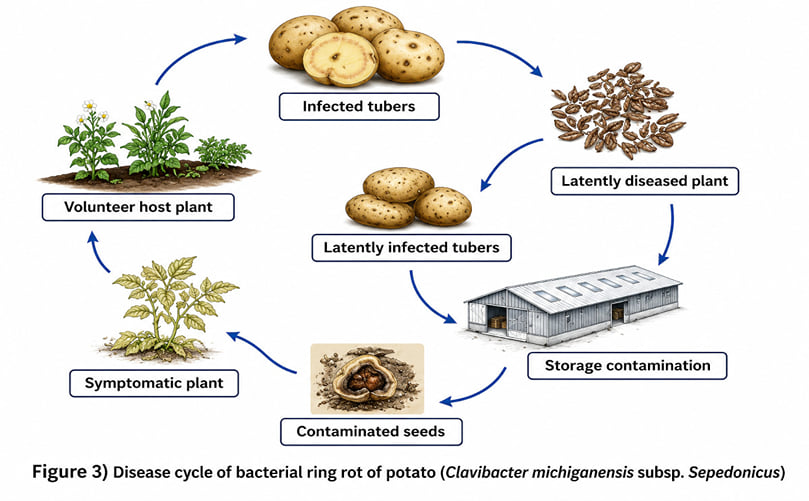
Disease Cycle and Transmission Pathways of Potato Ring Rot
Disease Development and Environmental Conditions Favoring Clavibacter sepedonicus
Clavibacter sepedonicus shows relatively slow growth with an optimum temperature range of approximately 21–23°C although it can survive and grow gradually over a broader temperature spectrum. Disease development is generally favored under moderate to warm conditions that enhance bacterial multiplication and systemic movement within the plant. However, symptom expression and disease progression are often most pronounced under cool, humid environments, where vascular colonization is more stable and wilting symptoms become more visible. High soil temperatures can accelerate internal spread within the host, while cooler conditions tend to support longer survival of the pathogen in infected plant material.
Moisture has a complex influence on disease dynamics. Free moisture and fresh wounds strongly facilitate infection and mechanical transmission, especially during planting, cutting and handling operations. At the same time, repeated wetting and drying cycles or excessively moist soil conditions may reduce bacterial survival on exposed surfaces outside the host. Within the plant, the pathogen thrives in vascular tissues and produces exopolysaccharides that aid adhesion, protection and movement through xylem vessels. In storage conditions, cool and relatively dry environments allow infected tubers to retain viable bacteria for long periods without rapid decomposition, enabling latent infections to persist until the next planting season.
Disease severity is strongly influenced by the interaction between environmental conditions, inoculum load and cultivar susceptibility. In field situations, hot and dry weather can sometimes intensify foliar symptom expression such as necrosis and wilting, whereas cooler climates often slow visible disease development but may allow longer persistence of latent infections. These environmental relationships help explain the higher importance of ring rot in temperate potato growing regions and the effectiveness of strict seed certification systems in limiting widespread outbreaks.
Transmission, Spread and Epidemiology of Potato Ring Rot
Infected seed tubers represent the primary source of inoculum and the most important pathway for long-distance dissemination of Clavibacter sepedonicus. After planting, the bacterium spreads systemically from infected seed pieces into stems, stolons and developing daughter tubers. Even a single infected tuber within a seed lot can lead to widespread contamination during cutting operations, particularly when knives are not disinfected between cuts. Mechanical planting systems can further amplify spread with contamination levels potentially becoming very high under poor hygiene conditions.
Mechanical equipment plays a major role in local and farm level transmission. Harvesters, graders, loaders, storage crates and transport containers can become contaminated with bacterial ooze or dried exudates, which then serve as secondary inoculum sources. The bacterium is capable of surviving for months to years in dried exopolysaccharide slime on surfaces such as equipment, storage structures and packaging materials, especially under cool and dry conditions. Volunteer potato plants arising from infected tubers also act as important reservoirs, maintaining the pathogen between cropping seasons and reintroducing it into new production cycles.
Human mediated movement, including contaminated tools, footwear, vehicles and irrigation or wash water, significantly contributes to spread across fields and facilities. Insect mediated transmission, such as by Colorado potato beetle or aphids has been demonstrated under experimental conditions but is considered epidemiologically minor in typical field environments. Natural plant-to-plant spread in soil is limited and inefficient unless wounds or mechanical assistance are present, reinforcing the highly human dependent nature of disease dissemination. This dependence highlights the importance of certified seed systems, strict sanitation protocols and rapid removal of infected material for effective disease containment.
Diagnosis and Detection Methods for Clavibacter sepedonicus in Potato
Field diagnosis of potato ring rot is challenging because symptoms are often latent, inconsistent or confused with other abiotic stresses and diseases. Above ground symptoms may be absent or resemble drought stress, nutrient deficiency or other vascular disorders, while tuber symptoms frequently develop late in storage. As a result, visual inspection alone is unreliable for certifying seed lots as disease-free, particularly in cases of low-level or latent infections.
Laboratory-based diagnostic methods are essential for accurate detection. Serological techniques such as ELISA, typically using monoclonal antibodies can detect bacterial populations at moderate sensitivity levels but may fail to identify low or atypical strains. Immunofluorescence assays provide additional confirmation but also have limitations in sensitivity when bacterial populations are low. Culture-based isolation on semi-selective media remains a traditional approach; however, it is time consuming and may not reliably detect low density infections.
Molecular diagnostic tools, especially conventional and real time PCR assays targeting specific genetic markers such as the CelA gene, provide the highest sensitivity and specificity for detecting latent infections. These methods can detect very low bacterial populations and are widely used in regulatory testing frameworks. Real time PCR is often more sensitive than serological methods and is effective in composite sampling strategies.
Emerging techniques such as loop mediated isothermal amplification (LAMP) offer rapid and field adaptable detection options in some contexts. In official diagnostic protocols, confirmation is typically achieved through a combination of methods, often including molecular detection supported by biological assays such as pathogenicity tests on indicator hosts like eggplant. Sampling generally focuses on vascular tissue from tuber stolon ends or stem bases to maximize detection reliability.
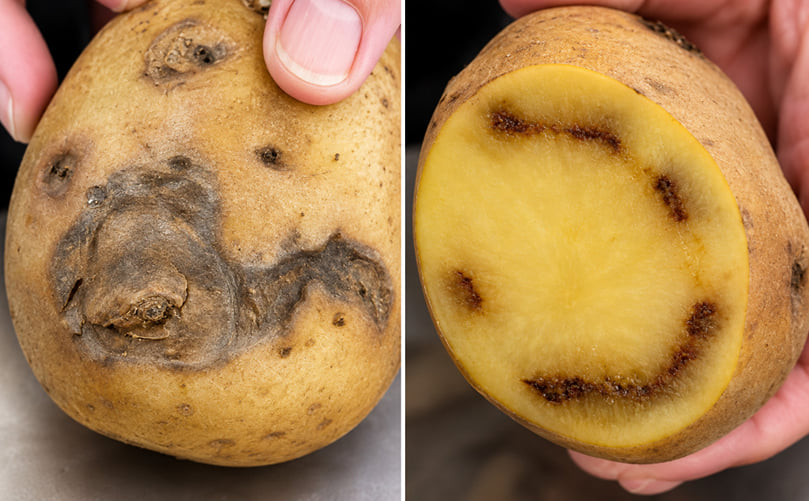
External and Internal Symptoms of Potato Ring Rot
Differentiation of Potato Ring Rot from Similar Diseases
Symptoms of Potato Ring Rot can resemble several other potato diseases and physiological disorders making laboratory confirmation essential for accurate diagnosis. Compared with Brown Rot, both diseases can cause vascular discoloration and wilting. However, Brown Rot typically produces rapid wilting, abundant bacterial streaming from cut vascular tissues and a thin, watery bacterial ooze. It is caused by the Gram-negative bacterium Ralstonia solanacearum and is favored by warmer temperatures. In contrast, Potato Ring Rot, caused by Clavibacter sepedonicus, produces a characteristic creamy to cheesy decay of the vascular ring with little or no bacterial streaming.
Blackleg, caused by Pectobacterium or Dickeya species is characterized by soft, slimy stem-base rot, blackening of stems, a foul odor and rapid plant collapse. These symptoms differ from the slower development of Ring Rot, which typically causes odorless vascular wilt and creamy, cheese-like tuber rot.
Fungal vascular wilt diseases such as Verticillium Wilt result in gradual yellowing, stunting and vascular browning but do not produce the creamy bacterial ooze or vascular ring breakdown typical of Ring Rot. Isolation of fungal pathogens or observation of fungal structures helps distinguish these diseases.
Other tuber disorders, including Late Blight, freezing injury and bacterial soft rots may also be confused with Ring Rot. These conditions commonly produce external lesions, water-soaked tissues, foul odors or extensive tissue breakdown, which are generally absent in the early stages of Ring Rot infection.
Field diagnosis can be further complicated by symptom overlap with natural plant senescence, drought stress, nutrient deficiencies or mechanical injury. Early Ring Rot symptoms, such as translucent or glassy vascular tissues may resemble other disorders. However, the presence of a creamy yellow, cheesy decay within the vascular ring combined with the absence of foul odor is highly suggestive of Ring Rot.
Because visual symptoms alone are not definitive, laboratory testing is required for reliable diagnosis. Confirmation is typically achieved through Gram staining, which identifies Clavibacter sepedonicus as a Gram-positive bacterium as well as serological methods such as ELISA or immunofluorescence assays (IFA) and molecular techniques including PCR. These methods accurately confirm the presence of the pathogen while excluding other bacterial, fungal or physiological causes.
Integrated Disease Management (IDM) of Potato Ring Rot
Integrated Disease Management (IDM) for Potato Ring Rot is primarily based on prevention because no effective curative treatments are available once the pathogen becomes established within the plant vascular system. The disease is caused by Clavibacter sepedonicus, which can survive for extended periods on contaminated equipment, storage facilities and plant debris. Therefore, the use of certified disease-free seed potatoes from seed certification programs with strict or zero tolerance standards is the foundation of successful management. Whole seed tubers are preferred over cut seed pieces as cutting creates wounds that can facilitate pathogen transmission.
Strict sanitation measures are essential to prevent disease spread. All equipment, including seed cutters, planters, harvesters, graders, conveyors and storage containers should be thoroughly cleaned to remove soil and plant debris before disinfection. Approved disinfectants such as chlorine-based products, quaternary ammonium compounds and peracetic acid formulations should be used between seed lots and production operations to eliminate surface contamination.
Crop rotation and volunteer potato control are important components of disease prevention. Potatoes should not be grown in the same field for at least 3–5 years or longer where practical to reduce the risk of disease carryover. Volunteer potato plants and cull piles must be eliminated because infected tubers can serve as reservoirs for the bacterium. Although C. sepedonicus survives poorly in soil in the absence of infected plant material, it can persist within infected tubers and debris. Selecting fields with no history of Ring Rot further reduces disease risk.
Regular monitoring and surveillance are necessary for early detection and containment. Seed lots and growing crops should be routinely inspected for symptoms, while laboratory testing using methods such as ELISA and PCR can identify latent infections that may not be visible in the field.
Chemical control options are limited because no bactericides can effectively eliminate the pathogen from infected vascular tissues. Consequently, disease management relies mainly on preventive cultural and sanitation practices. Avoiding the sharing of equipment between farms, using closed-cell rollers and easily sanitized conveyor surfaces and maintaining proper storage conditions can help minimize contamination and secondary infections.
Currently, no commercially available potato varieties provide reliable resistance to Potato Ring Rot. Although some varieties may exhibit tolerance, they can act as symptomless carriers and contribute to disease spread making them unsuitable for seed certification programs. Biological control agents have shown potential under experimental conditions, but they are not widely adopted or considered reliable in commercial zero tolerance production systems.
Successful management of Potato Ring Rot depends on a comprehensive integration of certified disease-free seed, rigorous sanitation, crop rotation, volunteer control, regular monitoring and compliance with seed certification and phytosanitary regulations. This preventive approach remains the most effective strategy for minimizing disease incidence and preventing economic losses.
Regulatory and Quarantine Measures for Potato Ring Rot
Potato Ring Rot, caused by Clavibacter sepedonicus, is recognized worldwide as a high-priority quarantine disease due to its potential to cause significant economic losses and disrupt seed potato trade. As a result, many countries enforce strict phytosanitary regulations aimed at preventing its introduction, establishment and spread.
In the European Union, C. sepedonicus is classified as a Union quarantine pest under the EU Plant Health Regulation. Official measures require surveillance, testing, containment and eradication whenever the pathogen is detected. Seed and ware potato crops are subject to regular inspections and laboratory testing, while infected crops and contaminated tubers must be destroyed. Additional measures may include restrictions on potato cultivation in contaminated fields for several years, mandatory disinfection of equipment and storage facilities and the use of phytosanitary certification for the movement of potato planting material. Member States are required to report detections and implement official control programs to prevent further spread.
In North America, Potato Ring Rot is regulated under strict zero tolerance standards within seed potato certification systems. In Canada, the disease is regulated by the Canadian Food Inspection Agency, while in the United States, certification programs are administered at the state level in accordance with standards established by the Potato Association of America. Detection of the pathogen can result in the loss of seed certification status, movement restrictions, mandatory sanitation measures, destruction of infected material and trade limitations. Rigorous testing and certification programs have significantly reduced the prevalence of the disease in major seed producing regions.
Internationally, C. sepedonicus is listed by the European and Mediterranean Plant Protection Organization as an A2 quarantine pest and is included in several regional plant protection and quarantine frameworks. Import and export regulations commonly require potatoes to originate from pest-free production areas, undergo official testing and be accompanied by appropriate phytosanitary certification. Countries where the pathogen is absent often maintain strict border inspections and restrictions on seed potato imports from infested regions.
The effectiveness of these regulatory measures has helped limit the spread of Potato Ring Rot in many seed producing countries. However, continued vigilance remains essential because the pathogen can survive in latently infected tubers without obvious symptoms. The use of uncertified or farmer saved seed potatoes increases the risk of disease introduction and spread, highlighting the importance of certified seed programs, routine testing and compliance with national and international phytosanitary regulations.
Future Research and Emerging Technologies for Potato Ring Rot Management
Future research on Potato Ring Rot is focused on enhancing early detection, improving disease management strategies and developing long-term solutions for sustainable control. Because latent infections often occur without visible symptoms, significant effort is being directed toward the development of faster, more sensitive and field deployable diagnostic technologies.
Advanced molecular diagnostic tools such as real time PCR, loop mediated isothermal amplification (LAMP) and CRISPR-based detection systems are showing considerable promise for the rapid identification of Clavibacter sepedonicus. Emerging technologies that combine CRISPR-Cas systems with nucleic acid amplification methods can provide highly sensitive and specific detection of viable bacterial cells making them valuable for seed certification and quarantine programs. Genomics-based diagnostic assays are also being developed to distinguish between different pathogen strains, identify virulence associated characteristics and improve outbreak tracing and epidemiological investigations.
The development of resistant potato varieties remains a major research priority but presents significant challenges because naturally occurring resistance to Potato Ring Rot is limited. In addition, tolerant cultivars may harbor the pathogen without exhibiting symptoms, increasing the risk of disease spread. Advances in whole genome sequencing, comparative genomics and host pathogen interaction studies are helping researchers identify bacterial pathogenicity genes, potato resistance mechanisms and potential targets for genetic improvement. Modern breeding approaches, including marker assisted selection and genome editing technologies such as CRISPR may accelerate the development of potato varieties with enhanced and durable resistance.
Research is also focused on improving sanitation and biosecurity practices. New disinfectant formulations, biofilm disrupting compounds and antimicrobial surface coatings are being evaluated to reduce bacterial survival and contamination on agricultural equipment, storage facilities and handling systems. Studies investigating composting processes, waste disposal methods and the environmental persistence of C. sepedonicus are expected to improve eradication protocols and reduce disease reservoirs.
Population genomics and molecular epidemiology are providing valuable insights into pathogen diversity, evolution, distribution patterns and adaptation mechanisms. These studies support more effective surveillance programs and help identify pathways of disease spread within and between production regions.
Emerging digital agriculture technologies are expected to play an increasingly important role in disease management. Artificial intelligence (AI), remote sensing, drone-based crop monitoring and data driven risk assessment models can improve disease surveillance, support early detection efforts and enhance decision making within seed potato production systems. When integrated with advanced diagnostics and certification programs, these technologies have the potential to strengthen disease prevention and reduce economic losses.
Overall, continued advances in molecular diagnostics, genomics, plant breeding, sanitation technologies and precision agriculture are expected to provide more effective and sustainable strategies for the detection, prevention and management of Potato Ring Rot in the future.