

Introduction: Potato Leafhoppers in Crop Production
Potato leafhoppers are small, highly mobile sap feeding insects belonging to the order Hemiptera. They damage plants using piercing and sucking mouthparts that extract plant sap while simultaneously injecting saliva that disrupts normal plant physiological processes, often leading to the development of characteristic injury symptoms.
The main economically important species is Empoasca fabae. Although other species within the genus Empoasca can also cause similar injury in different regions, E. fabae is the primary species associated with potato and several other crops, particularly in North America.
Potato leafhoppers are considered economically significant because of their wide host range and their ability to cause both direct feeding damage and physiological disruption in plants. Their feeding reduces plant vigor, lowers photosynthetic efficiency and increases production costs due to repeated monitoring and control measures. In certain crops such as alfalfa, they are among the most destructive pests in North America responsible for substantial yield and quality losses.
In potato production, their importance lies in their ability to cause yield reduction even at relatively low population densities. Because potatoes are sensitive to leafhopper feeding, early infestations can significantly reduce tuber bulking and overall marketable yield, even before obvious symptoms are visible.
The typical damage caused by potato leafhoppers is known as “hopperburn,” which appears as yellowing, browning and necrosis along leaf margins and tips. Infected plants may also show stunted growth, reduced vigor and a decline in photosynthetic activity. These symptoms are often confused with nutrient deficiencies or drought stress making field diagnosis challenging without careful scouting.
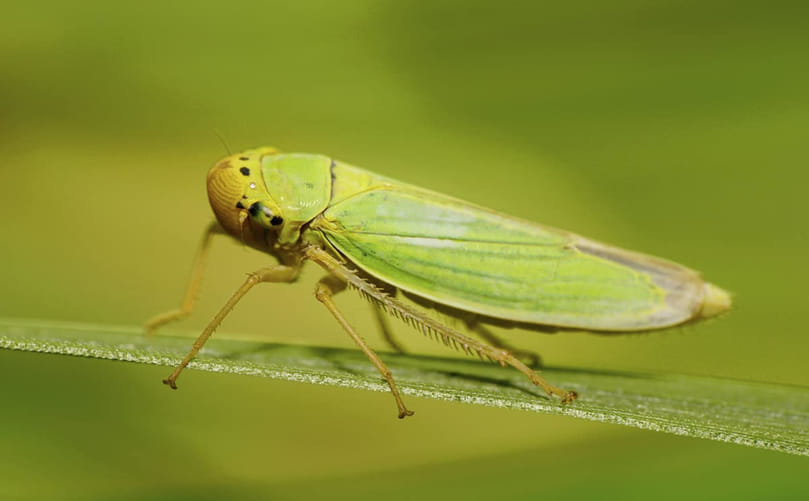
Silent Crop Stressor: Potato Leafhopper in Action
Scientific Classification of Potato Leafhopper
The potato leafhopper belongs to the following taxonomic hierarchy: Kingdom: Animalia, Phylum: Arthropoda, Class: Insecta, Order: Hemiptera, Family: Cicadellidae, Genus: Empoasca, Species: Empoasca fabae
The most economically important species is Empoasca fabae, which is the primary pest affecting potato, alfalfa, beans and several other crops within its distribution range. While other species within the genus Empoasca are present in different geographic regions, E. fabae is responsible for the majority of documented economic damage in potato production systems.
Field Guide to Potato Leafhopper Identification: From Eggs to Adults
Eggs: Eggs of potato leafhoppers are cylindrical and translucent to pale green, measuring less than 1 mm in length (approximately 0.8 × 0.25 mm). They are laid singly inside plant tissues such as leaf veins, petioles or tender stems of host plants. Due to their very small size and internal placement, eggs are extremely difficult to detect without magnification.
Nymphs: Nymphs pass through five developmental stages (instars) and resemble small, wingless versions of adults. They are pale white to bright yellow green in colour and are often found on the underside of leaves. Nymphs are highly active and move in a distinctive sideways, crab-like manner when disturbed. Early instars are extremely small, while later stages develop visible wing pads. They are very quick to move away when disturbed.
Adults: Adult potato leafhoppers are about 3 mm (1/8 inch) long, bright lime green to yellowish green and have a wedge-shaped body with a broad head and tapered abdomen. Their wings are clear and held roof-like over the body when at rest. A key identifying feature is the presence of white eyes and six distinct white spots on the pronotum just behind the head. Adults are extremely active insects that readily jump, fly or move sideways when disturbed. Males and females appear similar and females begin laying eggs after mating.
Identification Tips and Comparison with Similar Insects
Potato leafhoppers can be distinguished from aphids by their high mobility, jumping behavior and lack of honeydew production. Aphids are generally slower, often occur in clusters and possess cornicles (small tube-like structures on the abdomen), which leafhoppers do not have. Compared to other leafhoppers, such as the aster leafhopper, potato leafhoppers are typically brighter green and have more distinct white markings. Careful inspection of the underside of leaves is important as nymphs are commonly found feeding in these protected areas.
Global Distribution of the Potato Leafhopper (Empoasca fabae)
Empoasca fabae is native to North America and is widely distributed throughout the eastern and central United States and southern Canada. It is a highly migratory species, overwintering in the Gulf Coast states and moving northward each spring on prevailing winds. Because it cannot survive prolonged freezing temperatures, it does not establish permanent populations in colder northern regions and must recolonize these areas annually.
North America: The primary distribution range includes the eastern and central United States and parts of southern Canada, particularly the Great Lakes region. The insect overwinters in the southern United States and migrates northward each year making it a seasonal pest in northern production areas.
Europe:Empoasca fabae is not established and is not considered a significant agricultural pest. Although other Empoasca species occur in Europe, E. fabae has not become invasive or widespread.
Asia: There are no confirmed established populations of Empoasca fabae. Potato crops are affected by other native leafhopper species, but E. fabae is not regarded as an important pest.
Africa: Empoasca fabae has not been reported as established. Several indigenous leafhopper species occur on agricultural crops, but they are distinct from E. fabae.
South America: The species is not known to be established or economically important. Potato production is affected by different native leafhopper and sap-feeding insect species.
Oceania: Empoasca fabae has not been reported as established in Australia, New Zealand or other Oceanian countries. Local leafhopper species are responsible for similar crop damage.
Overall, Empoasca fabae remains confined to its native North American range and is not considered an invasive species globally. Its economic importance is greatest in the eastern and central United States and southern Canada, where annual seasonal migrations expose susceptible crops, including potatoes, alfalfa, beans and other hosts to damaging infestations.
Host Plants of the Potato Leafhopper (Empoasca fabae)
The potato leafhopper (Empoasca fabae) is a highly polyphagous insect that feeds on more than 200 species of cultivated and wild plants. Although its common name refers to potatoes, the insect attacks a broad range of agricultural, horticultural and ornamental plants making it an important pest in many cropping systems.
Primary Host: The principal host is potato (Solanum tuberosum), where feeding by both nymphs and adults causes the characteristic "hopperburn" symptoms, leading to reduced photosynthesis, stunted plant growth, lower tuber yield and diminished crop quality.
Major Crop Hosts: In addition to potatoes, Empoasca fabae infests numerous economically important crops, including beans, alfalfa, soybean, clover, tomato, eggplant, pepper and other members of the Solanaceae family. It also feeds on apple, strawberry, various ornamental plants, nursery crops and several deciduous tree species. While the level of damage varies among hosts, these plants provide suitable feeding and breeding sites that help sustain leafhopper populations throughout the growing season.
Weeds and Wild Host Plants: A wide range of weeds and wild plants, particularly leguminous species, serve as alternative hosts for E. fabae. These uncultivated plants provide food and shelter when cultivated crops are absent or less suitable allowing the insect to persist across diverse landscapes.
Importance of Alternate Hosts: Alternate host plants play a vital role in the seasonal ecology of Empoasca fabae. They enable populations to survive and multiply between crop cycles, support migrating adults during their annual northward movement and act as reservoirs for reinfestation of nearby agricultural fields. Volunteer potato plants and unmanaged weeds can also bridge successive generations, increase pest pressure and facilitate the spread of infestations. Consequently, effective weed management and the removal of volunteer host plants are important components of integrated pest management (IPM) programs for reducing potato leafhopper populations.
Life Cycle of the Potato Leafhopper (Empoasca fabae)
The potato leafhopper (Empoasca fabae) undergoes incomplete metamorphosis (hemimetabolism), consisting of three developmental stages: egg, nymph and adult. Unlike butterflies and beetles, it does not have a pupal stage. Under favorable environmental conditions, the complete life cycle can be completed in as little as 3–4 weeks, allowing several overlapping generations during the growing season.
Egg Stage: Female potato leafhoppers insert their eggs individually into leaf veins, petioles or tender stems using a specialized ovipositor. The eggs remain protected within the plant tissue and generally hatch within 7–14 days although development is faster under warm conditions. Egg development begins at temperatures above approximately 10°C.
Nymphal Stage: After hatching, the insect passes through five nymphal instars over approximately two weeks. Nymphs are wingless, pale green and resemble small adults. They feed on the undersides of leaves by sucking plant sap and are highly active, moving sideways when disturbed. Wing pads gradually develop during the later instars before the final molt to adulthood.
Adult Stage: Adults are bright green, wedge-shaped insects that typically live for about one month under field conditions. Females usually lay 2–5 or more eggs per day, depending on environmental conditions and host plant quality. Adults are highly mobile and readily disperse between host plants contributing to the rapid spread of infestations.
Number of Generations: The potato leafhopper generally produces 2–5 overlapping generations per year in northern parts of its range, depending on the timing of spring migration and seasonal temperatures. In warmer southern regions, where the growing season is longer, additional generations may occur.
Effect of Temperature on Development: Development is strongly influenced by temperature. Growth is fastest under moderate warm conditions, with an optimum temperature of approximately 21–24°C. Egg development begins at around 10°C, while cooler temperatures slow development and delay population buildup.
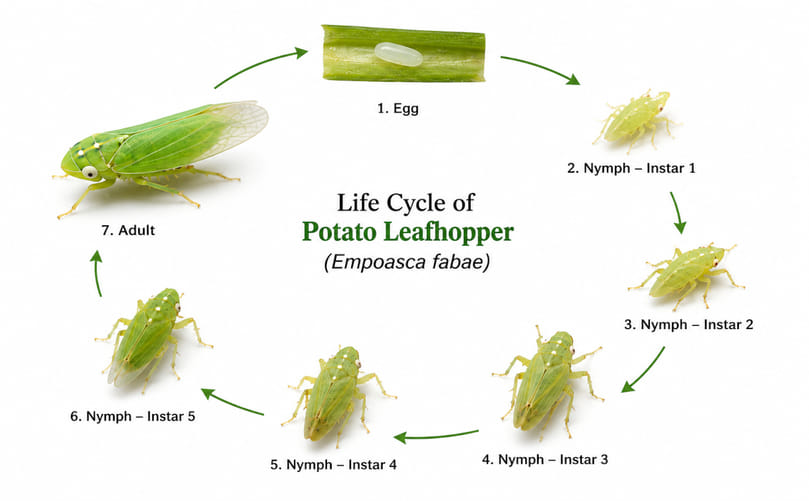
Life Cycle of the Potato Leafhopper (Empoasca fabae)
Biology and Behavior of the Potato Leafhopper (Empoasca fabae)
Feeding Mechanism: The potato leafhopper (Empoasca fabae) feeds using piercing sucking mouthparts (stylets) that probe vascular tissues, primarily the phloem, but also the xylem and mesophyll. Unlike some other leafhoppers, it repeatedly probes and lacerates plant cells while injecting watery saliva containing enzymes and phytotoxic compounds. This disrupts phloem transport, causes cell collapse and triggers physiological changes in the plant. Feeding occurs mainly on the undersides of leaves and on stems.
Preferred Feeding Sites: Both nymphs and adults feed actively on young leaves, leaf veins and petioles. Adults are more mobile than nymphs and readily move between host plants.
Diurnal Activity and Movement: The potato leafhopper is primarily diurnal. Both nymphs and adults are highly active, moving sideways in a crab-like manner and jumping or flying when disturbed. Adults are strong fliers and can be carried long distances by prevailing winds.
Seasonal Migration:Empoasca fabae is a long-distance seasonal migrant in North America. Adults migrate northward in spring from overwintering sites along the Gulf Coast on southerly winds and return southward in autumn with cold fronts, entering reproductive diapause. Migration is influenced by temperature, wind patterns and host plant availability.
Reproduction: Females mate soon after adult emergence and lay eggs daily over several weeks. A single mating generally fertilizes most or all eggs produced during the female's lifetime. High fecundity allows populations to increase rapidly under favorable conditions.
Population Dynamics: Populations can increase rapidly following spring migration, after alfalfa harvest, which concentrates or displaces leafhoppers into nearby crops and during favorable warm, dry weather. Population size is also influenced by density dependent factors and natural enemies although the insect's high mobility can reduce the effectiveness of biological control. Late in the season, populations shift to wild host plants before entering diapause.
Conditions Favoring Outbreaks: Potato leafhopper outbreaks are favored by warm temperatures, dry weather and mild winters, which promote earlier migration and faster population growth. Crop related factors such as continuous potato cultivation, the presence of nearby host plants and volunteer potato plants also increase infestation risk. Environmental conditions including wind assisted migration, early planting and dense crop canopies further contribute to population establishment and outbreak development.
Nature of Damage Caused by the Potato Leafhopper (Empoasca fabae)
Damage caused by the potato leafhopper (Empoasca fabae) results from a combination of mechanical feeding, sap removal and salivary toxin injection, leading to both direct and indirect effects. Yield losses often begin before visible symptoms appear.
Direct Damage: The potato leafhopper feeds by removing sap from vascular tissues. During feeding, it injects saliva containing enzymes and phytotoxic compounds that disrupt phloem transport, cause cell collapse and trigger a series of physiological changes, including increased respiration, reduced photosynthesis and impaired photosynthate transport. These effects result in the characteristic hopperburn symptoms.
Hopperburn appears as V-shaped or triangular yellowing at the leaf tips and margins, which gradually progresses to browning, upward leaf curling, necrosis and brittleness. Symptoms usually begin on older or lower leaves but may eventually affect new growth and under severe infestations, spread throughout the plant.
Indirect Damage: Reduced photosynthesis and vascular dysfunction limit energy production and the movement of photosynthates within the plant. This results in stunted growth, shorter internodes, reduced stem height and smaller tubers or leaves. In potatoes, infestations reduce tuber size and yield. In alfalfa, they reduce forage quality and protein content, while in beans they decrease pod and seed production. Severe infestations may result in plant death or stand loss and economic losses are often increased by quality downgrades, such as unmarketable produce.
Symptom Development: Initial feeding causes pale veins and subtle leaf curling within a few days. The effects of salivary toxins become visible after 4–5 days or more, producing the characteristic V-shaped marginal yellowing that later develops into necrosis spreading inward. Continued feeding increases plant stress and symptoms may resemble potassium deficiency although they can be distinguished by the presence of leafhoppers and their characteristic feeding injury. Damage is cumulative and becomes increasingly difficult to reverse as feeding continues.
Symptoms of Potato Leafhopper Infestation
Above Ground Symptoms: Symptoms first appear on the foliage as leaf curling, followed by yellowing that begins at the leaf tips and margins. As feeding continues, the affected areas turn brown and necrotic, producing the characteristic hopperburn symptoms. Severely affected leaves become dry and brittle, and plants exhibit stunted growth.
Below Ground Symptoms: Below ground, infestations reduce tuber initiation and tuber size in potatoes, resulting in lower overall yields.
Symptom Progression: Symptoms typically progress from pale veins to marginal yellowing, followed by necrosis spreading inward. Under heavy infestations, entire leaves or foliage may die. Early symptoms are often mistaken for plant diseases or nutrient deficiencies although potato leafhopper injury also affects newly developing leaves.
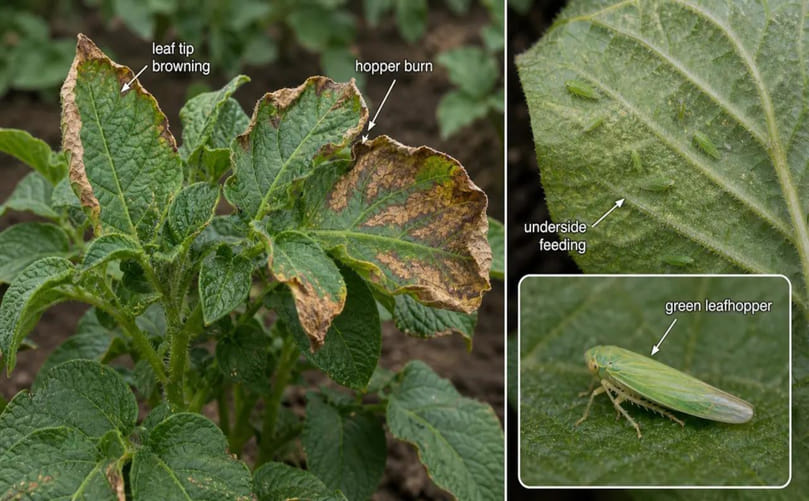
Potato Leafhopper Damage Symptoms on Potato Leaves
Economic Impact of Potato Leafhopper Infestations
The potato leafhopper (Empoasca fabae) is an economically important pest in North America, particularly in potato, bean and forage production systems. Yield losses of up to 50% have been reported under severe infestations, while reductions in crop quality further decrease marketability. In alfalfa, the insect causes significant annual economic losses, exceeding USD 15 million in some U.S. states.
Economic thresholds vary depending on the crop and its growth stage. In alfalfa, treatment thresholds generally range from 0.2 to 2 leafhoppers per sweep, depending on plant height. In potatoes, management is recommended at relatively low population levels, such as one adult per sweep or specific nymph densities making early scouting essential.
Integrated Pest Management (IPM) for the Potato Leafhopper (Empoasca fabae)
Effective management of Empoasca fabae relies on Integrated Pest Management (IPM), which combines cultural, mechanical, biological and chemical control measures to keep populations below economic thresholds while minimizing environmental impacts, insecticide resistance and unnecessary pesticide use. Successful IPM programs emphasize prevention, regular monitoring and timely intervention.
Cultural Control: Crop rotation and avoiding continuous cultivation of potatoes or legumes help break the pest's population cycle. Effective weed management and the removal of volunteer potato plants eliminate alternate hosts that support population buildup and seasonal survival. Maintaining good field sanitation further reduces pest reservoirs.
Adjusting planting dates may reduce exposure to peak spring migration although this practice should be balanced with local agronomic requirements. In alfalfa and other forage crops, harvesting fields early when economic thresholds are reached can significantly reduce leafhopper populations by removing eggs and nymphs. Short stubble with little remaining foliage increases exposure to desiccation and further suppresses surviving insects.
Intercropping with grasses, such as smooth bromegrass or orchard grass can reduce potato leafhopper populations by making the crop less suitable for feeding and reproduction. Where available, resistant or tolerant crop varieties provide additional protection. Certain potato cultivars, including Katahdin and Russet Burbank, show lower susceptibility, while some bean varieties with hooked leaf hairs (trichomes) reduce feeding and egg laying. Maintaining vigorous, well-fertilized crops also improves tolerance to leafhopper injury.
Mechanical Control: Yellow sticky traps and sticky cards are useful for monitoring adult populations and may provide limited population suppression. Physical barriers, including row covers and exclusion netting help prevent infestations in small scale or high value vegetable crops. In forage production systems, timely harvesting also serves as an effective mechanical control method by removing developing life stages.
Biological Control: Natural enemies contribute to the suppression of potato leafhopper populations. Important predators include lady beetles (Coccinellidae), lacewings (Chrysopa spp.), minute pirate bugs (Orius insidiosus), damsel bugs (Nabis spp.), spiders and predatory mites. Egg parasitoids, including Anagrus spp. and Aphelopus spp., as well as entomopathogenic fungi such as Zoophthora radicans (Erynia radicans) and Beauveria bassiana can cause significant mortality under favorable conditions. However, their overall effectiveness is often limited by the leafhopper's high mobility and rapid reproduction.
Conservation biological control can improve the effectiveness of natural enemies by maintaining hedgerows, wildflower strips and other habitats that support beneficial insects. Avoiding unnecessary applications of broad-spectrum insecticides and conserving beneficial organisms are important components of this strategy.
Chemical Control: Chemical control should be used only when scouting indicates that populations exceed economic thresholds. Insecticide applications are most effective when made early, before hopperburn develops or large nymph populations become established. Resistance management is essential and should include rotating insecticides with different IRAC modes of action while avoiding repeated use of the same insecticide group. Chemical control should always be integrated with cultural, mechanical and biological measures to reduce selection pressure and unnecessary applications. Pollinator exposure can be minimized by applying insecticides during the evening, using targeted application methods and following label recommendations. Several insecticide groups including neonicotinoids, pyrethroids, organophosphates and carbamates are effective where registered although available products vary by country and region.
Integrated Management Strategy: Successful IPM programs depend on regular scouting, accurate identification and timely management decisions. Combining preventive cultural practices, conservation of natural enemies, targeted insecticide applications and continuous monitoring provides the most effective and sustainable approach for managing potato leafhopper populations while minimizing economic losses.
Monitoring and Scouting: Potato leafhopper populations are monitored using sweep nets, yellow sticky traps, visual inspection of leaf undersides for nymphs and degree-day models to predict development and migration. Sweep net sampling is the standard method for monitoring adults and typically involves 20 sweeps at five locations in a W-shaped pattern across the field. Scouting should begin in mid-spring, when migration is expected or immediately after the first alfalfa harvest and continue weekly throughout the growing season. Early detection is essential for timely management and preventing economic losses.
Climate Change and Future Risks for Potato Leafhopper
Climate change is already influencing the biology and seasonal activity of Empoasca fabae and is expected to increase its pest pressure in many regions. Warmer temperatures and changing weather patterns are likely to affect migration, development, distribution and population growth.
Changing Migration Patterns: Long-term studies spanning more than 60 years indicate that potato leafhoppers now arrive in northern regions approximately 10 days earlier than they did during the mid-20th century. This shift is associated with warmer spring temperatures and extends the period during which crops are exposed to infestation.
Warmer Winters: Milder winter conditions may improve the survival of overwintering adults in the southern United States and could allow the overwintering range to expand farther north. As a result, populations may establish earlier in the season and rely less on long-distance migration.
Expanded Geographic Range: Climate models for Nearctic leafhoppers, including Empoasca fabae, predict an expansion of suitable habitat, particularly into northern Canada and parts of the eastern Nearctic region. As temperatures continue to rise, the species is expected to become active over a broader geographic area.
Increased Number of Generations: Higher temperatures accelerate insect development and may allow one or more additional generations per season, particularly near the current northern limit of the species' range. More generations increase the potential for higher population densities and greater cumulative crop damage.
Emerging Production Risks: The expansion of the potato leafhopper's range could expose new potato and legume producing regions to infestations. Climate related drought stress, which often coincides with leafhopper outbreaks can intensify hopperburn symptoms and increase yield losses. In addition, interactions with other climate driven pests and diseases may further increase production risks. Observations from recent warmer years also indicate a tendency toward earlier and more severe infestations.
Research and Emerging Technologies for Potato Leafhopper Management
Ongoing research focuses on improving the early detection, prediction and sustainable management of Empoasca fabae. Emerging technologies are helping growers monitor populations more efficiently, improve decision making and reduce reliance on chemical control.
Remote Sensing: Hyperspectral and multispectral imaging, using ground-based platforms, drones or satellites can detect plant stress associated with potato leafhopper feeding before visible hopperburn symptoms develop. Changes in chlorophyll content, water status and vegetation indices can be used to identify and map infestations across fields.
Artificial Intelligence (AI) Pest Detection: Machine learning and deep learning models are being developed to identify potato leafhoppers, feeding damage and plant stress from images and sensor data. These systems can be integrated into mobile applications and decision support platforms to provide automated detection and real-time management alerts.
Drone-Based Monitoring: Unmanned aerial vehicles (UAVs) equipped with RGB, multispectral or hyperspectral cameras and in some cases electronic sensors for volatile detection, enable rapid field scouting over large areas. Drone-based monitoring supports early detection, damage assessment and targeted spot treatments.
Precision Agriculture: Precision agriculture technologies, including GPS guided field operations, variable rate pesticide applications and data-driven treatment thresholds help optimize pest management while reducing unnecessary inputs. Degree day and phenology models are also used to predict migration and generation timing.
Forecasting Models: Weather-based forecasting models are continually being improved to predict migration, population development and outbreak risk using climate and environmental data. These models help growers schedule scouting and management activities more effectively.
Molecular Identification: Molecular techniques such as PCR and environmental DNA (eDNA) analysis provide rapid and accurate identification of Empoasca fabae, particularly where multiple leafhopper species occur together.
Biological Innovations: Current research includes improved formulations of biological control agents such as Beauveria bassiana, the use of beneficial endophytes and induced plant resistance and the development of crop varieties with greater resistance or tolerance through traits such as leaf trichomes.
Future Outlook: These emerging technologies support a more proactive, data driven and sustainable approach to potato leafhopper management. Their effectiveness will continue to improve through field validation, integration into decision support systems and wider accessibility for growers worldwide.